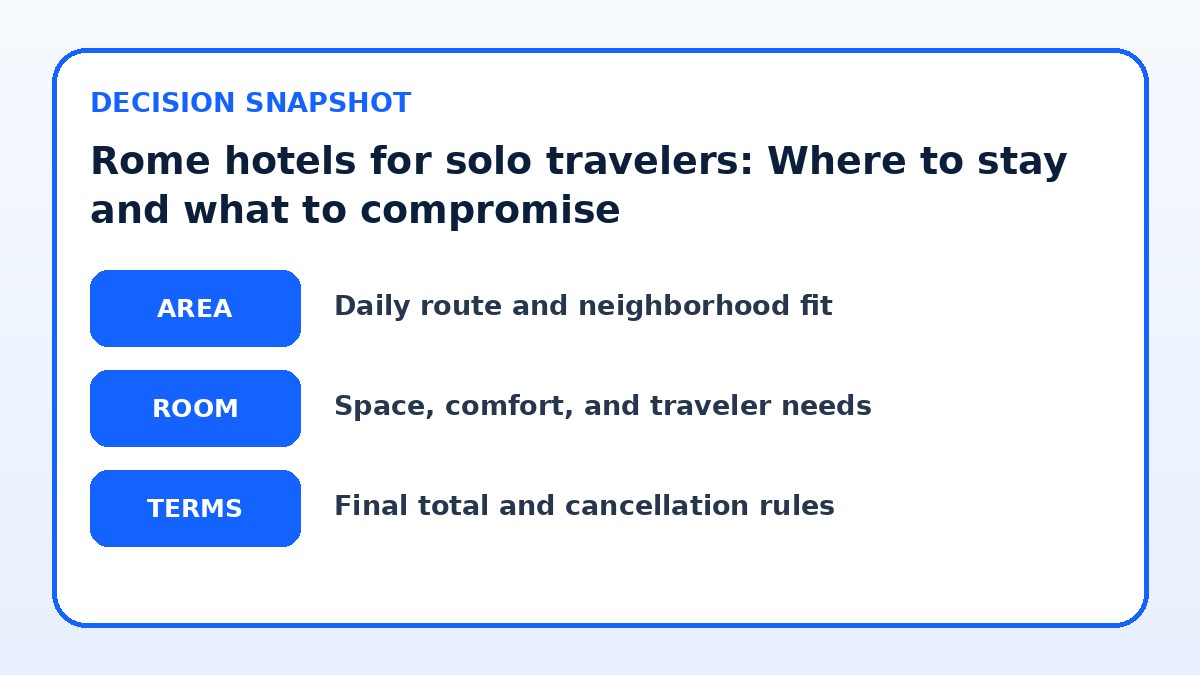
If you’re a solo traveler booking Rome hotels, start by deciding whether you want to spend saved time walking to major sights or prefer a restful, roomy base for evenings and work. For many solo visitors the right balance is a centrally located room that’s small but quiet and well-managed, or a slightly farther neighborhood with larger, calmer rooms and better value. Think about how you’ll use the room: short overnight sleep vs. daytime remote work, secure storage needs, and the amount of walking you’re willing to do each day. Also factor in arrival logistics: a long night arrival can make a central spot worth the extra money, while daytime arrivals make transfers easier to manage. Below I’ll explain how to weigh those tradeoffs, what to verify on booking pages, and concrete questions to ask before you confirm a reservation.
See current options before you compare the details
Availability and final conditions change. Open Trip.com now or keep reading for the practical comparison.
Decide what you’ll actually use the room for
Start by listing your typical day in Rome. If you’ll be out early and late every day, a comfortable bed and good shower may be all you need, so prioritize location and quick access to sights. If you plan to work from the room, read, or rest between long museum visits, give more weight to room size, a desk or stable table, reliable Wi‑Fi, and lighting. Solo travelers who expect to return to the room for long stretches often prefer quieter neighborhoods with larger rooms; those who treat the room as a short overnight stop can accept smaller central spaces.
Also consider security and storage. Solo travelers sometimes carry cameras, extra tech, or important documents; a room with a safe or lockable wardrobe reduces stress. If you carry a lot of luggage, check whether the listed room is on a walk‑up floor or has elevator access. When the booking page is ambiguous about these details, message the property directly or use the provider’s verified questions section. Always confirm the specifics of Wi‑Fi speed and whether the listed workspace is private or shared.
Neighborhood tradeoffs: what central versus peripheral means in Rome
Staying in the historic center (Centro Storico, Pantheon area) puts major sights, restaurants, and public transport within easy walking distance, cutting down on time spent commuting. Expect narrower streets, lively evenings, and smaller hotels or guesthouses that maximize location over room size. Street noise and cobblestone vibration can affect sleep; check whether rooms face an inner courtyard or the street. For many solo travelers the convenience of walking to the Colosseum, Vatican, or Trevi Fountain outweighs a smaller footprint, but confirm noise and window details before booking.
Choosing neighborhoods a little farther out—like Prati, Testaccio, San Lorenzo, or Monteverde—often yields larger rooms, calmer streets, and more local cafés at lower crowd density. You’ll trade longer walks or a short tram/bus ride for extra personal space and quieter nights. These areas can also provide more authentic neighborhood life and restaurants that locals frequent. Evaluate how much transit you’re comfortable using: if you prefer to avoid multiple transfers with luggage, central locations minimize that hassle; if a short metro ride is acceptable, you’ll gain living space and value.
| Approach | Best for | Tradeoff to check |
|---|---|---|
| Central small room (historic center) | Sightseeing efficiency and minimizing transit time | Smaller space, potential street noise, and higher per-night cost |
| Larger room farther out (residential neighborhood) | Quiet nights, more space, local atmosphere | Longer walks or short transit rides to main attractions |
| Boutique guesthouse with concierge | Personal assistance, tailored local advice, safer late arrivals | Often smaller rooms and variable service hours |
| Chain hotel near transport hub | Predictable amenities, elevators, and clear check-in policies | Less character and sometimes farther from the most scenic streets |
Ready to check the option that fits your plan?
Use your exact dates and traveler details so the provider page can show the current total and conditions.

How to read hotel descriptions and reviews constructively
Don't rely on just star ratings. Focus on concrete details in descriptions: room square meters, bed type, window orientation, elevator presence, and reception hours. Photos can be helpful, but they’re often the property’s best angles—compare photos of the same room type across booking pages. Pay attention to mentions of soundproofing, inner courtyard windows, or street-facing balconies. If the listing lacks specifics about room size or window placement, contact the property and ask for exact measurements or a map showing room location relative to the street.
When scanning reviews, look for repeated, specific comments—noise at night from a named bar, thin walls admitting hallway sound, or praise for a particularly comfortable mattress. Single negative or positive reviews are less reliable than patterns. For safety and solo traveler needs, look for comments about reception helpfulness, night check‑in, and neighborhood safety at different hours. If you use review sites or aggregator pages like Trip.com to compare availability and recent guest photos, remember to verify arrival policies, cancellation terms, and any extra fees on the hotel’s official booking page before completing a reservation.
Before you book
- Confirm the room’s exact sleeping arrangement, square footage or bed type, and whether a desk is included if you plan to work.
- Ask which direction the room faces (street or inner courtyard) and whether the hotel advertises soundproofing or double‑glazed windows.
- Verify elevator access and the floor number if you have heavy luggage or mobility considerations.
- Check reception hours, late check‑in instructions, and whether the property accepts late arrivals without prior notice.
- Confirm Wi‑Fi availability and speed on the booking page or with the property if you need reliable internet for remote work.
- Read recent guest reviews for repeated mentions of noise, cleanliness, and staff helpfulness, then message the hotel with specific questions.
Practical booking checks and arrival planning
Before you hit confirm, verify three practical items: how to get from your arrival point (Fiumicino, Ciampino, or train stations) to the hotel; whether the property has 24‑hour reception or a clear late‑check‑in procedure; and luggage storage options if you arrive early. If transportation requires navigating multiple transfers with heavy bags, a more central location might be worth the extra cost. If your flight or train lands late, confirm late check‑in fees or key‑collection procedures to avoid being locked out or stranded on arrival.
Also confirm cancellation and payment terms on the provider’s final booking page; some properties require prepayment or impose stricter refund rules. Check whether the room rate includes Wi‑Fi, city tax, or other extra charges and whether the property can provide a receipt in English if you need one. If you want a quiet night, ask which rooms face the internal courtyard or whether the hotel offers upgraded, soundproofed rooms. When in doubt, message the property directly and keep written confirmation of any special requests.
Frequently asked questions
Is it better for a solo traveler to stay in the historic center or in a quieter Rome neighborhood?
It depends on priorities. The historic center saves time and transit costs because many major sights are within walking distance, which is useful for short stays and late-night returns. Quieter neighborhoods give you more space, calmer nights, and a local feel—good for longer stays or when you need to work. Consider arrival time, how much walking versus public transport you’re comfortable with, and whether you value immediate access to nightlife and landmarks or prefer calmer evenings.
How can I judge sound levels from listing photos and descriptions?
Photos rarely reveal noise. Look for descriptive cues: mentions of inner courtyard rooms, double‑glazed windows, or soundproofing are positive signs. Check the room orientation—street‑facing rooms in narrow historic streets tend to be noisier. Read multiple recent reviews for consistent reports about noise at specific times, and ask the property which rooms are quietest. If noise is a dealbreaker, request a courtyard or higher-floor room and get confirmation in writing on the booking page or by message.
What specific details should I verify on a hotel’s booking page before I pay?
Confirm check‑in/out times, late arrival procedures, cancellation and prepayment rules, Wi‑Fi inclusion, and any city or service taxes not included in the rate. Verify elevator access and luggage policies, whether rooms are on upper floors, and if the property lists accessibility features you need. For solo travelers, also check for 24‑hour reception or a documented after‑hours check‑in process. If booking through an aggregator, review the property’s own page to ensure special requests and policies are recorded before final payment.
Final planning note
Balancing location and room comfort in Rome is a personal calculation: choose central spots when you value walking access and minimal transit; choose quieter neighborhoods when room size, sleep quality, and local life matter more. Decide how you will spend your daytime and evenings, then prioritize the three most important room features—quiet, workspace, or bed comfort—and use those as dealbreakers when comparing listings. Always verify orientation, elevator access, reception hours, and cancellation terms on the provider’s booking page before you pay. When comparing options, a short checklist and direct questions to the property will save frustration and help you pick a room that supports the experience you want in Rome.
Continue planning
Check current options and final conditions
Use the provider page to confirm live availability, the final total, cancellation terms, and every condition that matters to your trip.
This evergreen planning guide was created with AI-assisted drafting and a structured quality review. It does not display live prices, schedules, availability, visa guidance, or provider rankings. Verify current details before booking. Some links are affiliate links; we may earn a commission at no additional cost to you.