
Practical answer first: when booking Penang hotels as a couple, prioritize refundable or partially refundable rates if your travel dates might shift, but choose a nonrefundable rate only if you’re confident in fixed plans and the price difference is meaningful. For most couples balancing work, family, or health variables, a free-cancellation window of at least seven days and a minimal change fee provides the best sweet spot: it keeps flexibility without the usually higher cost of instantaneous full refunds. Before you click Confirm, check the exact cancellation cut-off, any administrative or credit-card fees, how upgrades or extra guests are treated, and whether the property or booking platform enforces different rules for group bookings or special promos. The next sections unpack tradeoffs, the questions to ask on the final booking page, and practical comparison methods so you can make an informed decision for your Penang trip.
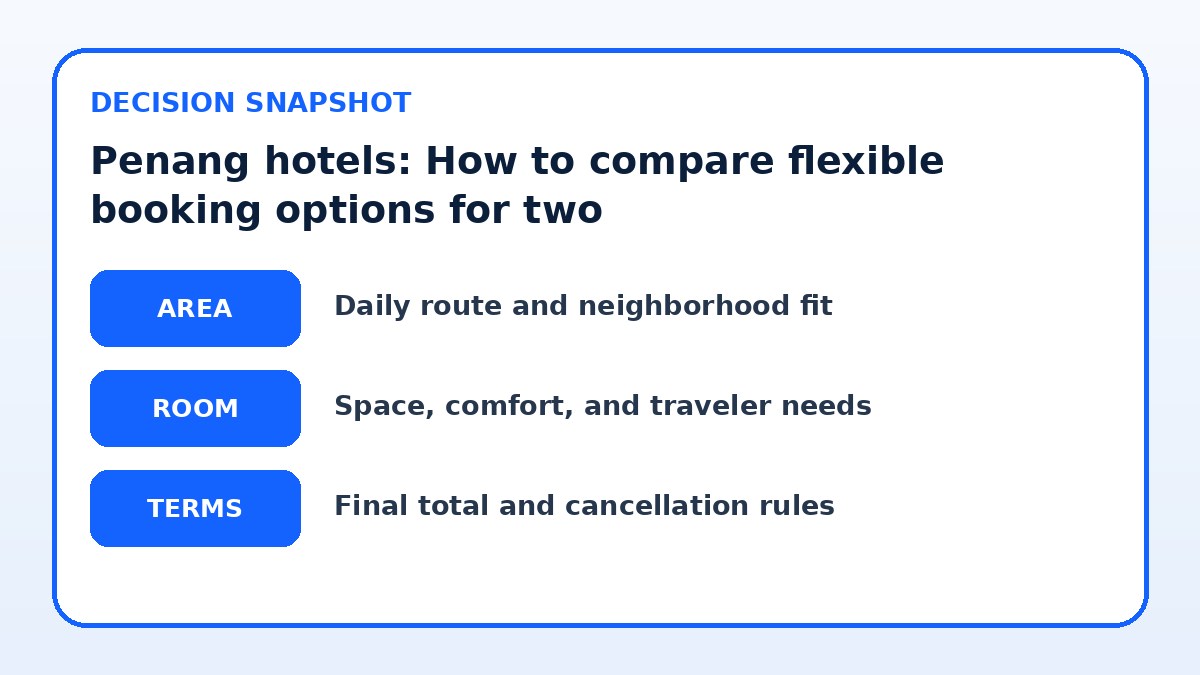
See current options before you compare the details
Availability and final conditions change. Open Trip.com now or keep reading for the practical comparison.
What flexible booking terms mean for couples
Flexible booking terms commonly include fully refundable rates, partial refunds, free cancellation within a set window, or ticket-style credits for future stays. For couples, flexibility often matters beyond simple schedule changes: illness, family emergencies, work shifts, or visa document timing all affect whether you can travel or need a different date. A refundable rate returns money to your card and is useful if you expect a significant chance of canceling. Credits convert your payment into a property or platform credit with varying expiry rules—handy if you plan another trip but inconvenient if you prefer cash returned.
Some hotels offer explicit couple-friendly options—late check-in guarantees, flexible bed setups, or complimentary upgrades with flexible rates—but the core booking terms are what determine your financial exposure. Pay attention to whether a flexible rate still requires a deposit, whether extra-person charges apply on rebooking, and if third-party platforms impose their own service or processing fees on refunds. Always read the provider’s cancellation and change policy on the final booking page; that is the contractual text that matters, not the marketing label like “free cancellation” on a search listing.
Tradeoffs: cost, certainty, and peace of mind
Choosing a fully refundable rate is the clearest path to peace of mind but typically reduces immediate savings. Couples who value low stress—maybe celebrating a honeymoon, anniversary, or a milestone where changing plans would be costly emotionally—may accept higher rates to avoid uncertainty. Conversely, if your dates are locked down, a nonrefundable deal can free budget for nicer experiences in Penang such as a waterfront dinner or an excursion. The decision hinges on your tolerance for risk and the outlay difference between refundable and nonrefundable options.
Partial refunds and credit-only cancellations act as compromise solutions: they lower upfront cost while offering a safety net if something changes. However, credits often carry expiry dates and usage restrictions, and partial refunds may incur processing fees. Also consider the administrative hassle—calling to rearrange a booking or dealing with refunds can be time-consuming. Balance the financial premium for flexibility against the couple’s practical likelihood of needing to alter the trip and how much administrative friction you’re willing to endure.
| Approach | Best for | Tradeoff to check |
|---|---|---|
| Fully refundable rate | Couples with uncertain schedules or high desire for low stress | Higher upfront cost but straightforward cash returns on cancellation |
| Free-cancellation window (e.g., 7+ days) | Couples who expect minor schedule tweaks close to travel | Less costly than fully refundable but requires cancel before cut-off |
| Partial refund or credit-only | Couples willing to accept platform/property credit for future travel | Lower price now, but credits may expire or have restrictions |
| Nonrefundable rate | Couples with fixed plans aiming to save money | Lowest price but no cash return if plans change |
Ready to check the option that fits your plan?
Use your exact dates and traveler details so the provider page can show the current total and conditions.

How to compare flexible terms on the final booking page
When you get to the provider’s final booking page, compare these exact items: the cancellation deadline (date and local time), whether refunds are full or partial, any fees for changes, how credits are issued and how long they last, and whether different room types have different policies. Also check whether taxes, service charges, or third-party fees are refundable. For couples, confirm how changing guest names, adding a night, or extending the stay will be handled and whether such changes trigger a new rate or penalty.
Don’t assume platform summaries match the property’s policy—some online travel agency listings simplify or combine terms. Scroll to the cancellation section and read the full policy copy. If anything is unclear, use the booking platform’s chat or the hotel’s contact to get a clear statement you can keep as a screenshot or confirmation email. Verify whether the property requires the original payment card for refunds, which can complicate matters if you change cards before canceling or rebooking.
Before you book
- On the booking page, copy the exact cancellation deadline and refund terms into a note or screenshot before paying.
- Verify whether refunds return to the payment card, to a platform wallet, or as a property credit, and note any expiry dates.
- Check if change or name-modification fees apply and ask the provider how extensions are priced if you decide to lengthen the stay.
- Compare refundable and nonrefundable rates side-by-side for the same room type and dates to quantify the flexibility premium.
- If booking through a third-party site, confirm the hotel’s own policy by contacting the property directly or checking its official policy page.
- Consider travel insurance that covers cancellations for reasons your booking policy does not, and confirm the insurer’s claim requirements.
Practical decision frameworks for couples
Use a simple framework: low-risk travelers choose refundable or generous free-cancellation windows; medium-risk travelers choose change-fee–friendly or partial-refund options; low-flexibility travelers choose nonrefundable rates. Apply this by estimating the probability you’ll change or cancel and multiplying by the refund difference—the expected value method helps decide whether the flexibility premium is worth paying. Also consider qualitative factors: how essential are the dates (wedding anniversary), how easy would it be emotionally to lose the money, and how much time will you spend managing a change?
Remember that other protections can supplement booking flexibility: comprehensive travel insurance that covers cancellations for a broader list of reasons, travel-card protections tied to certain payments, or refundable travel credit rules from airlines. For couples, coordinate who holds the booking and payment method to avoid name or card mismatches that can complicate modifications. Finally, create a decision point committed time—like a seven-day checkpoint—where you review plans and, if needed, switch to a more flexible rate before the nonrefundable deadline passes.
Frequently asked questions
Can we switch a nonrefundable Penang hotel booking to a different date or name?
Many nonrefundable bookings restrict changes, but some properties or platforms offer paid amendments even on nonrefundable rates. Whether you can switch dates or guest names depends on the booking terms the hotel sets and any platform rules. Before attempting a change, check the booking confirmation for amendment clauses and contact the hotel or platform with your reservation number to request an exception or paid modification. On the final booking page you should verify whether changes will trigger a new rate, an amendment fee, or forfeiture of the payment.
Is booking directly with a Penang hotel safer than using an online travel agency for flexibility?
Booking directly can sometimes make amendments and refunds smoother because you deal with fewer intermediaries, but it is not universally better. Agencies may offer their own flexible-rate products or protections and can negotiate on your behalf. The critical step is comparing the exact cancellation and change wording on the final confirmation, whether direct or via an agency. If you prefer direct contact for quick resolution, call the hotel to confirm the same policy shown on the platform and request written confirmation of any promised flexibility.
How much flexibility is reasonable for a short couple’s trip to Penang?
For short trips, a free-cancellation window of at least seven days gives most couples a practical buffer for last-minute hiccups without paying the highest flexibility premiums. If your travel involves potential work commitments, health concerns, or overlapping family events, aim for refundable bookings or flexible-change options. If your dates are fixed and the savings matter, a nonrefundable rate may make sense, but ensure you understand the financial loss if plans change. Always cross-check final policy wording to avoid surprises.
Final planning note
Choosing flexible booking terms for Penang hotels as a couple is a tradeoff between cost and certainty. Start by honestly estimating how likely your plans are to change, then pick the policy that matches your risk tolerance: refundable for high uncertainty, change-fee–friendly or partial credit for moderate risk, and nonrefundable only when your dates are immovable. Always review the cancellation deadline, refund method, fees for changes, and any expiration on credits on the provider’s final booking page before paying. If you need a quick comparison, platforms such as Trip.com can show current options, but rely on the hotel or booking confirmation for the definitive terms. With a clear checklist and a quick verification step, couples can lock in accommodations in Penang without unnecessary financial surprises and focus on enjoying the trip.
Continue planning
Check current options and final conditions
Use the provider page to confirm live availability, the final total, cancellation terms, and every condition that matters to your trip.
This evergreen planning guide was created with AI-assisted drafting and a structured quality review. It does not display live prices, schedules, availability, visa guidance, or provider rankings. Verify current details before booking. Some links are affiliate links; we may earn a commission at no additional cost to you.