If you’re flying solo from Paris to Istanbul, the practical priority is to pick a fare and carrier whose change and cancellation terms match how certain your plans are. Start by deciding whether you need full flexibility, moderate flexibility, or a strict no-change option, then consult each fare’s specific rules: permitted changes, change fees, rebooking windows, refundability, and how taxes and ancillary fares are handled. Some fares allow free changes within a limited time; others only permit changes against a fee or offer credit rather than cash refunds. Since airline policies, fare conditions, and ticketing channels vary, verify the exact wording on the airline’s final booking page and on any travel-agent checkout (you can also compare availability and policy summaries on Trip.com, but check the carrier’s page to confirm). This article helps you weigh tradeoffs, compare direct and connecting itineraries, and pick a booking strategy aligned with your risk tolerance and itinerary certainty.
See current options before you compare the details
Availability and final conditions change. Open Trip.com now or keep reading for the practical comparison.
How to read change and cancellation rules before you book
Fares include three related but distinct things: change allowance (can you alter dates or routes), change penalties (fees or price differences applied), and refundability (whether you can get money back). When reviewing a fare, open the fare conditions or rules link; that legal text contains whether changes are permitted, how much notice is required, whether a voucher is issued instead of cash, and whether taxes or seat fees are refundable. If the booking platform shows a simplified policy icon or summary, use it for a quick screen but always click through to the full fare conditions or the airline’s terms for the final booking step to confirm wording and any exclusions.
paragraphs_1_second_half_content_rewrite_missing_warning_if_needed_or_extra_clarification_Legality_and_verification_requirements_useful_examples_like_medical_or_business_changes_but_no_specifics_allowed_by_rules_to_avoid_fabrication_of_scenarios_refrain_from_claiming_provider_details_or_prices_and_remind_readers_to_check_provider_page_and_documents_including_confirmation_emails_and_e_tickets_when_changes_are_made
Balancing flexibility and cost for solo travelers
Solo travelers often weigh safety and convenience against fare cost. If you can’t predict your return date or may extend your stay in Istanbul, prioritize fares that allow free or low-fee date changes, or that are refundable. If your dates are fixed and you want to save money, a restrictive fare might make sense — just accept the tradeoff that cancellations could result in vouchers or no refund. Also compare ticket channels: booking directly with the airline usually simplifies changes, while third-party sellers may impose additional fees or longer processing times. Whatever you choose, make a decision based on how much uncertainty you have and how quickly you might need a change processed.
paragraphs_1_second_half_content_rewrite_missing_warning_if_needed_or_extra_clarification_Remind_readers_to_check_for_travel_protection_options_offered_either_by_credit_cards_or_standalone_insurance_policies_and_to_confirm_whether_these_cover_change_fees_or_only_medical_emergencies_without_naming_specific_products
| Approach | Best for | Tradeoff to check |
|---|---|---|
| Book the most flexible (refundable or free-change) fare | Travelers who expect date uncertainty or need peace of mind | Higher fare upfront but easier cash refunds and simpler rebooking |
| Choose a semi-flexible fare with modest change fees | Those who want balance between cost and the option to change | Lower cost than fully flexible fares but fees and fare differences can apply |
| Buy a restrictive, nonrefundable fare | Travelers with fixed schedules and a focus on lowest fare | Lowest upfront cost but cancellations may yield vouchers or no refund |
| Book connecting legs separately to save money | Experienced solo travelers willing to manage risk and rebook segments | Potentially cheaper but higher risk of needing separate rebooking and no interline protection |
Ready to check the option that fits your plan?
Use your exact dates and traveler details so the provider page can show the current total and conditions.
Comparing direct and connecting options for changeability
Direct flights can simplify change and cancellation logistics because you only manage one ticket and a single set of rules; changes typically apply to the whole itinerary. Connecting itineraries booked as a single ticket usually have protection for missed connections when the airline is the same or partners, but if connections are on separate tickets you assume more risk: you may need to rebook each leg separately if plans change. When comparing options, check whether the itinerary is coded as a single ticket and whether the airline will reissue the ticket without extra catch-all fees when moving dates.
paragraphs_1_second_half_content_rewrite_missing_warning_if_needed_or_extra_clarification_Emphasize_to_verify_on_provider_pages_whether_connections_are_protected_and_whether_change_fees_apply_per_segment_or_per_ticket_without_making_specific_claims_about_any_carrier
Before you book
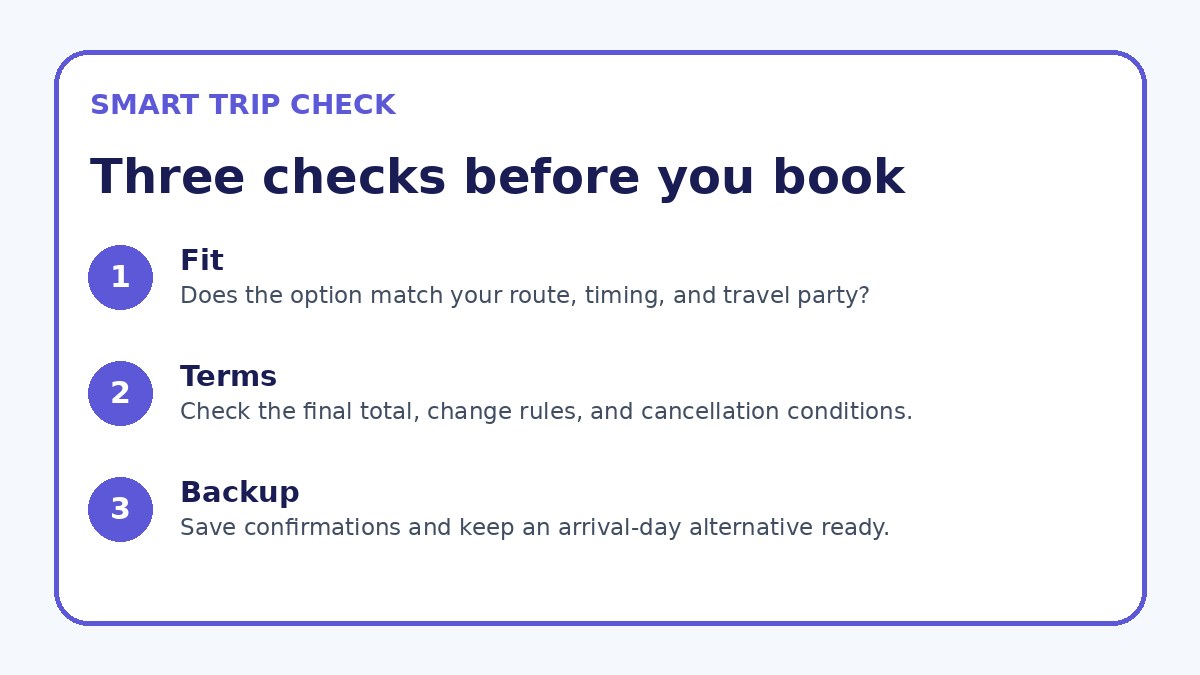
- Open and save the fare conditions or rules link for the exact ticket you intend to buy.
- Confirm whether changes are allowed, what fees apply, and whether changes issue cash refunds or vouchers.
- Verify if your itinerary is on one ticket (single PNR) or multiple tickets, and ask the seller to confirm connection protection if needed.
- Check how ancillaries—seat assignments, checked baggage, and extras—are handled on rebookings or cancellations.
- Screenshot the final booking page, terms shown at checkout, and the booking confirmation email for dispute evidence.
- Compare the airline’s own change/cancellation page with the booking platform’s summary before completing payment.
Practical steps to lock in the right protection
Before finalizing payment, take these practical steps: read the fare rules link on the booking page, note exactly how changes are processed and whether you’ll get a cash refund or voucher, and confirm whether seats, baggage, and ancillaries are amended or refunded separately. If you plan to use a credit card benefit for trip protection, check the issuer’s terms and the documentation required to claim fees or refunds. If the booking platform shows a change-fee waiver or flexible fare badge, still cross-check the airline’s own policy page and the final ticket fare rules because platform summaries can omit small but important exclusions.
paragraphs_1_second_half_content_rewrite_missing_warning_if_needed_or_extra_clarification_Remind_travelers_to_save_screenshots_of_the_fare_conditions_and_booking_confirmation_emails_and_to_record_deadlines_for_free_changes_or_refunds_to_avoid_disputes_later
Frequently asked questions
Can I change a Paris to Istanbul flight without extra cost?
Possibly, but it depends entirely on the fare rules and the airline’s current policy. Some fares permit free changes within a certain time window or under specific fare classes; others charge a fee plus any fare difference. Also check whether the booking channel (airline versus third-party seller) imposes additional charges. Before booking, click the fare conditions and the carrier’s change policy, and verify the final checkout wording—if it isn’t explicit, ask customer service to confirm in writing.
If my plans change, will I get a cash refund or only a voucher?
That depends on whether the fare is refundable and what the carrier’s policy specifies. Refundable fares generally permit cash refunds, though processing times and administrative fees can vary; many non-refundable fares only allow travel credit or vouchers. The full fare rules on the ticket will state whether refunds are allowed and under what conditions. Always confirm the payout method shown on the final booking page before you pay.
How should I handle a multi-leg trip with mixed carriers for Paris to Istanbul?
If your trip mixes carriers or separate tickets, treat each ticket as an independent contract usually governed by its issuing carrier’s rules. Single-ticket itineraries often provide better protection for missed connections and consolidated change processing. For mixed or separately issued legs, check each ticket’s change and cancellation conditions and consider buying protection or scheduling longer connection buffers. Verify on the booking confirmations which carrier issued the ticket and confirm change procedures on each carrier’s final booking page.
Final planning note
For solo travelers deciding on Paris to Istanbul flights, clarity about change and cancellation rules should guide your booking choice more than price alone. Decide how much flexibility you truly need, inspect the fare conditions closely, and confirm the exact wording on the airline’s or seller’s final booking page before payment. Weigh direct versus connecting itineraries, and remember that a slightly higher fare that offers easier changes or cash refunds can save time, stress, and expense if your plans shift. Use tools like Trip.com to compare options quickly, but always verify critical policy details with the carrier and keep documentation of the fare rules and booking confirmation.
Continue planning
Check current options and final conditions
Use the provider page to confirm live availability, the final total, cancellation terms, and every condition that matters to your trip.
This evergreen planning guide was created with AI-assisted drafting and a structured quality review. It does not display live prices, schedules, availability, visa guidance, or provider rankings. Verify current details before booking. Some links are affiliate links; we may earn a commission at no additional cost to you.