
If you’re planning your first trip to Paris, the most practical first question is: do you want a package that bundles flights, hotel, and extras, or do you prefer to assemble each piece yourself? For many first-time visitors a package reduces planning friction and brings a single point of contact if something changes. Conversely, booking components separately can offer more flexibility over where you stay, which airports you use, and the exact timing of activities. This article lays out the decision criteria—convenience, control, cost transparency, flexibility, and risk management—so you can weigh what matters most for your style and trip priorities. Read on to see clear tradeoffs, comparison rows tailored to common traveler types, and a checklist of concrete steps to verify on provider pages before you commit.
Convenience and Support: Why Packages Appeal
Packages are designed to remove friction for first-time visitors: one reservation often covers flights, a chosen hotel category, and optional guided activities. That single-reservation model means you usually get consolidated documents, a single provider to contact for itinerary changes, and sometimes an English-speaking helpline. The main practical advantage is psychological and administrative—less time spent comparing dozens of listings and fewer separate confirmation numbers to track.
However, convenience comes with boundaries you should understand before booking. Packages may use a limited set of hotels or flight schedules that fit the operator’s network; switching components later can trigger fees or require rebooking through the operator. Before you buy, confirm on the provider’s final booking page which items are included, how changes and cancellations are handled, and whether local transfer times and meeting points for included activities are specified.
Control and Customization: Building Your Own Trip
Booking separately gives you granular control over every choice: pick the arrondissement that fits your energy—left bank bohemian neighborhoods or central areas close to museums—select flight times that match your jet-lag plan, and choose boutique or chain hotels that meet your accessibility or amenity preferences. This approach also makes it easier to add or remove individual experiences, book a restaurant in advance, or extend a stay in a second city without waiting for a package operator.
The tradeoff is added work and distribution of responsibility. You’ll manage multiple confirmations, coordinate arrival logistics between airlines and hotels, and need to purchase travel insurance that covers independent bookings. Double-check seat availability if you prefer direct routes versus connections, and verify baggage rules and transfer options on each provider’s checkout to avoid surprises at the airport or train station.
| Approach | Best for | Tradeoff to check |
|---|---|---|
| Package deal (flight + hotel + excursions) | Travelers who want simplified planning and single-point support for changes. | Less control over exact hotels, flight times, and ability to mix-and-match components. |
| Separate bookings for flights and hotels | Travelers prioritizing neighborhood choice, specific flight schedules, and customized itineraries. | You manage more confirmations and bear responsibility for missed connections between suppliers. |
| Package for core items, separate for extras | Those who want convenience for basics but want to customize activities or add stops. | Requires careful coordination of included transfer times and independently booked activities. |
| Book independently and add third-party day tours | Experienced independent travelers who value flexibility and hand-picked local experiences. | Higher planning time and potential mismatch between personal schedule and tour availability. |
Money and Value: How to Compare True Costs
Never rely on the headline price alone—true cost includes taxes, city lodging fees, baggage, transfers, and included extras like museum passes or breakfast. Packages sometimes bundle extras that make comparison straightforward, but they can also obscure separate fees or use off-peak accommodations that affect convenience. When comparing, list every inclusion and exclusion and then add likely extras to your calculation so you’re comparing apples to apples.
If a low packaged rate looks attractive, check the final booking page for the provider’s cancellation fees and what happens if a flight is rescheduled. For separate bookings, add potential costs such as extra nights if a flight delay forces an overnight or the price of a private transfer if public transit is inconvenient with luggage. It’s wise to compare refund and change policies as rigorously as the numbers—some inexpensive options impose strict penalties that outweigh any initial savings.
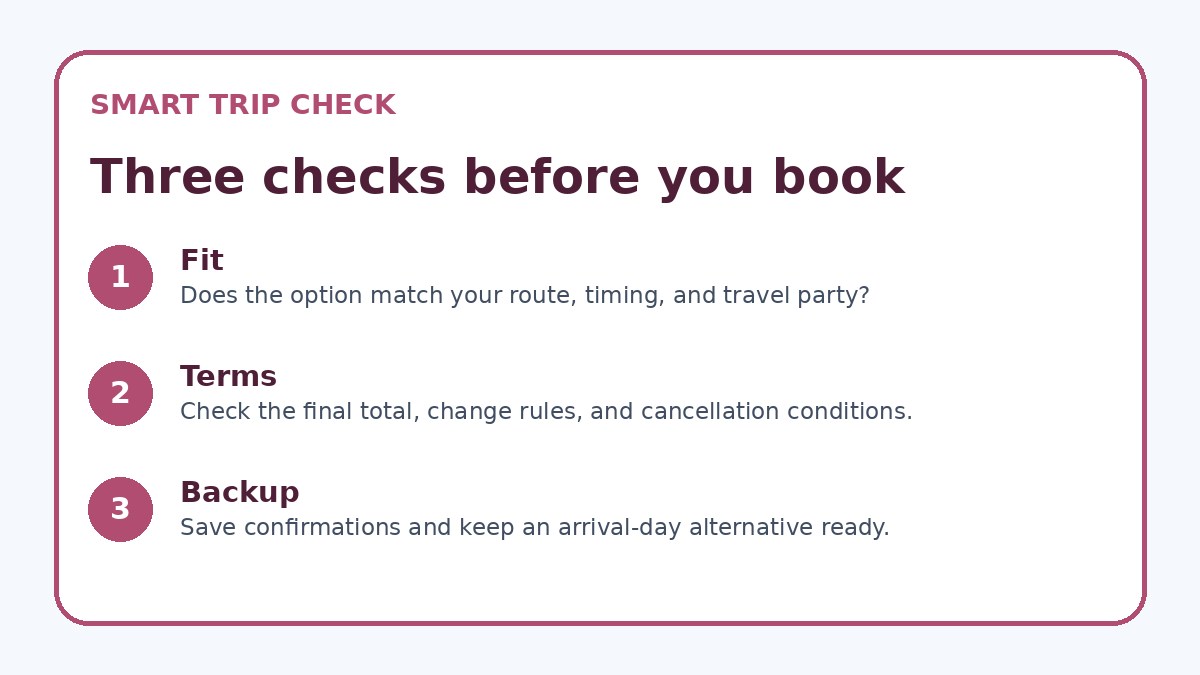
Before you book
- On the provider’s final booking page, read the full cancellation and change policy line-by-line and note any time windows for free changes.
- Confirm exactly what is included: airport transfers, baggage allowance, daily taxes, breakfast, and the number of nights of accommodation.
- If a package includes guided activities, verify meeting points, start times, language of the tour, and whether reservations are required after booking.
- For separate flights, compare direct versus connecting options and check each carrier’s luggage and rebooking rules before purchase.
- Verify supplier contact details and emergency procedures so you can reach someone locally if your arrival time or plans change.
- Buy suitable travel insurance and ensure the policy covers independent bookings, missed connections between separate suppliers, and medical evacuation if needed.
Risk and Flexibility: What to Know Before You Commit
Assess how comfortable you are handling disruptions. Packages can simplify recovery from an airline delay if the operator manages rebooking across included elements, but that depends on the operator’s terms—confirm how they handle missed connections or force majeure events on the final page before payment. For DIY bookings, you control rebooking choices but must manage multiple suppliers separately if plans change.
Travel insurance and flexible fare options matter regardless of booking style. For separately booked trips, insurance should explicitly cover missed connections between independently booked flights and trains. For packages, check whether the operator’s insurance is optional and what it covers versus a standalone policy. Always verify emergency contact procedures and where to get help locally—these are the practical details that determine whether a problem is a nuisance or a trip-stopping issue.
Frequently asked questions
Are packaged Paris travel deals safer for first-time visitors?
Packages can feel safer because a single operator coordinates multiple parts of the trip and can assist if something goes wrong. That benefit depends entirely on the operator’s customer service and the terms shown on the final booking page. You should verify how the operator handles delays, cancellations, and supplier failures. If you prefer a single contact and less on-the-ground juggling, a package often reduces stress. If you value control and can handle logistics, separate bookings with strong travel insurance can be equally secure.
How do I compare the total cost between a package and booking everything separately?
Start by listing every included item in the package—flights, nights, transfers, meals, and extras—then price each component independently. Add foreseeable extras like city tourist taxes, airport transfers, baggage fees, and cancellation penalties. Don’t forget intangible costs: time spent planning and the value of supplier flexibility. Use the provider’s final booking page to confirm inclusions and cancellation rules so your comparison reflects the real total cost rather than the headline price.
What should I check about tours and activities included in a package?
Confirm meeting points, exact start and end times, the language used by the guide, group size limits, and whether reservations are required after purchase. Also check age or mobility restrictions and any dress or equipment notes for visits like cathedral entries or river cruises. If an activity is a key part of your trip, find the operator’s contact on the final booking page and ask about contingency plans for weather or strikes so you understand refund or rescheduling options.
Final planning note
There’s no single right answer for every first-time visitor to Paris: packages buy convenience and a single place to get help, while separate bookings grant control over neighborhoods, schedules, and bespoke experiences. Make your decision by ranking what matters most—time saved versus personal control—then compare final booking pages for inclusions, cancellation rules, and supplier contacts. Use the checklist above before you commit, and consider a hybrid approach if you want the benefits of both methods. If you want to compare current availability and terms quickly, you can check a site like Trip.com alongside provider pages, but always verify the final contract on the seller’s own checkout.
Continue planning
Check current options and final conditions
Use the provider page to confirm live availability, the final total, cancellation terms, and every condition that matters to your trip.
This evergreen planning guide was created with AI-assisted drafting and a structured quality review. It does not display live prices, schedules, availability, visa guidance, or provider rankings. Verify current details before booking. Some links are affiliate links; we may earn a commission at no additional cost to you.