
If you need to be productive on travel day, the simplest practical step is to choose the option that minimizes risk and transition time for your schedule. Barcelona to Madrid transport choices—high-speed train, flight with transfers, or driving/rideshare—each affect how much uninterrupted work, rest, or last-minute errands you can realistically handle before meetings. Focus first on door-to-door considerations: actual travel time including transfers, where you’ll plug in and get reliable Wi‑Fi, and how luggage or security checks will eat into your available time. Once you narrow to one mode, verify the provider’s latest timetable, luggage rules, station-to-office transfers, and any ticket change or refund terms on the booking page you intend to use. If you want a quick availability check, Trip.com can be used as one place to compare options, but always confirm schedule and boarding details with the carrier before relying on them.
Choosing the right transport mode for productivity
Start by matching transport characteristics to your work needs. If you must join back-to-back video calls or work on long documents, a route with predictable connectivity and minimal security checks will reduce interruptions. Trains often allow you to sit with a stable surface, mid-length power access, and fewer preboarding delays, so plan seating and carriage class based on whether you need a quiet working environment or a short rest. If privacy and guaranteed quiet are essential, consider private rooms or premium seating where available, but verify what those products actually include on the provider’s booking page.
Flights can cut the clock on in-air time but introduce extra steps—airport transfers, security, and boarding—that fragment work time and raise the chance of unexpected wait time. For early or late flights, check who will handle your ground transfers and how predictable they are; a reliable car service may save time but adds cost and coordination. Driving yourself or taking a rideshare gives maximum schedule control but moves responsibility for traffic and parking to you; weigh whether that control helps or distracts from the work you need to deliver.
Practical logistics to verify before you book
Confirm station or airport access details that affect your day: platform locations, typical time to leave the point of origin, transfer options at arrival, and how far the station or airport is from your meeting or hotel. Look up luggage drop and storage options if you have meetings before check-in, and check whether the service you’re booking enforces strict carry-on size or has extra fees that could slow you down. Always review the provider’s official booking page for the latest luggage and boarding policies rather than relying on secondary summaries.
Check on-board and terminal amenities that matter to a business traveler: Wi‑Fi availability and reliability, power outlet prevalence, quiet zones, catering or the ability to bring your own food, and restroom accessibility. If your itinerary could involve a connection, make sure the minimum transfer times you allow are realistic by researching the exact stations or terminals involved. When comparing options, build conservative buffers—plan for extra time to print boarding passes, pass through security, or take a last-minute call.

| Approach | Best for | Tradeoff to check |
|---|---|---|
| High-speed train | Working en route with predictable boarding and fewer security steps | Longer in-motion time compared with a quick flight but typically simpler transfers |
| Flight (with transfers) | Minimizing airborne time when ground transfers are short and reliable | More fragmentation from airport procedures and greater sensitivity to connection timing |
| Drive or rideshare | Maximum schedule control and door-to-door flexibility | Traffic, parking, and the burden of navigating can reduce usable work time |
| Hybrid approach (e.g., train both ways, car at ends) | Balancing predictability with last-mile convenience | Requires coordinating multiple bookings and adds complexity if plans change |
Timing, disruption management, and calendar coordination
Create a travel-day timeline from door to destination door rather than focusing only on scheduled departure and arrival times. Include time for urban transfer, security and boarding, possible delays, and a decompression window at the arrival point to check email, change clothes, or test your connection. Notify colleagues and clients of the window when you’re unavailable and where you’ll be reachable; include backup contacts in case technical issues prevent you from joining a planned call.
Prepare contingency plans for common disruptions: if your first option is delayed, know the next practical alternatives that still meet your meeting times. That might mean an earlier or later train, a different carrier, or booking refundable or changeable fare classes. Decide in advance what trade-offs you’ll accept—arriving slightly later for a simpler transfer, or paying more to preserve a guaranteed seat and simpler rebooking—so you can act quickly without making stressed decisions on the day.
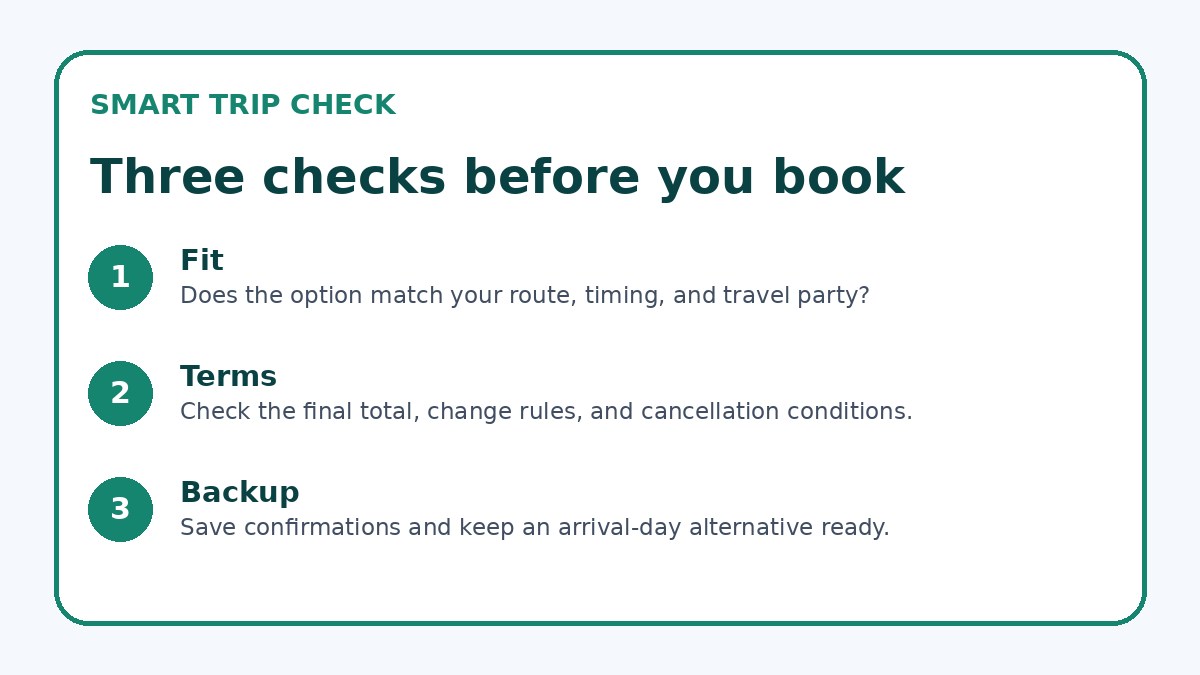
Before you book
- Confirm exact departure and arrival stations or terminals and map door-to-door travel time including transfers.
- Review the carrier’s latest luggage, boarding and change/refund policies on its official booking page before purchasing.
- Pack essential work gear in an accessible carry-on and carry tested cables, a power bank, and noise-cancelling earbuds.
- Block conservative buffers on your calendar and inform colleagues of your limited-availability windows for the travel day.
- Book reliable last-mile transport in advance or plan walking routes and platform transfers from the arrival point.
- Identify at least one realistic alternate itinerary you can use if your primary option is delayed or canceled.
Packing, tech, and last-mile arrangements
Pack for accessibility. Put essential work items—laptop, chargers, portable hotspot, meeting notes, and any presentation materials—in an easily reachable carry-on. Include a compact power bank with enough capacity to charge your devices and a set of adapters if needed. Test your laptop and headset before departure so you aren’t troubleshooting software updates during a tight transfer window. Also keep a small emergency kit with toiletries and a fresh shirt for quick touch-ups if you go straight to meetings.
Plan the last mile in advance: pre-book a taxi or rideshare if the station arrival is not within a short walking distance from your meeting, and confirm estimated travel times for the chosen window. If you intend to use city transit, check schedules and platform walking distances and confirm whether luggage will be manageable. For car parking, determine whether long-term or short-term parking is nearer to your departure point and factor in the walk or shuttle time to the terminal or station.
Frequently asked questions
Should I choose the high-speed train or a flight between Barcelona and Madrid if I need to work?
If uninterrupted work with a laptop is your priority, many business travelers prefer rail because trains often offer stable seating, a table surface, and fewer preboarding interruptions. However, evaluate whether the specific train service you plan to use provides power outlets and reliable Wi‑Fi for the duration you need. Flights can save in-air time but include airport security and transfer steps that fragment the day; if you choose air travel, factor those steps into how much actual work time you’ll have and verify check-in and transfer logistics on the airline’s booking page.
How much buffer time should I add around departure and arrival for meetings?
Plan conservative buffers on both ends: allow time for local transfers, security or boarding processes, and a short decompression period after arrival to test connectivity and freshen up before meetings. The exact buffer depends on your tolerance for risk and the complexity of transfers; if your meeting is critical, err on the side of extra time and consider earlier departures or booking a flexible option you can change. Communicate the buffer window to meeting organizers so expectations are clear.
What should I verify on the provider’s site before finalizing a booking?
Always check departure and arrival locations (specific terminal or station platforms), baggage allowances and size rules, coach or cabin amenities (power outlets, Wi‑Fi, quiet sections), and the carrier’s change and cancellation policy. For connections, confirm minimum transfer times and whether the ticket covers rebooking for missed connections. If booking through a third party for comparison, go to the provider’s official page before relying on details, and use Trip.com only as one of several comparison tools if you choose.
Final planning note
For business travel between Barcelona and Madrid, the best day-of-travel plan ties mode selection to how you actually need to use the time: uninterrupted work, shortest time to the meeting, or control over schedule. Narrow choices by mapping door-to-door time, verifying luggage and boarding rules, and planning conservative calendar buffers. Prepare tech and last-mile arrangements in advance and choose fare conditions that match your tolerance for disruption. A small amount of verification on the provider’s booking page—terminals, change policies, and on-board amenities—will reduce stress on the day and make it easier to arrive ready for business.
Continue planning
Check current options and final conditions
Use the provider page to confirm live availability, the final total, cancellation terms, and every condition that matters to your trip.
This evergreen planning guide was created with AI-assisted drafting and a structured quality review. It does not display live prices, schedules, availability, visa guidance, or provider rankings. Verify current details before booking. Some links are affiliate links; we may earn a commission at no additional cost to you.