If you need to travel between Paris and Rome for business, the core decision is simple: prioritize schedule flexibility or prioritize convenience. That single choice shapes whether you book a no-change-fee fare that lets you shift plans at short notice, a direct flight that keeps ground transfers minimal, or a routed itinerary that saves time at the airport but increases connection risk. Start by locking in exact meeting dates, preferred time windows, airport preferences in both cities, and how much baggage and ground transfer time you consider acceptable. With those details you can objectively compare direct versus connecting itineraries, flexible fare classes, and the tradeoffs between shorter door-to-door time and more forgiving rebooking rules. Below you’ll find a practical framework for making that call, what to verify on the airline or booking page, and four concrete selection strategies to match different business priorities.
See live routes for your exact travel day
Compare direct and connecting choices with the same baggage and traveler details.
Routing: direct versus connecting and where flexibility matters
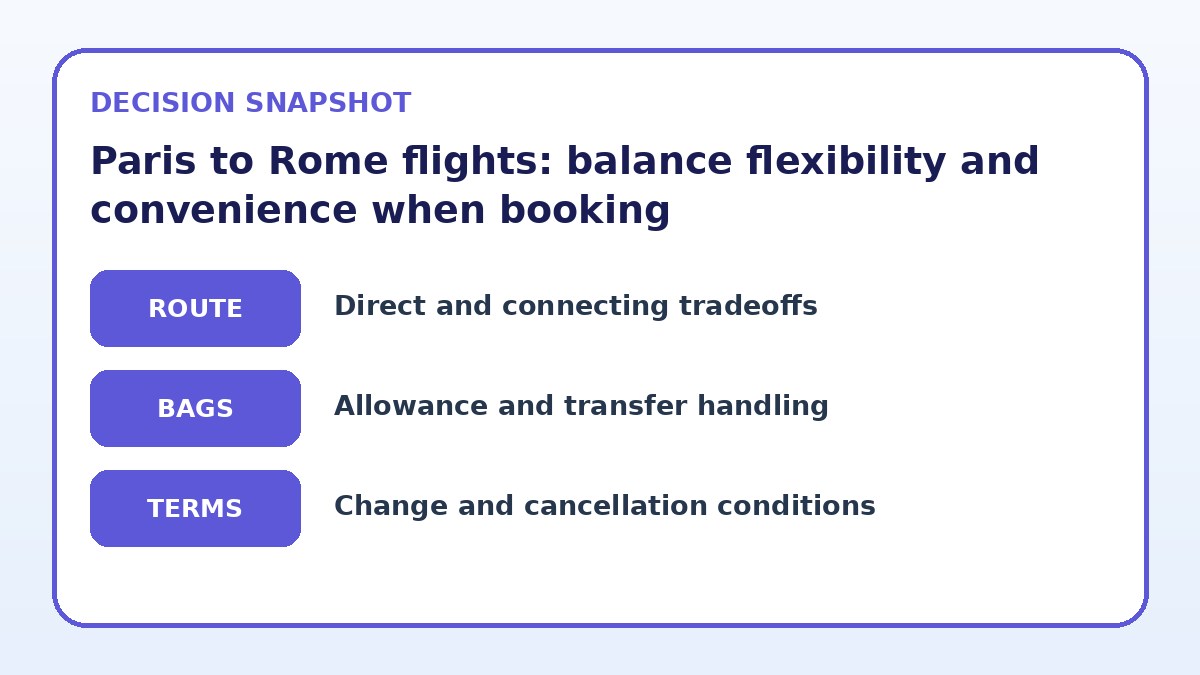
For business travelers the routing decision centers on whether the itinerary is nonstop or requires a connection. A nonstop flight minimizes the number of moving parts — fewer takeoffs, landings, and terminals — which reduces the chance of a missed meeting due to an in-flight delay or a missed connection. However, nonstops can have tighter rebooking options on the same day if your schedule shifts. A connecting itinerary may offer more departure time choices and lower fares, but each additional flight leg adds risk and complexity.
When reviewing options, compare total travel time from your departure point in Paris to arrival location in Rome, not just airborne time. Include transit time to and from airports, typical security and check-in windows, and any required time to change terminals if you connect. If a connection route includes a short layover, weigh whether the carrier's minimum connecting time is realistic given typical delays at that airport. The right routing balances predictable arrival times against your tolerance for last-minute schedule adjustments.
Baggage and connection risk: practical implications for business trips
Baggage rules and how carriers handle transfers matter more than they first appear for business travelers who rely on suits, presentation materials, or sensitive equipment. If you check bags on a connecting itinerary, verify whether transfers are protected on a single ticket and if the connection airport requires a baggage recheck. Carry-on-only travel avoids checked-bag transfer risk but may restrict what you can bring and affect comfort on longer days. Also consider how late-night arrivals or split itineraries change your options for retrieving baggage.
Assess the connection risk by asking whether you would be willing to rebook if a missed connection means a late arrival that affects your meeting. If the answer is no, prefer direct routings or add a buffer between flights when connecting. Where connections are necessary, choose longer minimum layovers or carriers that offer rebooking support at the airport. On the booking page, check where responsibility for re-accommodation lies, and confirm baggage transfer rules and liable carrier if legs are on different tickets.
Compare flight-selection strategies
| Flight strategy | Best for | Risk to check |
|---|---|---|
| Book a nonstop flexible fare | Travelers who need predictable door-to-door timing and the ability to change plans with minimal disruption | Higher fare and fewer departure time options compared with connecting itineraries |
| Choose a cheaper connecting itinerary with buffer time | Travelers looking to lower ticket cost while keeping a realistic cushion for delays | Longer total travel time and more moving parts to manage if delays occur |
| Buy a restrictive low-fare and add travel insurance | Cost-focused travelers who can accept some hassle in exchange for lower upfront costs | Insurance may not cover every disruption and administrative rebooking burden falls to the traveler |
| Mix carriers or tickets to optimize times | Experienced travelers who prioritize exact timing and are comfortable managing separate bookings | Higher connection and baggage transfer risk, with less responsibility from carriers for missed connections |
Recheck the complete itinerary
Confirm airports, connection handling, baggage, and change conditions before deciding.
Schedule fit: matching flight times to meeting windows and on-the-ground logistics
Match departure and arrival windows to your meeting schedule rather than picking the cheapest departure time. A flight that arrives too early can leave you stranded until your hotel room is ready or force you into a costly early check-in. Conversely, flights that arrive late the night before can increase hotel and taxi costs but reduce risk of same-day delays. For morning meetings, arriving the day before is often the safest choice; for afternoon meetings, an early-morning direct flight may be appropriate if delays are rare on that route.
Also factor in ground logistics: which Paris airport you use (and travel time to it), which Rome airport is closest to your meeting, and typical transit times between airport and city center. Business travelers often trade a longer, predictable transfer for smoother ground transport arrangements, like a private transfer or reliable rail connection. On the booking page, confirm scheduled arrival and departure airports, and double-check terminal information and estimated transit times before you finalize.
Flight details to verify
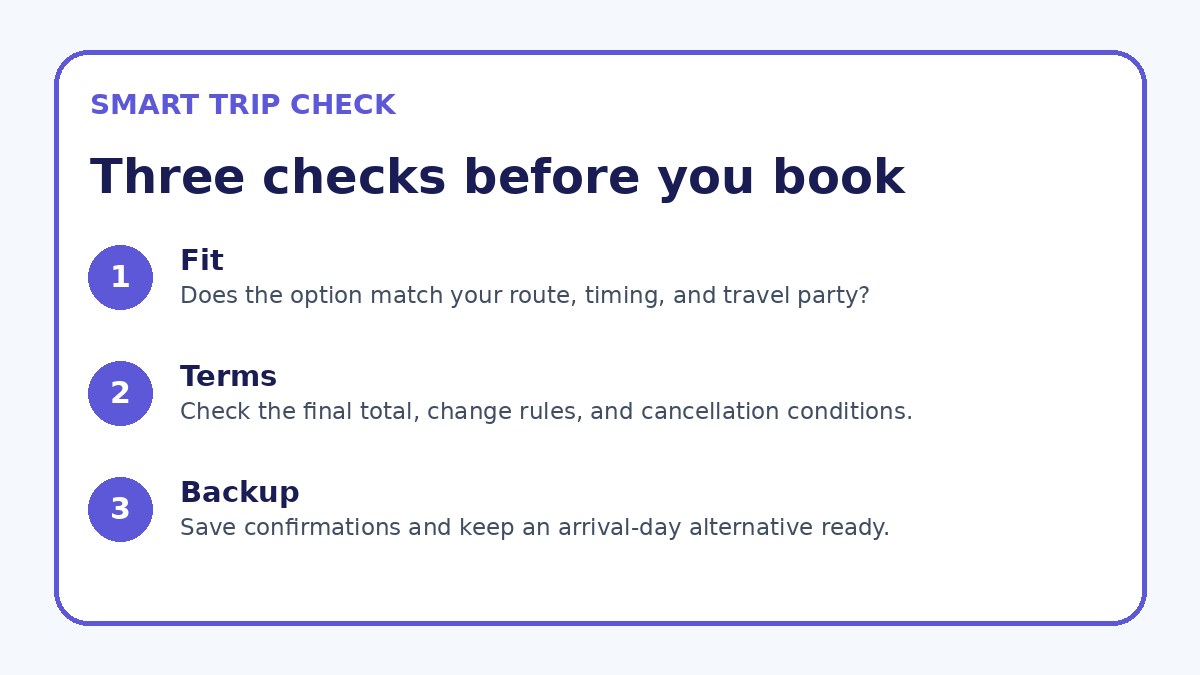
- Lock in exact travel dates, meeting start and end times, traveler full names and passport nationality before searching fares.
- Decide preferred Paris and Rome airports and measure realistic door-to-door travel time for each option.
- On each fare’s booking page, read the full change and cancellation policy and take screenshots of the terms.
- Confirm baggage transfer rules for connecting itineraries and whether tickets are protected under a single PNR.
- Compare total door-to-door travel time, not just flight duration, and add buffer time for transfers and local traffic.
- If flexibility matters, prioritize fares that allow free or low-fee changes and verify same-day change options.
Fare conditions: what to verify before you click buy
Fare conditions are where flexibility is formalized. Look for explicit change and cancellation rules: whether changes incur fixed fees, fare differences, or are permitted without penalty. Also check the carrier’s policy on same-day changes, name corrections, and whether a different fare class is required for reissue. If you plan to book a connecting itinerary across two different tickets, verify each ticket’s change policy and who is responsible for rebooking in case of disruption. On the airline’s final booking page, confirm exactly which changes are free and which attract fees or fare recalculation.
Beyond change rules, confirm baggage allowances, seat assignment options, and whether your fare earns loyalty points if that matters. Check whether the booking includes protection for missed connections under irregular operations, and whether the carrier contracts out ground handling at connecting airports. Because policies can vary by market and ticketing channel, read the full fare conditions shown at checkout and keep a screenshot or PDF of the terms you relied on.
Flight Guide questions travelers ask
How do I decide whether a nonstop or connecting flight is better for my Paris to Rome business trip?
Start by matching flight arrival to your meeting window. If you need to be reliably in Rome with minimal risk of delay, prioritize nonstop options or arrive the night before. If your schedule is flexible and you want more departure choices or lower fares, evaluate connecting flights but add realistic buffer time between legs. Consider baggage handling: if you check luggage and connect, confirm whether it will transfer automatically. Finally, weigh your tolerance for last-minute changes against the fare’s rebooking terms before you book.
What fare rules should I verify to keep my business schedule flexible?
Check the ticket’s change and cancellation rules on the final booking page. Look for whether changes are permitted with only a fare difference or if fixed fees apply, and whether same-day changes are supported. Verify name-correction policies, the conditions under which refunds are permitted, and which carrier is responsible for re-accommodation on multi-carrier itineraries. Keep a copy of the fare conditions and the carrier’s customer-service contact for quicker handling if plans shift.
Can I safely mix two separate tickets to get better times between Paris and Rome?
Mixing separate tickets can unlock better times but increases your personal risk: airlines are typically not responsible for missed connections across independent tickets. If you choose this path, build comfortable buffers between flights, limit checked baggage when possible, and allow time for recheck procedures. Have contingency plans and a clear understanding of alternative flights you could take if a delay occurs. For complex itineraries, consider buying protection or choosing a slightly more expensive single-ticket option for peace of mind.
Final decision note
For business travel between Paris and Rome the smart booking choice begins with a clear priority: do you need schedule flexibility, or do you need the most convenient door-to-door option? Once that priority is defined, compare nonstop and connecting routings by total door-to-door time, baggage handling rules, and fare change conditions. Verify all fare restrictions and transfer responsibilities on the carrier’s final booking page and prepare exact traveler details before you search. If you want current availability and to cross-check options quickly, sites like Trip.com can show live schedules — but always confirm policies shown at checkout before finalizing. With dates, airports, and tolerance for risk locked in, you’ll be able to choose the flight-selection strategy that keeps your meeting commitments secure.
Continue planning
Check current options and final conditions
Use the provider page to confirm live availability, the final total, cancellation terms, and every condition that matters to your trip.
This evergreen planning guide was created with AI-assisted drafting and a structured quality review. It does not display live prices, schedules, availability, visa guidance, or provider rankings. Verify current details before booking. Some links are affiliate links; we may earn a commission at no additional cost to you.