If you’re traveling alone in Madrid, the first question is simple: will a rental car actually improve your trip? In central Madrid most visitors find public transport, walking, and occasional taxis more convenient for museum days, tapas neighborhoods, and evenings in the city. A car becomes useful when you plan day trips to nearby regions, have flexible rural itineraries, or carry bulky gear. This article gives the practical answer up front, then walks through the tradeoffs that matter to a solo traveler—route value, insurance language, pickup and return friction, and a clear non-driving fallback. Read the pickup and return sections to know what to check on the booking page (hours, location, ID and card rules, fuel and toll policies) so there are no surprises at collection or drop-off.

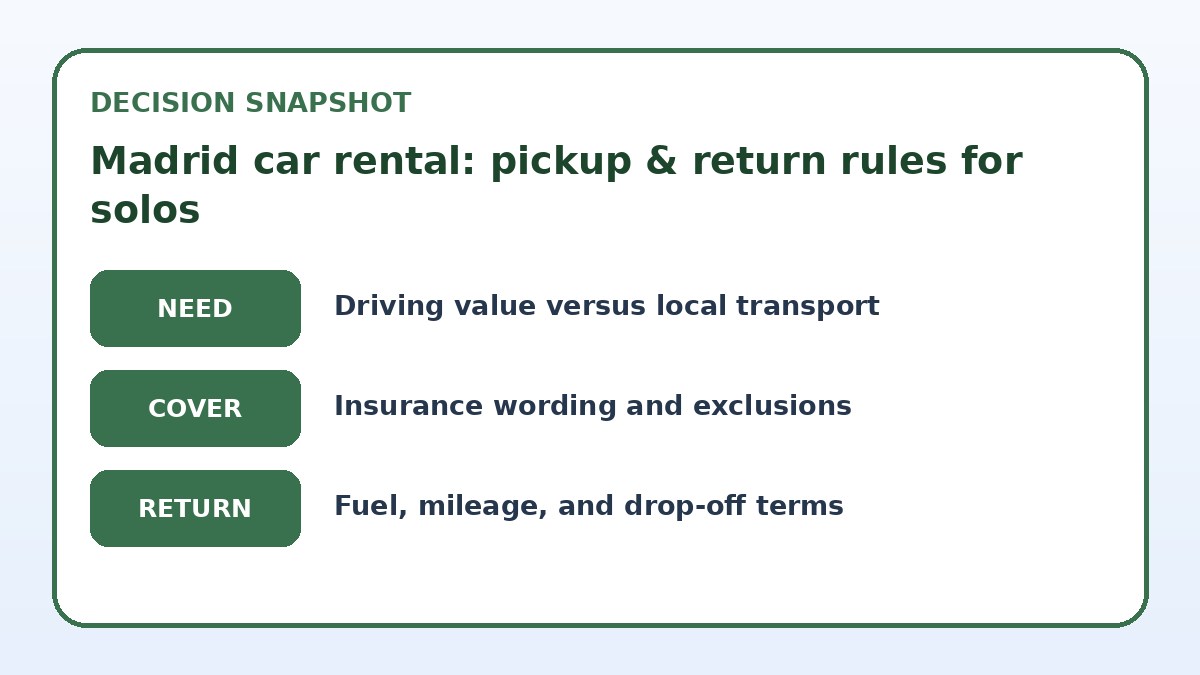
Decide whether driving actually improves your Madrid itinerary
Start by listing the places you want to reach and how often you'll travel there. If most activities are inside Madrid—museums, central neighborhoods, short evening outings—public transit, metro, and walking typically save time, parking stress, and city congestion charges. By contrast, if your solo trip includes multiple day trips to Toledo, Segovia, Ávila, or rural Castilla-La Mancha villages, a car can save hours and let you reach scenic roads and smaller towns on your own schedule. Consider travel pace: solo travelers can manage long train connections more easily than groups, but a car gives you control over timing and detours without relying on local timetables.
Factor in parking and city driving comfort. Madrid’s center has restricted zones, paid parking, and limited kerbside space; if you dislike city parking or driving in heavy traffic, the supposed convenience of a car can become a daily nuisance. Also weigh one-way fees and potential cross-border restrictions if you plan to cross into Portugal or travel beyond Spain. For each candidate day trip, compare actual door-to-door time using public transport versus driving; use that comparison to decide whether the time saved justifies extra rental and parking costs, which are often higher in urban cores.
Decide whether driving earns its place
| Mobility strategy | Best for | Cost or friction to check |
|---|---|---|
| Rent a compact car from city desk | Short day trips to nearby towns with predictable parking needs | Parking and city driving stress; pickup may be inside busy hubs with limited hours |
| Airport pickup with one-way return | Solo travelers arriving by air who then head straight to the regions | Potential one-way fees and extra time at airport desks; off-site shuttles can add friction |
| No car: public transit and regional trains | City-centric itineraries and those uncomfortable with Spanish city driving | Less flexibility for remote day trips and limited service to small villages |
| Short-term car hire for selected days | Combining public transport in-city with rented car for specific excursions | Multiple pickups/returns add coordination and possible extra fees |
Check live rental choices only after the route test
Use the exact driver, dates, pickup point, and return plan to compare current conditions.
Insurance and coverage wording solo travelers must parse
Insurance descriptions use specific terms that change your financial exposure. Look for the exact deductible or excess amount, whether theft protection is included, and whether glass, tyres, and undercarriage are covered. Many suppliers advertise a CDW or LDW but still list a sizeable excess that you must pre-authorize on your payment card—this is a key detail for a solo traveler with limited credit capacity. Also check if third-party liability limits meet local legal requirements and whether roadside assistance is included or sold as an add-on. If you intend to rely on a credit card’s rental protection, read both the card’s policy and the rental company policy to confirm they don’t conflict.
On the booking page, verify the wording around optional waivers and the precise process to reduce or eliminate your excess: whether you can buy a company-supplied zero-excess product at pickup, or whether you need to pre-purchase from a third party. Note any language that restricts coverage for single-driver-only claims, young or senior driver exclusions, or cross-border travel. If anything is ambiguous, contact the provider to request a written clarification before you book. Remember that verbal assurances at the desk cannot override the rental agreement you sign at pickup.
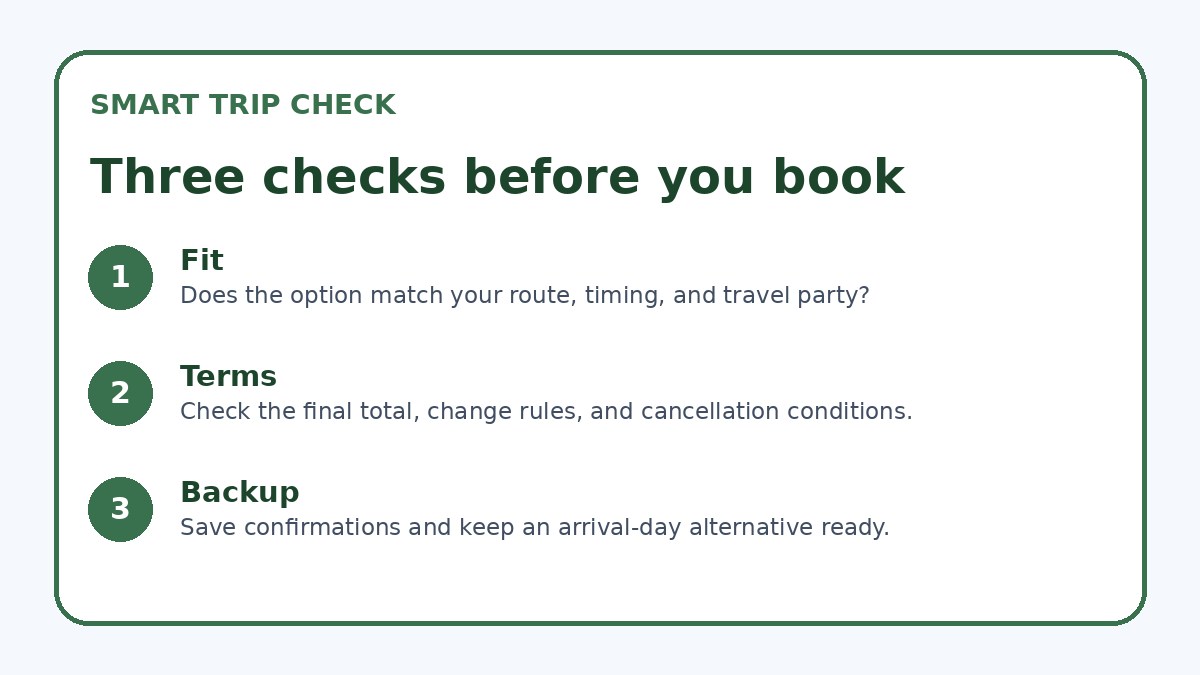
Compare the full rental conditions
Confirm insurance wording, exclusions, deposit, fuel, mileage, and return terms on the final page.
Pickup and return friction: practical items to confirm
Pickup friction often starts with location and hours. Some Madrid rental desks are inside airports or train stations, others are off-site requiring a shuttle or taxi; after late arrivals these logistics matter. Confirm the exact desk or counter, how the company handles off-hour pickups, and the ID and card requirements: many companies insist on the primary driver’s physical credit card and a passport or EU ID. Also check what the company requires for proof of address or driving history; if your license is not in Roman characters you may need an International Driving Permit. Written confirmation of what documents are mandatory will save both time and stress at collection.
Return friction centers on fuel, damage inspection, and timing. Verify whether the rental uses a full-to-full policy or charges for refuelling at return, and how they calculate fuel charges. Ask how damage is assessed—do they do a physical checklist with you present, or is the vehicle photographed and billed later? For late returns, confirm grace periods and potential hourly penalties. If you expect to arrive outside office hours, clarify the exact off-hour drop-off process and whether a signed receipt or confirmation email will be provided as proof of return.
Car rental terms to verify
- Confirm the exact pickup location and opening hours on the provider’s booking page, including shuttle details if off-site.
- Verify which identity documents and payment methods are mandatory—passport, driver’s license, international permit, and primary credit card.
- Read the fine print to find the deductible amount, which damage types are excluded, and whether roadside assistance is included.
- Check fuel policy wording (full-to-full or charged on return) and ask how fuel charges are calculated if returned not full.
- Ask the company to detail the damage inspection process and request a photographed or signed return receipt upon drop-off.
- Compare cancellation and modification terms so you can adjust bookings or cancel without penalty if plans change.
A non-driving fallback and how to plan it
A clear non-driving itinerary keeps options open if you decide not to rent. Madrid has a dense metro and bus network that reaches most districts and nearby suburbs; for day trips, frequent trains and direct buses connect to many historic towns. When planning without a car, choose accommodations near a major metro or train station to minimize transfers and use day-trip operators or regional rail for destinations where point-to-point public transport is reliable. For one-off rural sites, a taxi or a rideshare for part of the route combined with local buses can be a practical alternative to committing to a full rental.
Prepare booking contingencies: check the cancellation policy for the car so you can book refundable or flexible options if your plans change, and have backup transit timetables saved offline. Pre-identify a handful of reliable taxi ranks, overnight parking garages by stations, and luggage storage options at major hubs. If you decide to hire a car after arriving, compare on-the-day desk rates to pre-booked offers and re-check insurance language carefully—sometimes last-minute rentals include higher deductibles or different pickup and return rules. Trip.com can be used to compare current availability and terms if you want a quick cross-check, but always verify the final details on the rental provider’s own booking page.
Car Rental & Road Trip questions travelers ask
Do I need an International Driving Permit (IDP) to rent in Madrid as a solo traveler?
Whether you need an IDP depends on your home country’s license and whether it uses Roman characters. If your license is not in the Roman alphabet or if your country’s agreement with Spain requires it, an IDP is commonly requested. Always verify the rental company’s stated license requirements on the booking page and bring both your original license and passport. If the booking page is unclear, contact the provider in writing before departure; an unexpected IDP requirement at the desk can prevent you from collecting the car.
What should I do if I want to avoid surprises in the damage claim process?
Before you drive away, walk the vehicle with the attendant and ensure every existing scratch or dent is documented in the rental agreement with photos or an inspection checklist. Photograph the car yourself—multiple angles, kilometres shown on the dash, and close-ups of any damage—and keep timestamps. At return, request a signed or photographed completion record from the agent as proof of condition and time of drop-off. If any damage is later claimed, these records help dispute incorrect charges; check the booking page for explicit return inspection procedures so you know what to expect.
How do I evaluate whether on-the-day airport desk rates beat pre-booked rentals?
Compare the total cost plus the pickup/return friction you’ll accept; on-the-day desk rates can sometimes appear lower but may lack the clearer insurance language of pre-booked options. Pre-booked rentals allow time to read terms, verify deductible and fuel policies, and select add-ons at known rates. If considering an airport desk rate, ask for written terms and the deductible amount before signing. Use Trip.com or other aggregators to check availability quickly, but always confirm the provider’s own booking page for the precise terms and cancellation policy.
Final decision note
For many solo travelers, driving in Madrid is a decision based on a few clear factors: the number and nature of day trips, your comfort with city driving and parking, and the insurance and pickup/return wording on the rental contract. If your days are mainly urban, the metro and trains will usually be faster and less stressful. If you choose to rent, read the fine print—deductible amounts, ID and card rules, fuel and return procedures—and get written confirmation of anything that matters. If you prefer not to drive, plan around major transport hubs and book day trips by rail or bus. Verifying these details on the provider’s final booking page prevents surprises at the desk and keeps your Madrid trip smooth.
Continue planning
Check current options and final conditions
Use the provider page to confirm live availability, the final total, cancellation terms, and every condition that matters to your trip.
This evergreen planning guide was created with AI-assisted drafting and a structured quality review. It does not display live prices, schedules, availability, visa guidance, or provider rankings. Verify current details before booking. Some links are affiliate links; we may earn a commission at no additional cost to you.