If you’re traveling from Paris to Amsterdam, the practical decision is about which stations or terminals to use, and how to handle the transfers between them. For most travelers this means choosing a departure point in Paris (rail or airport), a destination in Amsterdam (central station or airport), and a transfer plan that fits your luggage, time tolerance, and onward connections. First-time visitors should prioritize straightforward transfers over marginal time savings: fewer changes, easy connections, and clear signage reduce stress. This article explains the typical station and terminal options, the tradeoffs of each, and simple decision rules to pick the route that suits your priorities. Before you finalize any booking, verify times, platform assignments, baggage rules, and terminal names on the transport provider’s final reservation page — availability and details can change after you read this.
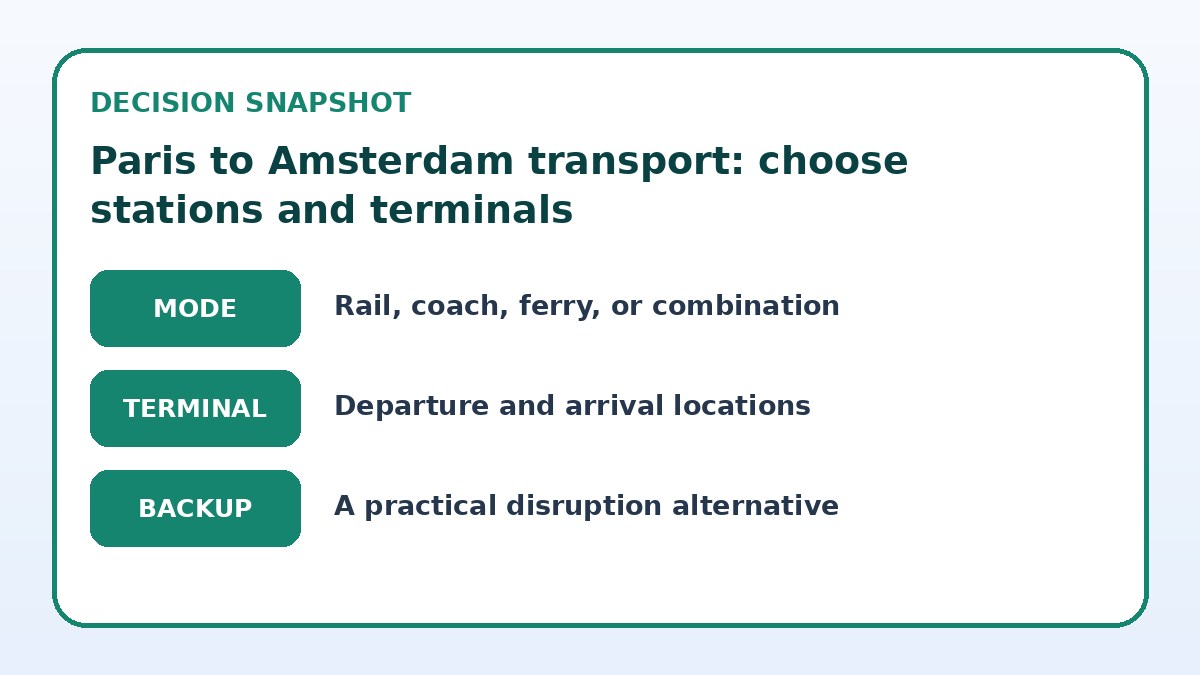
See current options before you compare the details
Availability and final conditions change. Open Trip.com now or keep reading for the practical comparison.
Common departure and arrival points
In Paris, first-time travelers most often start from one of two types of locations: city railway stations (such as major hubs) or airports. City stations connect to national and international trains, while airports connect to air services plus rail links to the city. Choosing a station versus an airport departure depends on where you’re staying, how much luggage you have, and whether you prefer to avoid airport security and extra check-in steps. For many, leaving from a central rail station reduces transfers and delivers you directly to Amsterdam’s city center.
Amsterdam’s arrivals typically divide between Amsterdam Centraal (the central rail station) and Schiphol Airport. Centraal places you within walking or short transit distance of central neighborhoods, hotels, and onward local trains or trams. Schiphol is convenient if you have onward flights or want connections to regional destinations; it also offers direct high-speed rail into the city. Decide whether proximity to your hotel or a smooth onward flight connection matters more — that choice will shape the rest of your transfer planning.
Transfer options and practical tradeoffs
Direct trains generally minimize the number of transfers and the complexity of your trip, but you should weigh that against where the train departs in Paris and where it arrives in Amsterdam. A direct rail option that leaves from a Paris city station and arrives at Amsterdam Centraal usually beats an option that requires an airport hop plus local transit: fewer luggage moves, clearer signage, and lower risk of missed connections. However, if your onward journey begins or ends at an airport, or if flight schedules are more convenient for your itinerary, a route involving an airport may still be preferable.
Choosing an airport-based transfer can add steps: airport terminal transfers, security lines, and longer transit between arrival gates and ground transport. Those extra steps increase door-to-door time even when the in-air or in-vehicle time is short. Conversely, traveling between city centers can require local transit to reach your final address, which might be slower on public transport but easier to navigate on arrival. Your decision should balance total travel time, the number of handoffs, and how comfortable you are handling luggage and navigating transfers.
| Approach | Best for | Tradeoff to check |
|---|---|---|
| Direct city-center train to Amsterdam Centraal | Travelers wanting fewer transfers and quick access to central hotels | May require getting to a specific Paris station rather than leaving from an airport |
| Fly into Schiphol and take train to city | Those starting or ending with flights or needing airport connections | Adds airport procedures and possible terminal walking time compared with city-center arrival |
| Mix of airport and rail (depart airport, arrive Centraal) | Travelers balancing flight availability with arrival in city center | Involves both airport transfers and one rail segment, increasing handoffs |
| Separate bookings with long transfer buffer | Flexible travelers who want to combine different carriers or schedules | More time between segments and greater responsibility for missed connections |
Ready to check the option that fits your plan?
Use your exact dates and traveler details so the provider page can show the current total and conditions.
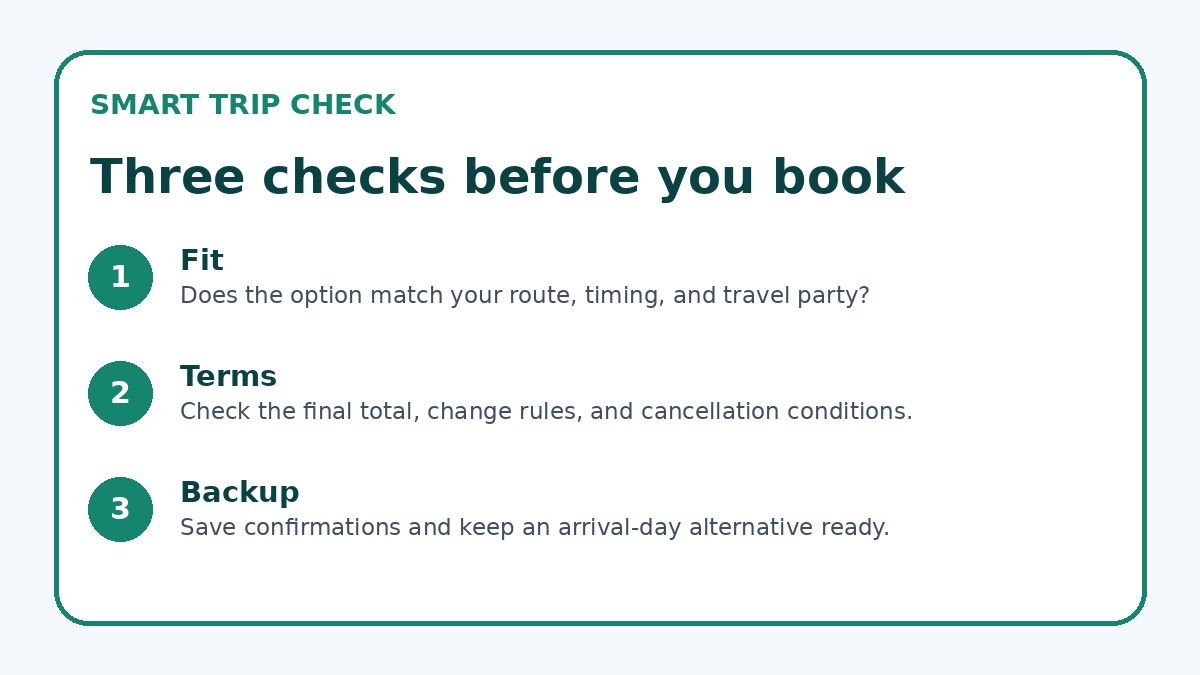
How to compare direct and connecting journeys
When comparing direct versus connecting options, look at the full journey timeline: add the time to get to the departure station or terminal, time between transfers, and expected delay buffers. For trains, confirm whether a service is advertised as direct or has scheduled intermediate stops; a ‘direct’ train that still lists stops usually avoids a terminal change but may require extra time. For flights that connect to rail or other flights, check minimum connection times at each airport and whether your tickets include baggage transfer — if not, plan extra time to collect and recheck luggage.
Don’t assume that a shorter scheduled transit time equals a faster trip in practice. Consider peak-hour crowds, the distance between platforms or terminals, and whether you’ll need to pass through immigration or customs. If you must change between a train and an airport service, research the transfer route in advance so you can find the shortest public transport option or reliable shuttle. Always verify platform, terminal, and transfer instructions on the carrier or station website and on your final booking confirmation before you travel.
Before you book
- Confirm the exact departure station or airport terminal shown on your final booking page and save a screenshot or PDF of the confirmation.
- Allow extra buffer time for transfers: add time for luggage, platform changes, and passport control if your route crosses borders.
- Map the walking route between platforms or terminals in advance using official station maps or apps to avoid last-minute confusion.
- Check whether baggage is through-checked across segments or if you must collect and recheck luggage during transfers.
- Reserve seats or make reservations when available to reduce stress during busy travel periods and ensure a smoother boarding process.
- Have digital and printed copies of tickets and ID, and know where to find the official provider’s customer service contacts at each station or terminal.
Practical tips for smoother transfers
Pack and label luggage clearly so transfers are quicker and less stressful. Carry essential documents and small items in a daypack to avoid retrieving checked bags during short transfers. If you anticipate tight connections, prioritize services with through-checking of baggage or choose a single-booking itinerary that links segments under one reservation; otherwise, add buffer time. Use official station maps and the transport provider’s mobile app or website to identify platforms and terminal exits in advance.
Allow extra time for entry formalities when crossing borders, especially if your route includes an airport. Check whether passport control or customs is on arrival or departure routes; plan for that when calculating transfer windows. Consider booking seats or reservations for trains that offer reserved seating to reduce the risk of being left standing during busy periods. Finally, when in doubt consult the transport provider’s final booking page for platform and terminal details, and use Trip.com as one of several tools to compare current availability and connections.
Frequently asked questions
Should I choose a train to Amsterdam Centraal or a flight to Schiphol?
Choose based on door-to-door priorities: if you want to be in Amsterdam’s city center quickly with fewer transfers, a train to Centraal is typically simpler. If your itinerary includes short international connections or you have onward flights, flying into Schiphol could be more convenient despite extra airport steps. Compare total travel time including transfer walks, security, and baggage handling. Always check the final booking page for terminal, platform, and baggage-transfer rules before confirming.
How much transfer time should I allow between a Paris airport and a city-station departure?
Factor in time to exit your aircraft, pass passport control (if applicable), collect checked luggage, and get from the terminal to the relevant rail station or local transit. Add extra time for rush-hour crowds and possible delays. If you’re unsure about transfer logistics, choose a later departure or book a single itinerary that links segments under one reservation. Verify recommended connection times on the airport or carrier’s official pages rather than relying on general rules.
Can I rely on station signage and announcements for transfers as a first-time visitor?
Station signage in Paris and Amsterdam is generally clear and often bilingual, but crowded platforms and multiple levels can be confusing if you’re unfamiliar with the layout. Prepare by reviewing station maps and platform arrangements before arrival, and follow official apps or customer service kiosks if unsure. Auditory announcements may be in the local language; watch electronic displays and consult staff when necessary. For complex transfers, plan extra time so you won’t need to rush based on announcements alone.
Final planning note
For first-time travelers planning Paris to Amsterdam transport, prioritize simplicity: fewer transfers, clear station choices, and verified terminal details reduce stress. Start by deciding whether arriving in Amsterdam Centraal or at Schiphol better serves your onward plans, then compare full door-to-door time rather than just in-transit minutes. Reserve seats or choose single-booking itineraries when possible to simplify baggage handling and missed-connection responsibility. Before you finalize anything, double-check departure stations, terminal names, and baggage rules on the provider’s final booking page; use Trip.com only as one of several places to compare current options. With a little advance mapping and conservative time buffers, your transfers will feel manageable and predictable.
Continue planning
Check current options and final conditions
Use the provider page to confirm live availability, the final total, cancellation terms, and every condition that matters to your trip.
This evergreen planning guide was created with AI-assisted drafting and a structured quality review. It does not display live prices, schedules, availability, visa guidance, or provider rankings. Verify current details before booking. Some links are affiliate links; we may earn a commission at no additional cost to you.