Practical answer up front: before you search or hit buy, decide your acceptable tradeoff between a faster itinerary and a lower fare, lock exact travel dates and traveler details, and confirm your preferred arrival window in Taipei. For most business travelers the core choice is whether a shorter door-to-door time justifies a higher fare and stricter ticket rules, or whether you’ll accept a connection or longer schedule to save money and gain flexibility. With those decisions set, you can efficiently compare options on airline sites and comparison tools like Trip.com to confirm baggage allowances, connection minimums, schedule buffers, and fare change/cancellation rules on the provider’s final booking page. This article gives a structured pre-booking checklist, explains the route-versus-fare tradeoffs, and shows how to evaluate routing, baggage and connection risk, schedule fit, and fare conditions so you can book with confidence.
See live routes for your exact travel day
Compare direct and connecting choices with the same baggage and traveler details.
Routing: direct vs connecting and the business tradeoff
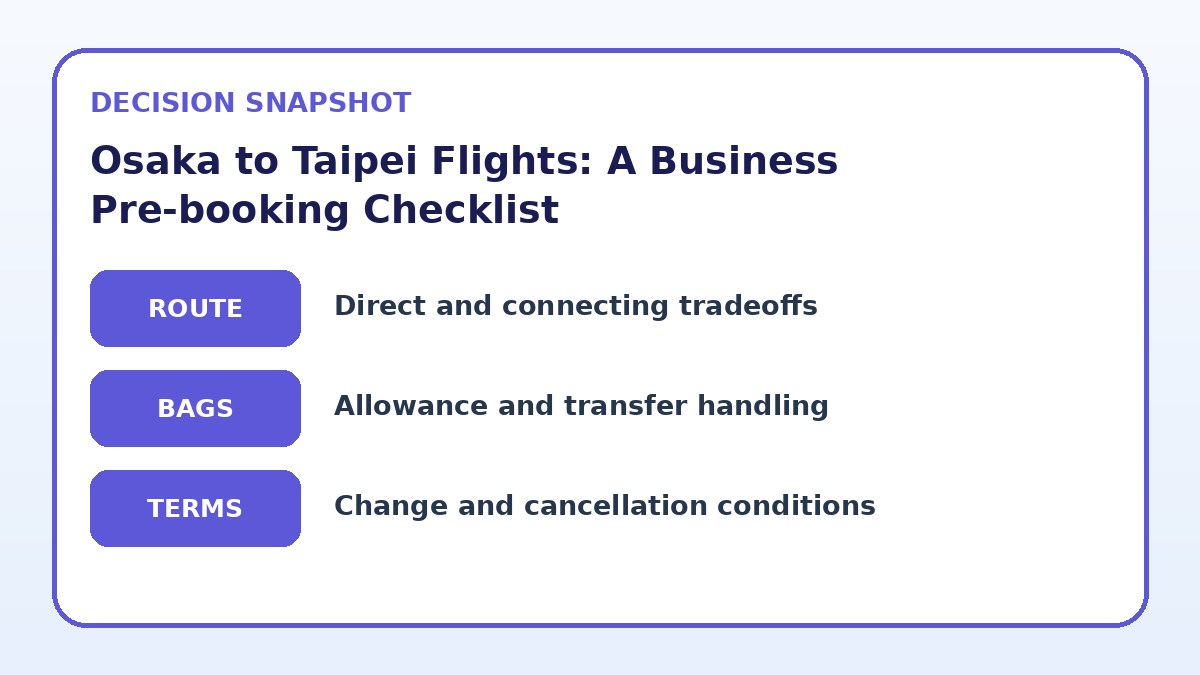
Start by deciding whether you need the shortest possible travel time or are willing to accept a connection to lower the fare or open schedule options. Direct options cut complexity: fewer places for delays to ripple, no gate-to-gate recheck, and simpler baggage handling. But direct flights may depart at inconvenient times, have higher fares, and fewer seats in flexible fare buckets. Connecting itineraries can allow greater schedule choice, potentially lower fares, and more frequent departures, but they introduce connection minimums and the risk of missed connections affecting your overall arrival window.
When comparing routing options, calculate door-to-door time, not just airborne time. Add transfer time to/from Osaka terminals and Taipei arrival transit to your meeting location. Also weigh connection length: tight connections reduce buffer but may save hours; long connections extend travel fatigue and reduce productivity. If your meeting schedule is fixed, prioritize schedules that lock arrival at least a comfortable buffer before your first obligation. Note any carrier or alliance partnerships that promise protection for missed connections on a single ticket, but verify protection and rebooking policies on the booking page before purchasing.
Baggage and connection risk: what to verify before booking
Baggage allowances and how checked luggage is handled on connecting itineraries are frequent sources of trouble. Before booking, confirm whether checked bags transfer automatically between segments on a single ticket and whether any segment has differing weight or piece limits. Low-fare buckets sometimes omit free checked baggage or use different allowances for each carrier on a codeshare. If you rely on a single checked bag for business equipment or presentation materials, choose an option that guarantees through-checked luggage to avoid collecting and rechecking in a connection.
Consider the operational risk to your schedule from transfers: a tight connection at a low-cost-carrier hub, or a connection requiring re-clearing security or immigration, increases the chance your luggage or you will be delayed. If your items are time-sensitive or you need them on arrival, pack critical gear in carry-on and verify carry-on size and weight limits. Always check the final booking page for exact baggage dimensions, fees, and transfer rules; these are set by the operating carrier and can differ from the marketing carrier or search results.
Compare flight-selection strategies
| Flight strategy | Best for | Risk to check |
|---|---|---|
| Book the fastest direct flight | Travelers who must minimize travel time and risk of missed connections. | Usually higher fare and fewer flexible fare buckets; verify seat availability and change penalties. |
| Choose a cheaper connecting itinerary | Cost-conscious travelers with flexible arrival windows and tolerance for longer travel time. | Higher connection risk, potential baggage rechecks, and more limited protection if segments are separate tickets. |
| Buy a flexible/refundable fare | Those with unpredictable schedules who value rebooking ease and lower change fees. | Higher upfront cost; verify exactly what changes and refunds are allowed on the booking page. |
| Pick a low-cost fare and add protections | Travelers seeking low fares but wanting some cover via add-ons or travel insurance. | Add-ons can erode savings; confirm what the carrier’s add-on covers and what the insurer excludes before purchase. |
Recheck the complete itinerary
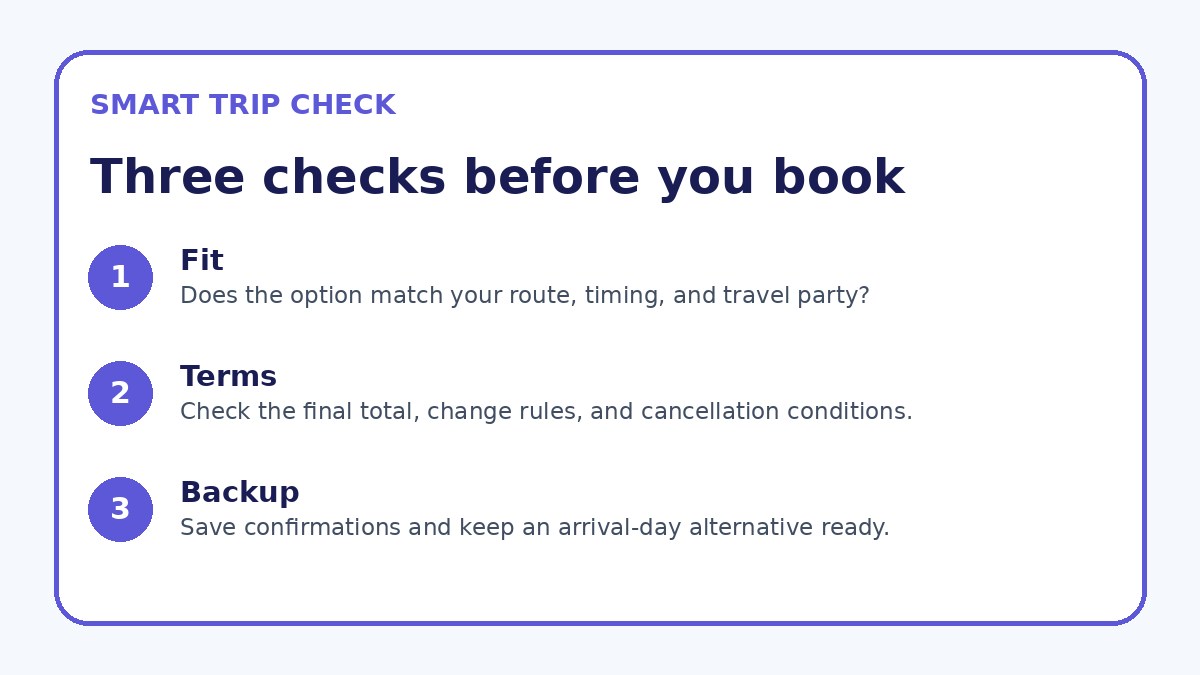
Confirm airports, connection handling, baggage, and change conditions before deciding.
Schedule fit: matching flight times to business needs
For business travelers, the schedule is often the primary constraint. Identify the earliest acceptable arrival and latest acceptable departure for your trip, then filter options by those windows. Think about airport transit time: which Osaka airport (Kansai International or Itami) is more convenient for you, and what ground transport options and journey times are realistic given your meeting calendar? Similarly, in Taipei, choose flights that land with enough time to clear immigration, collect luggage, and travel to your meeting venue with a buffer for potential delays.
Also consider time-of-day effects on productivity: red-eye departures can save a calendar day but may impair your performance on arrival; mid-day arrivals may be less stressful. When comparing itineraries, factor in likely in-flight sleep time, how many time zones you cross, and whether you need the first day in Taipei to be fully productive. If meetings are early, prioritize arrival the evening before rather than a risky same-day flight. Always verify scheduled departure and arrival times on the carrier’s booking page; provisional schedules in search tools can change and may differ by date.
Flight details to verify
- Lock exact travel dates, full traveler names (as on passports), and contact details before starting a search to avoid booking errors.
- Decide whether door-to-door time or ticket flexibility is your priority; mark the maximum acceptable total travel time and buffer before meetings.
- On each candidate itinerary, open the operating carrier’s final booking page and verify checked baggage allowances, carry-on rules, and any baggage fees.
- Confirm connection details: whether luggage transfers automatically, minimum connection time, and whether immigration/security re-clearance is required.
- Read the fare conditions for change and cancellation rules, same-day change options, and refund procedures; note the currency of any penalties.
- If relying on corporate benefits or frequent-flier status, verify applicable perks (baggage, priority boarding, or waived fees) on the carrier’s booking page before paying.
Fare conditions: flexibility, change fees, and refundability
Fare buckets differ widely in what they permit. Before you book, review the fare’s change and cancellation rules, whether seat selection is included, and whether upgrades or refunds are permitted. For business travel where plans change, favor fares that allow free or low-cost changes and offer refundable or partially refundable options if budget permits. If you select a lower-cost nonrefundable fare, have a clear contingency plan—such as flexible internal scheduling or a higher-cost standby option—because rebooking can be costly and time-consuming.
When comparing fares, examine what’s included: checked baggage, seat assignment, priority boarding, and the policy for same-day changes or standby. If you expect to travel frequently on this route, check whether loyalty status or corporate agreements alter change fees or baggage allowances and verify those adjustments on the carrier’s booking page. Always confirm the currency and exact amount of fees, any required non-refundable deposit, and the procedure and contact points for issuing refunds or making changes, because the search summary often omits granular fare terms.
Flight Guide questions travelers ask
Should I always prefer a direct Osaka to Taipei flight for business travel?
Not always. Direct flights reduce the number of transfer points and typically lower the operational risk of missed connections and baggage delays, which is valuable when time is tight. However, direct flights can be more expensive or fly at times that don't fit your schedule. If a connection provides a better arrival time or a more flexible fare that lets you change plans cheaply, a connecting itinerary might be the smarter business decision. Always compare door-to-door time, the quality of the schedule for your meeting needs, and ticket flexibility before deciding.
What connection minimum should I require when booking a connecting itinerary?
There’s no universal minimum because acceptable connection time depends on the airports, whether you change terminals, and whether you need to clear immigration and security. For single-ticket itineraries where bags are checked through, shorter connections can be acceptable; for separate tickets or when baggage must be rechecked, allow significantly more time. Consider your personal tolerance for risk, the airport layout, and the carrier’s minimum connection times. Verify whether the connection is protected by the carrier on a single ticket and check the provider’s official guidance on the booking page.
How do I evaluate fare flexibility versus cost for corporate travel policies?
Start with your company policy: does it require refundable fares, caps on out-of-pocket spend, or preferred carriers? If flexibility matters, choose fares that allow low-cost or no-cost changes and list clear refund terms. If the policy prioritizes cost savings, weigh the potential expense of a last-minute change against the savings from a cheaper fare. Consider purchasing travel insurance or add-on flexible options if your company allows it. Always document the fare conditions and retain the booking confirmation showing change and refund terms in case you need corporate reconciliation.
Final decision note
Booking Osaka to Taipei flights for business requires deliberate pre-search decisions: choose whether speed or flexibility matters more, gather exact traveler details, and set realistic arrival and departure windows. Use the checklist to verify routing, baggage transfer rules, connection protection, and fare conditions on the carrier’s final booking page before you pay. Compare direct and connecting itineraries by door-to-door time, baggage risk, and fare flexibility, and match your selection to meeting priorities and corporate rules. When in doubt, prioritize arrivals that give you a comfortable buffer before obligations and confirm every fare term shown on the booking page; for convenience, Trip.com can be used as one comparison tool, but always verify details with the operating carrier before purchase.
Continue planning
Check current options and final conditions
Use the provider page to confirm live availability, the final total, cancellation terms, and every condition that matters to your trip.
This evergreen planning guide was created with AI-assisted drafting and a structured quality review. It does not display live prices, schedules, availability, visa guidance, or provider rankings. Verify current details before booking. Some links are affiliate links; we may earn a commission at no additional cost to you.