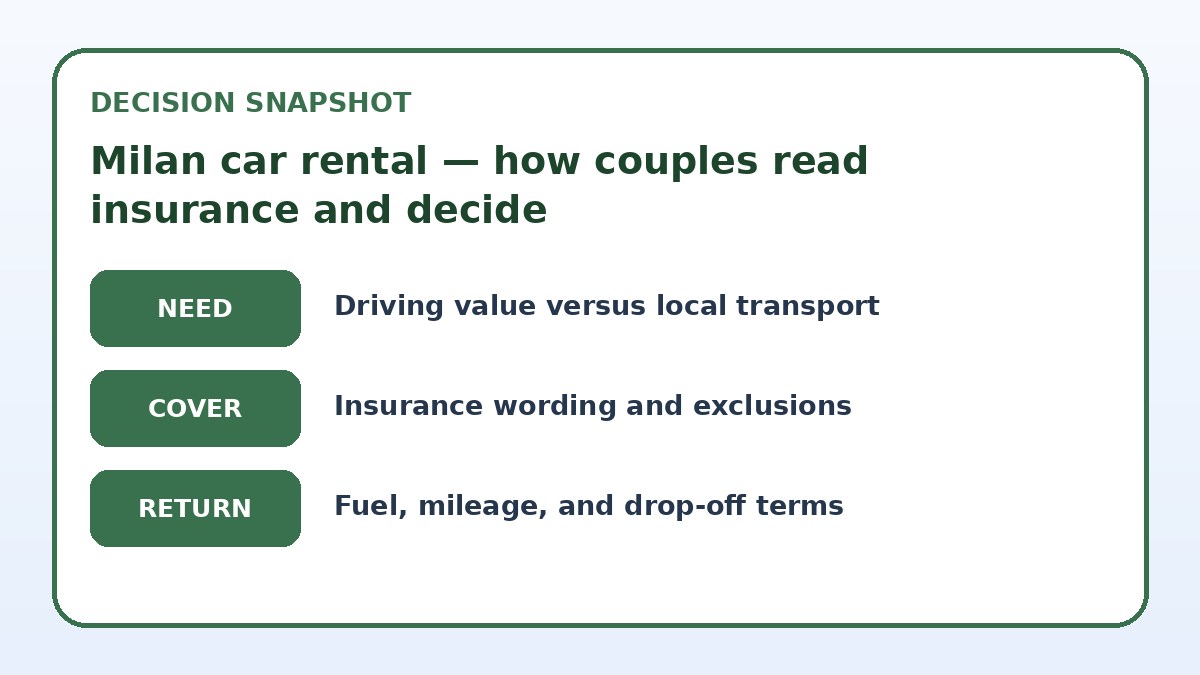
Practical answer first: for most couples staying inside Milan, driving is optional and often more hassle; choose a rental only if your itinerary includes day trips outside the city or flexible countryside routes. If you do rent, the crucial step is reading insurance wording: excess amounts, collision damage waiver (CDW) language, who counts as an authorized driver, whether roadside assistance and theft cover are included, and how cross-border travel is handled. Couples should decide who is listed as the primary driver and whether both need to be authorized to avoid surprise charges. This article explains when driving truly adds value, how common insurance terms shift financial risk, the pickup/return frictions to expect, and a reliable non-driving fallback for couples who prefer trains, trams, and day tours.
Does driving add value to a Milan trip for couples?
Consider what you want to do together. Within central Milan, most iconic sites—Duomo, Brera, Navigli—are compact and easily reached by walking, tram, or metro, so a car can become a liability rather than an asset. Driving only improves the itinerary if you plan multiple flexible day trips to places with limited public transport (rural wineries, small lakeside towns, or dispersed villas). Couples who value spontaneity, photography stops, or remote picnic spots may find it worth renting for part of the trip rather than the whole stay.
Think about parking and city restrictions. Milan has limited ZTL (restricted traffic) areas, paid parking, and time-limited spaces that can complicate day-to-day movement for visitors. For couples who want a relaxed pace and fewer administrative tasks, relying on trains or regional coach lines keeps travel simpler. If you still lean toward a car, aim for a single pick-up/drop-off day aligned with your longest road-hop to reduce parking hassles, and reserve a small vehicle suitable for narrow streets and tight parking in small towns.
Decide whether driving earns its place
| Mobility strategy | Best for | Cost or friction to check |
|---|---|---|
| Rent a car for the whole stay | Couples doing multiple off-the-grid day trips and carrying bulky gear | Higher parking, ZTL risk, and full rental/process overhead for days you don’t need a vehicle |
| Rent a car for selected days only | Couples who want flexibility for one or two long excursions without city hassles | Coordination of pickup/return days and possible extra one-way fees or insurance changes |
| Public transport and taxis only | Couples staying mainly in Milan or taking straightforward regional train trips | Less flexibility for remote locations and dependence on timetables or last-mile taxis |
| Public transport plus guided day tours | Couples who prefer convenience, local guides, and door-to-door logistical planning | Less spontaneous schedule control and potential mismatch with personal pace |
Check live rental choices only after the route test
Use the exact driver, dates, pickup point, and return plan to compare current conditions.
How to decode insurance wording as a couple
Start with the headline items: excess (or deductible), CDW (collision damage waiver) scope, theft protection, and whether taxes and roadside assistance are included. The excess is the amount you would pay out of pocket if the vehicle is damaged; some contracts list a per-claim cap while others show a sliding scale for different damage types. CDW reduces or waives this excess only if the incident falls under the contract’s covered causes—read the fine print for exclusions like undercarriage, windscreen, or damage from misuse.
Pay attention to defined drivers and the phrase 'additional driver'—some companies include a second driver for free, others charge per person, and some require each driver to be explicitly authorized to maintain cover. Also check territorial limits: if you plan a day trip that crosses a regional or international border, confirm whether coverage applies and whether a cross-border fee or special permit is required. Finally, read the provider’s final booking page to verify exactly which coverages are included, the hold amount on your card, how claims are reported, and contact details for roadside support.
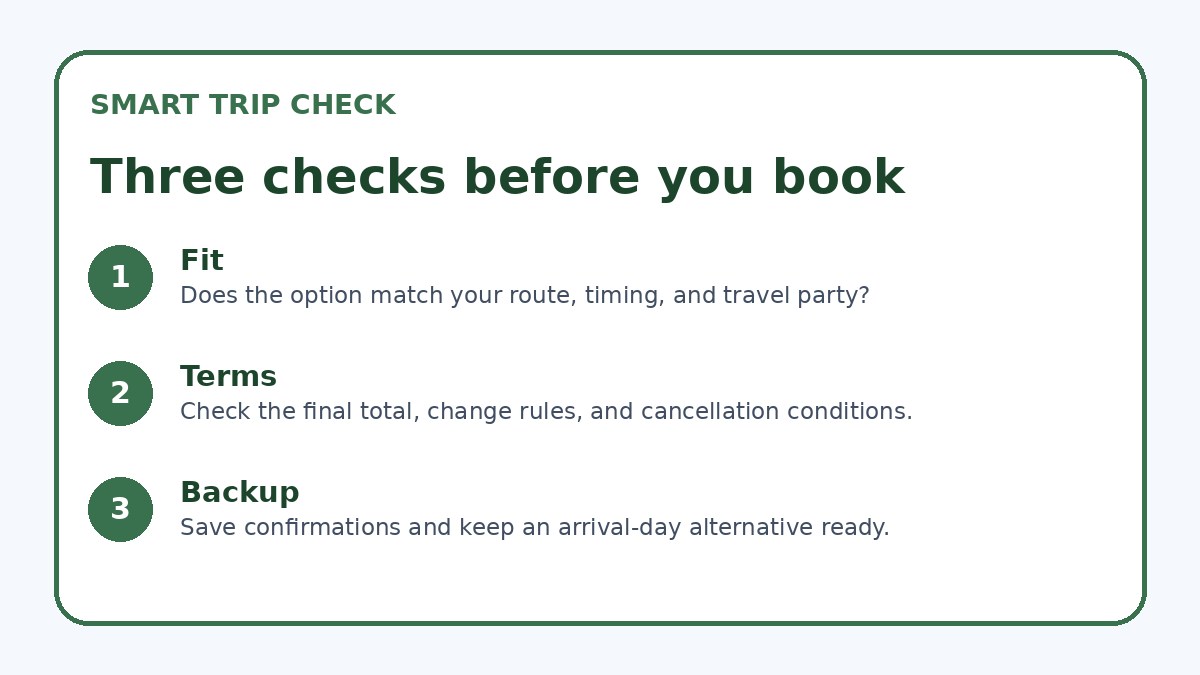
Compare the full rental conditions
Confirm insurance wording, exclusions, deposit, fuel, mileage, and return terms on the final page.
Pickup, return friction, and partner responsibilities
At pickup, expect identity checks, a credit card pre-authorization for the excess, vehicle condition documentation, and, occasionally, language differences that slow the process. Couples should decide who will sign as the primary renter and who will be added as an authorized additional driver—both need to provide a valid license and any extras requested (like an International Driving Permit if required by the rental company). Inspect the vehicle together, document existing scratches with timestamped photos, and ensure both partners are listed in the rental contract to avoid disputes over responsibility.
Return can introduce unexpected charges if fuel policies or damage disputes arise. Note the fuel policy (full-to-full is usually clearest) and understand the refuel options to avoid penalty refueling fees. Agree beforehand which partner handles navigation and parking to limit stress on busy return days. If you disagree about responsibility for a claim later, having both partners on the contract and a thorough photo record from pickup and return will simplify the resolution. Always confirm the final damage report and get a receipt or email confirmation before leaving the lot.
Car rental terms to verify
- Confirm who is listed as primary and additional driver in the rental contract and ensure both drivers meet ID and license requirements.
- Verify excess (deductible) amounts, what types of damage are excluded, and whether CDW or theft protection is included.
- Check the provider’s stated hold amount on your credit/debit card and whether pre-authorization or a deposit will be taken at pickup.
- Read the territorial limit clause to confirm coverage for any cross-region or cross-border day trips you plan to take.
- Document vehicle condition together with timestamped photos or video at pickup and again at return, saving emailed condition reports.
- Confirm fuel policy and return procedures; obtain a final damage and payment receipt before leaving the rental desk.
A practical non-driving fallback for couples
If both of you prefer to skip the car, Milan is well served by regional trains, trams, and a dense metro network that reaches the main neighborhoods and many day-trip hubs. Trains link Milan to larger nearby attractions and regional bus services reach smaller towns—pair those with short taxi rides or on-demand transfers for first-mile/last-mile needs. For flexibility without renting, consider booking a single guided small-group day tour for a specific destination you both want to see; this provides door-to-door movement and local context without insurance or parking concerns.
Plan logistic details ahead: check train frequency, luggage policies, and station locations relative to your accommodation, and build buffer time for connections. Pre-book tickets for popular regional routes to secure seats during busy periods, and choose tours that explicitly state meeting points convenient to your hotel or metro stops. If you want a car occasionally, reserve one for a single day of exploration—this hybrid approach often yields the freedom of driving when needed and the simplicity of public transport the rest of the trip.
Car Rental & Road Trip questions travelers ask
Do both partners always need to be listed to be covered?
Not always, but often. Some rental contracts cover only the named primary driver unless an additional driver is registered. If one partner drives but is not listed, the insurer or rental company may refuse a claim or charge an unauthorized driver fee. For couples who plan to share driving, register both people at booking or at pickup. When comparing options, check the final booking page for any additional-driver fees, required documents, and whether names must exactly match the driving license and credit card used.
What does 'excess' mean, and how can couples manage that risk?
Excess (or deductible) is the amount you are responsible for paying toward damage or theft before the rental insurer contributes. Couples can manage this risk by choosing rentals with a lower excess, buying the rental company’s excess-reduction product, or purchasing third-party insurance that specifically covers the excess. Before buying any additional insurance, read the provider’s booking page terms to verify whether the excess-reduction covers all damage types and if it requires an immediate claim procedure at return. Keep receipts and the rental agreement handy if you file a claim.
How do I verify roadside assistance and claim procedures?
Look for explicit mentions of roadside assistance hotline numbers, response times, and whether assistance is included in the base rate or sold as an add-on. The booking page should state how to report incidents, whether a police report is required for theft or significant damage, and whether towing or replacement vehicle costs are covered. Note any time windows for reporting damage and who handles payment initially—some providers expect you to pay and later reimburse you, which affects couples traveling on a tight daily budget.
Final decision note
For most couples visiting Milan, the right choice is pragmatic: skip a full-stay rental unless your plan includes multiple rural day trips or specific flexible routes that public transport cannot serve. If you do rent, the most valuable time you spend will be reading insurance wording with your partner: confirm excess amounts, who is listed as a driver, territorial limits, and pickup hold policies on the provider’s final booking page. Use a hybrid approach—public transport for city days and a single rental day for targeted excursions—if you want both convenience and occasional freedom. Before you book, cross-check terms on the carrier’s page (and optionally on a comparison site like Trip.com) so you know exactly what you’re covered for and who pays what in case of a claim.
Continue planning
Check current options and final conditions
Use the provider page to confirm live availability, the final total, cancellation terms, and every condition that matters to your trip.
This evergreen planning guide was created with AI-assisted drafting and a structured quality review. It does not display live prices, schedules, availability, visa guidance, or provider rankings. Verify current details before booking. Some links are affiliate links; we may earn a commission at no additional cost to you.