
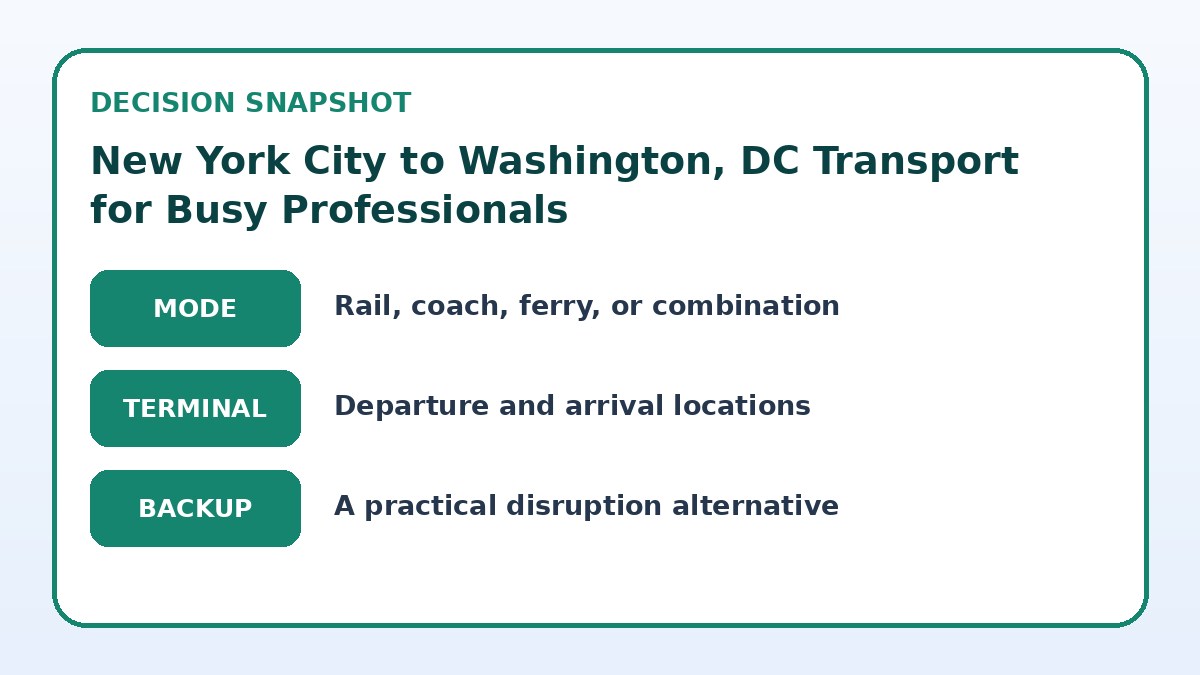
If you must travel from New York City to Washington, DC for a meeting, the practical choice depends on your day’s priorities: speed, reliability, workspace, or cost control. Trains typically balance quick city-center departures with onboard Wi‑Fi and a stable workspace; coaches win on cost and predictability in advance bookings; ferries are niche but can offer a calm, scenic alternative if schedules fit; and flying or driving remain options for certain itineraries or last-minute needs. This guide gives a compact recommendation up front, then walks through the tradeoffs business travelers care about—timing, comfort, connectivity, station-to-office transfers, and how to verify the details you’ll actually book. Wherever you look next, check the provider’s booking page for exact schedules, luggage rules, seat-selection options and cancellation terms before finalizing.
See current options before you compare the details
Availability and final conditions change. Open Trip.com now or keep reading for the practical comparison.
Train: why business travelers often prefer it
Trains frequently hit the sweet spot for business trips between New York City and Washington, DC: they depart from city centers, avoid airport check‑in and long security lines, and typically provide a steady work environment with seats, tables, and power outlets. When choosing a train, look for services that advertise reliable Wi‑Fi and quiet cars or business-class seating—those aspects make a tangible difference if you need uninterrupted time to read briefs or join a video call. Also check how stations connect to your hotel or meeting location; a short taxi or subway ride can outweigh minor differences in journey time.
Decide between direct and connecting train options by comparing total door-to-door time rather than railhead-to-railhead time alone. A direct train may be slightly longer on paper but avoid the stress and potential delays of transfers; conversely, a one-change itinerary with a faster segment can win if connections are generous and both stations have good facilities. Before booking, confirm seat reservation rules, flexible ticket options, and luggage allowances on the provider’s final booking page so you’re not surprised by restrictions or fees that affect a business schedule.
Coach: when to choose a bus for business travel
Coaches are the cost-conscious business option and can work well when meetings are flexible or your company prioritizes lower travel expense. Many coach services now offer reserved seating, power outlets, and onboard Wi‑Fi—enough for email and light work between stops. The trick for business travelers is picking departure and arrival points with reasonable access to your meeting location and allowing extra buffer for traffic, which is the main source of variability in coaches’ door-to-door time.
If you consider a coach, compare advertised travel times with realistic door‑to‑door estimates that factor in transfers and rush-hour congestion. For important appointments, choose an earlier coach or a service that lists multiple daily departures so you can move to a later option if needed. Verify cancellation and change policies on the carrier’s booking page; some low-cost fares have strict rules that can be costly if meetings shift. Check whether onboard power and Wi‑Fi are guaranteed or merely subject to availability, especially if you need sustained remote access.
| Approach | Best for | Tradeoff to check |
|---|---|---|
| Train | Business travelers needing city-center access and reliable onboard workspace. | Often higher fare than coach; check reservation flexibility and station transfer times. |
| Coach | Cost-conscious travelers who can tolerate longer, variable door-to-door time. | More affected by traffic; onboard connectivity and comfort vary by operator. |
| Ferry (combined routes) | Those who prioritize a calm, scenic segment and unique travel experience. | Limited direct routes to downtown DC and often longer last-mile transfers. |
| Flight or driving | Last-minute trips or itineraries needing extreme schedule control or multiple stops. | Higher effective travel time to city centers (flights) or reduced workability (driving). |
Ready to check the option that fits your plan?
Use your exact dates and traveler details so the provider page can show the current total and conditions.
Ferry and water-route options: niche but useful
Ferry travel between New York and points along the mid‑Atlantic corridor is not a mainstream way to reach downtown Washington, DC, but for certain itineraries—for example, combining ferry legs with rail or road segments—it can offer a calmer, less crowded travel experience. Ferries can provide a pleasant working environment with natural light and space to spread documents, and the novelty can reduce travel stress before an important meeting. However, ferry terminals are often farther from central business districts than major rail stations, so last-mile logistics matter.
When evaluating a ferry-inclusive route, map the full chain of transfer times and local transport connections; a scenic day segment is only worthwhile if it doesn’t add unpredictable transfer risk. Check the provider’s documentation for baggage limits and boarding procedures—these can vary widely by operator. For business travelers with tight schedules, ferry options are best considered as part of multimodal plans where each transfer is confirmed and backup alternatives (train or coach on the same day) are accessible should weather or operational issues arise.
Before you book
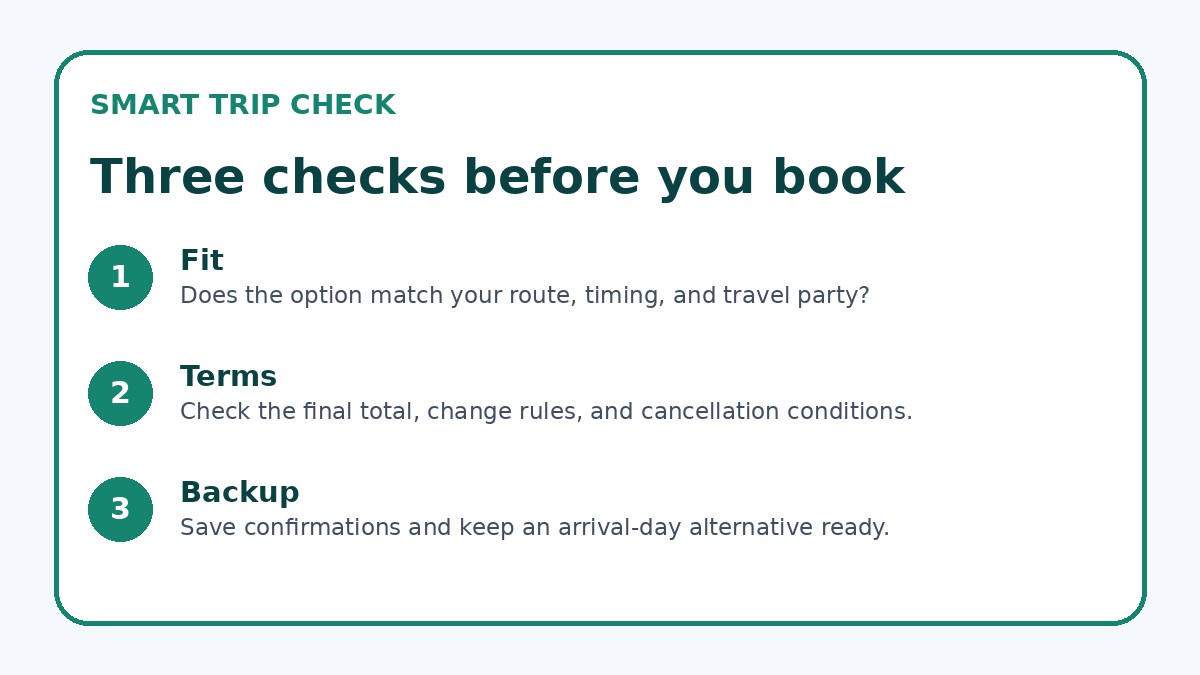
- Confirm total door-to-door time for your preferred option, including transfers from stations or terminals to your final meeting address.
- Verify seat selection, power outlets, and Wi‑Fi availability on the provider’s official booking page before purchasing.
- Check change and cancellation rules, and consider a flexible fare if your meeting schedule could shift.
- Compare cost versus productive time lost—calculate whether a faster but pricier option is justified by billable hours.
- Identify backup same‑day alternatives (later train, coach, or flight) in case of delays or missed connections.
- Plan last-mile logistics: prebook a taxi or rideshare to avoid queueing upon arrival and to ensure timely transfer to meetings.
Flights, driving, and the practical decision framework
Flying can be right for last-minute travel or when a connection makes rail or coach impractical, but airports add time for check‑in, security, and transfers to downtowns. Driving your own vehicle or using a car service gives unsurpassed control over departure times and door-to-door routing, useful for multiple stops or carrying bulky materials—but you trade off the ability to work freely en route and expose yourself to variable road traffic. For business trips, weigh the value of productive time against total travel time and logistical complexity.
A practical decision framework: 1) set the earliest and latest acceptable arrival times for your meeting; 2) estimate door-to-door times for each mode including transfers; 3) prioritize uninterrupted work time versus cost; and 4) confirm provider policies (changes, refunds, seat selection, Wi‑Fi, luggage) on the booking page before you commit. Trip.com can be used as one place to check current availability, but always verify critical details on the operator’s official site when finalizing reservations.
Frequently asked questions
Should I always pick the train for business travel between New York City and Washington, DC?
Not always. Trains often offer the best balance of city-center arrival, workspace, and reliability, but the right choice depends on your priorities. If your meeting timetable is inflexible and a faster flight aligns better, or if cost constraints push you to coach options, those may be preferable. Also consider the exact station locations relative to your meeting and whether a direct rail option exists that minimizes transfer risk. Always compare total door-to-door time and verify seating, Wi‑Fi, and ticket flexibility on the booking page before deciding.
How much buffer time should I allow for transfers and delays when traveling for a meeting?
For critical business meetings, build extra time beyond the nominal travel duration: allow for local traffic to and from stations, security or boarding procedures, and potential small running delays. A sensible buffer is typically at least 60–90 minutes for rail or coach travel when you must be on time, and more for air travel because of airport procedures. If missing the meeting is not an option, choose a departure that arrives well before your earliest acceptable arrival time and verify change policies in case you need to move to a later service.
Can I reliably work onboard these modes of transport?
You can usually get work done onboard trains and many modern coaches thanks to stable seating, tables, and power outlets; Wi‑Fi quality varies by operator. Ferries offer a calm environment for reading and offline work but may have intermittent connectivity. Flying or driving is less conducive to focused work—flying includes restricted electronic usage during certain phases and driving prevents working at all. Before relying on onboard connectivity for crucial calls, confirm whether the operator guarantees Wi‑Fi or labels it as available but not assured, and have a cellular-data backup plan.
Final planning note
Choosing how to travel from New York City to Washington, DC for business is a tradeoff between productive time, predictability, and cost. Trains are often the best all-around choice for city-center access and onboard work, coaches can cut travel spend if you accept longer journeys, ferries serve specific scenic or stress-reduction needs within a multimodal plan, and flights or driving address last-minute or highly controlled itineraries. Use the decision framework in this guide: map door-to-door time, prioritize the type of onboard workspace you need, and confirm seat, luggage and change rules on the provider’s booking page before you finalize. Keep a realistic backup in your calendar so a delay doesn’t upend your meeting.
Continue planning
Check current options and final conditions
Use the provider page to confirm live availability, the final total, cancellation terms, and every condition that matters to your trip.
This evergreen planning guide was created with AI-assisted drafting and a structured quality review. It does not display live prices, schedules, availability, visa guidance, or provider rankings. Verify current details before booking. Some links are affiliate links; we may earn a commission at no additional cost to you.