If you’re traveling solo between New York City and Toronto, the practical question is how much schedule flexibility you need versus how much convenience you’re willing to pay for. The right choice depends on whether your priority is a tightly timed itinerary—meetings, a same-day return, or connecting travel—or an easier trip with fewer unknowns, like a direct flight or a single checked bag. Start by deciding firm dates (or a 1–2 day range), total travel time you can tolerate, and whether you’ll accept connections. From there, compare options by routing, typical baggage and connection risk, schedule fit for your plans, and fare conditions like change and refund rules. This guide walks solo travelers through the tradeoffs, offers concrete decision strategies, and lists the exact items to confirm on the carrier or booking site before you commit.
See live routes for your exact travel day
Compare direct and connecting choices with the same baggage and traveler details.
Routing: direct versus connecting options
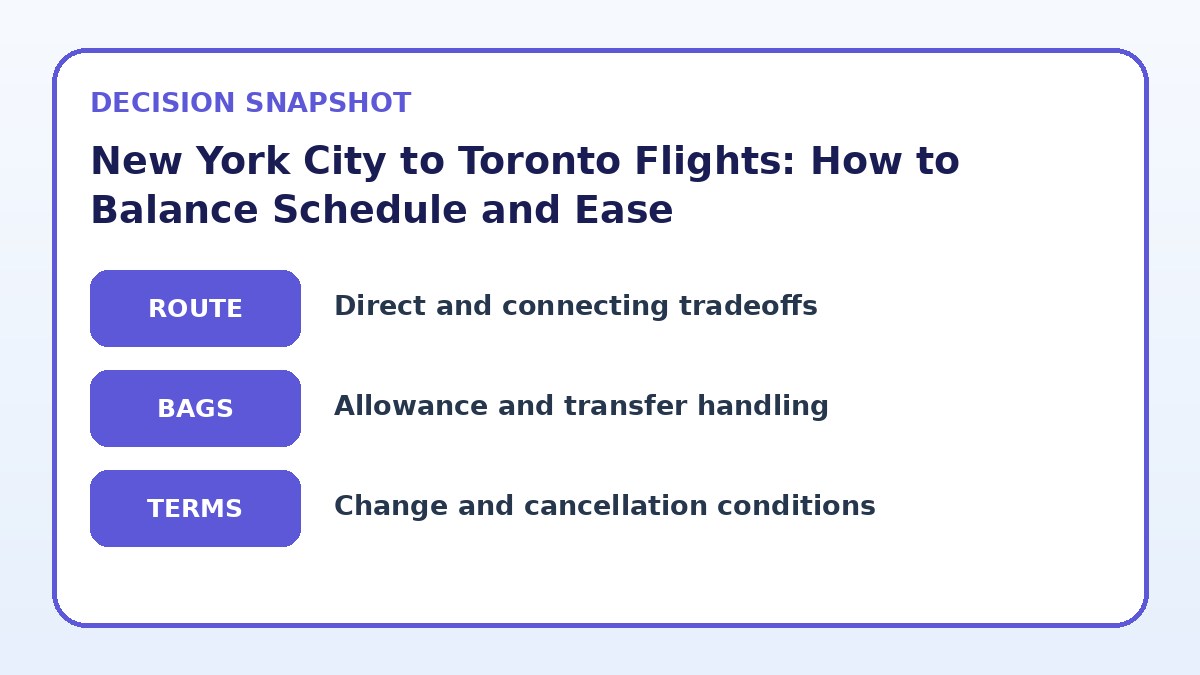
Routing is the first practical choice: a nonstop flight reduces complexity and is usually the most convenient for a solo traveler focused on minimizing transit stress. Nonstops cut the number of times you handle luggage, reduce the risk of a missed connection, and simplify arrival logistics in Toronto. If you prioritize convenience for a short trip or want predictability for a tight schedule, filter search results to show nonstop services first and then compare departure times and airport terminals to match your ground transport plans.
Connecting routes can save money or expand timing options, but they add layers to manage. When considering a connection, check minimum connection times listed by the airline and the same-day connection history for those airports if available. With connections, verify whether your itinerary is on a single ticket—this matters for baggage transfer and missed-connection protection. Solo travelers who value choice and a broader range of departure times may accept a single connection, provided they allow a cushion for delays and know exactly where to claim and recheck baggage.
Baggage and connection risk: packing for control
Baggage policy differences often determine how convenient a flight will feel. A fare that includes a checked bag will keep your hands freer and reduce the chance of last-minute fees; conversely, basic fares that exclude baggage can work well for lightpackers willing to tour with carry-on only. For itineraries with connections, ask whether bags are checked through to your final destination or must be picked up and rechecked; when this is unclear, prepare to handle your bag during a connection and leave extra time.
Assess connection risk by mapping the transfer process: will you change terminals, pass through security again, or cross border controls? Solo travelers should favor itineraries with simpler connections—same terminal and through-checked bags—when convenience matters. If you choose a cheaper connecting route, plan a conservative buffer between flights and pack essentials (documents, medication, a charger) in your carry-on so a disrupted baggage delivery won’t derail your plans.
Compare flight-selection strategies
| Flight strategy | Best for | Risk to check |
|---|---|---|
| Book nonstop premium or standard fare | Travelers prioritizing convenience and minimal transit risk | Higher fare and fewer departure time choices compared with connecting options |
| Buy a connecting cheapest fare with long layovers | Travelers prioritizing lower upfront cost and who accept extra travel time | Increased chance of delays, baggage handling, and missed connections |
| Choose a flexible fare on a single-ticket itinerary | Solo travelers needing schedule adaptability or potential last-minute changes | Higher ticket cost but simpler rebooking and better protection for connections |
| Mix-and-match separate tickets for maximum scheduling options | Independent travelers maximizing time-window choices across carriers | You assume responsibility for missed connections and baggage transfers |
Recheck the complete itinerary
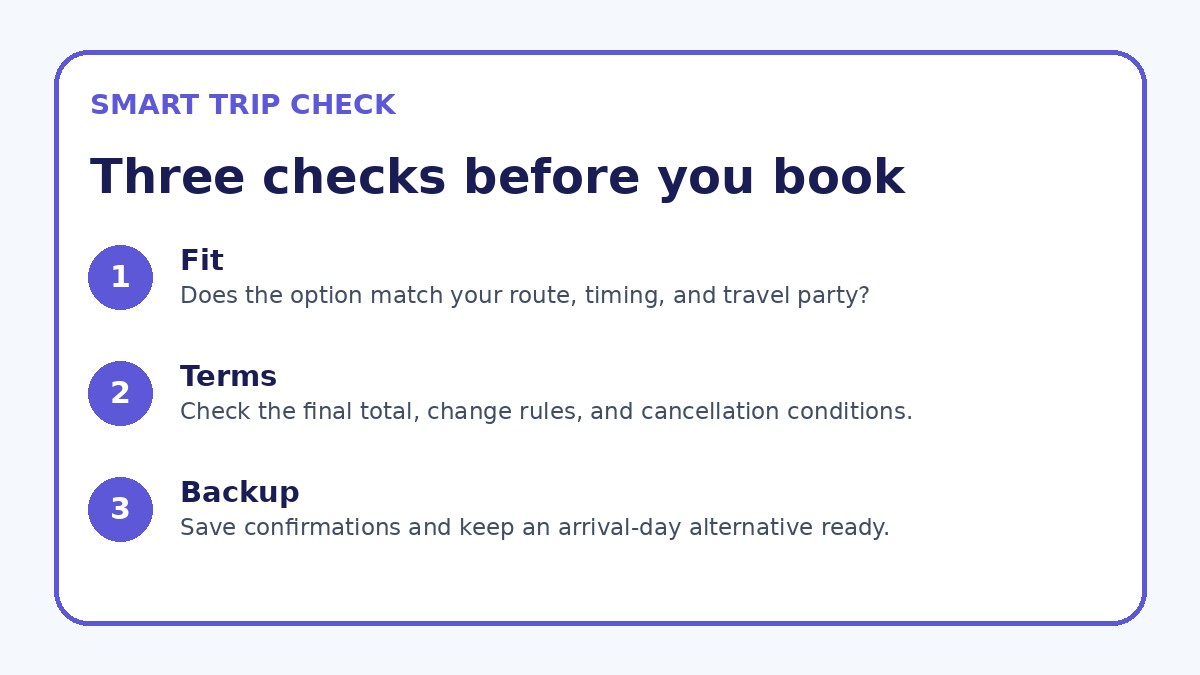
Confirm airports, connection handling, baggage, and change conditions before deciding.
Schedule fit: aligning flights with your plans
Think in door-to-door time rather than airborne hours. For many solo travelers, early morning departures or late-night returns can create hidden time costs—city transportation, safety concerns, or accommodation check-in windows. Map realistic transfer times to and from the airports at the specific hours you’d travel and check public transit or taxi availability for those times. If you have a meeting or an event, allow extra cushion for immigration and ground travel; for flexible leisure trips, a wider time window can unlock lower fares or easier connections.
When your schedule is tight—an appointment, same-day return, or onward connection—prioritize itineraries with the smallest number of risk points, even if they cost more. If your calendar is more flexible, use time windows to compare cheaper or more varied options: midday flights, connecting routes, or multi-airline combinations that might fit your broader schedule. Always note the scheduled arrival times in local time zones so you avoid day-mixups, and record the airport terminals for arrival and departure to plan transfers precisely.
Flight details to verify
- Set exact travel dates and enter them into flight search filters before comparing options.
- List required documents (passport, eTA, or other ID) and confirm carrier check-in and border-crossing requirements on the booking page.
- Decide if carry-on only is viable; if not, search fares that include your preferred checked baggage allowance.
- Note desired arrival and departure times and map ground transport options to and from NYC and Toronto airports.
- Confirm whether itineraries are single-ticket or separate tickets and read the carrier’s change/refund rules on the booking screen.
- Save airline terminal and connection details for your chosen itinerary and allow conservative layover time for transfers.
Fare conditions: changeability, refunds, and the fine print
Fare rules shape how much flexibility you actually have after booking. Fully flexible or refundable fares allow changes with minimal fuss but tend to be pricier; non-refundable or basic economy fares lower upfront cost at the expense of change fees or strict baggage limits. Before booking, read the fare conditions on the carrier’s final booking page: confirm how much a change costs (or whether changes are free within a period), how refunds are handled, and whether seat selection and baggage are included or add-ons.
Also check who provides protections: single-ticket itineraries typically place the responsibility for missed connections with the airline, while self-connecting separate tickets often leave you to manage missed legs. Verify whether travel waivers, irregular operation policies, or rebooking tools are available and how they work. For cross-border travel between the U.S. and Canada, confirm any required identity documents and whether the airline will allow smooth check-in and pre-clearance steps; always validate these details on the carrier’s booking page or a reliable aggregator like Trip.com before purchase.
Flight Guide questions travelers ask
Should I always pick a nonstop flight between New York City and Toronto?
Not always. Nonstop flights minimize handling and connection risk, which is often the best choice for convenience and tight schedules. But if your travel dates are flexible, or nonstop times don’t fit your plans, a connecting option can provide more departure choices or lower fares. Balance convenience against schedule fit: if avoiding transfers is most important, prioritize nonstop; if you need a specific departure time or lower cost, consider a connection while building in extra buffer time.
How much layover time should I allow for a connecting itinerary?
Allow enough time for deplaning, potential terminal changes, security or customs steps, and baggage recheck if required. Longer airport transfers, border procedures, or switching terminals need greater buffers. As a solo traveler, err on the side of caution when connections are important to your itinerary—pick longer layovers for high-risk airports or cross-border transfers. Always check the airline’s stated minimum connection times and then add a reasonable personal safety margin.
What fare details matter most when balancing flexibility with convenience?
Focus on change and refund policies, baggage inclusion, and whether the ticket is on a single itinerary. Flexible or refundable fares give more freedom to change plans but usually cost more; basic fares save money but often restrict changes and carry-on or seat options. For connections, single-ticket itineraries typically protect you if a delay causes a missed leg. Confirm the exact fare conditions on the airline’s final booking page, including any change fees, refund rules, and baggage allowances, before completing purchase.
Final decision note
For solo travelers between New York City and Toronto, the core decision is straightforward: pay more for convenience and lower transit risk, or accept connections and tighter baggage rules in exchange for broader timing choices and potentially lower fares. Start by locking your travel dates and the level of schedule certainty you need, then filter results for nonstop options if convenience matters most. If flexibility or price is the priority, compare connecting itineraries carefully and plan conservative layovers. Always verify fare conditions, baggage rules, and terminal details on the carrier or booking page before you buy; consider using an aggregator such as Trip.com to compare availability, but confirm the final terms with the airline at checkout.
Continue planning
Check current options and final conditions
Use the provider page to confirm live availability, the final total, cancellation terms, and every condition that matters to your trip.
This evergreen planning guide was created with AI-assisted drafting and a structured quality review. It does not display live prices, schedules, availability, visa guidance, or provider rankings. Verify current details before booking. Some links are affiliate links; we may earn a commission at no additional cost to you.