If you need to travel from New York City to Toronto for business, the practical choice hinges less on headline ticket price and more on how a fare handles schedule changes, cancellations, and rebooking flexibility. Start by deciding whether a direct routing or connection risk fits your meeting cadence; then prioritize a fare class and carrier policy that matches your tolerance for risk and last-minute schedule shifts. For frequent last-minute changes, a higher-fare refundable or change-permitted ticket often saves time and stress. If your schedule is fixed and you can accept stricter conditions, lower fares may be appropriate but require careful backup planning. Before you click buy, gather exact travel dates, passenger names as on passports, preferred airports and loyalty numbers, and a clear time window for meetings — you’ll need those to compare provider pages and any fine-print waiver conditions.
See live routes for your exact travel day
Compare direct and connecting choices with the same baggage and traveler details.
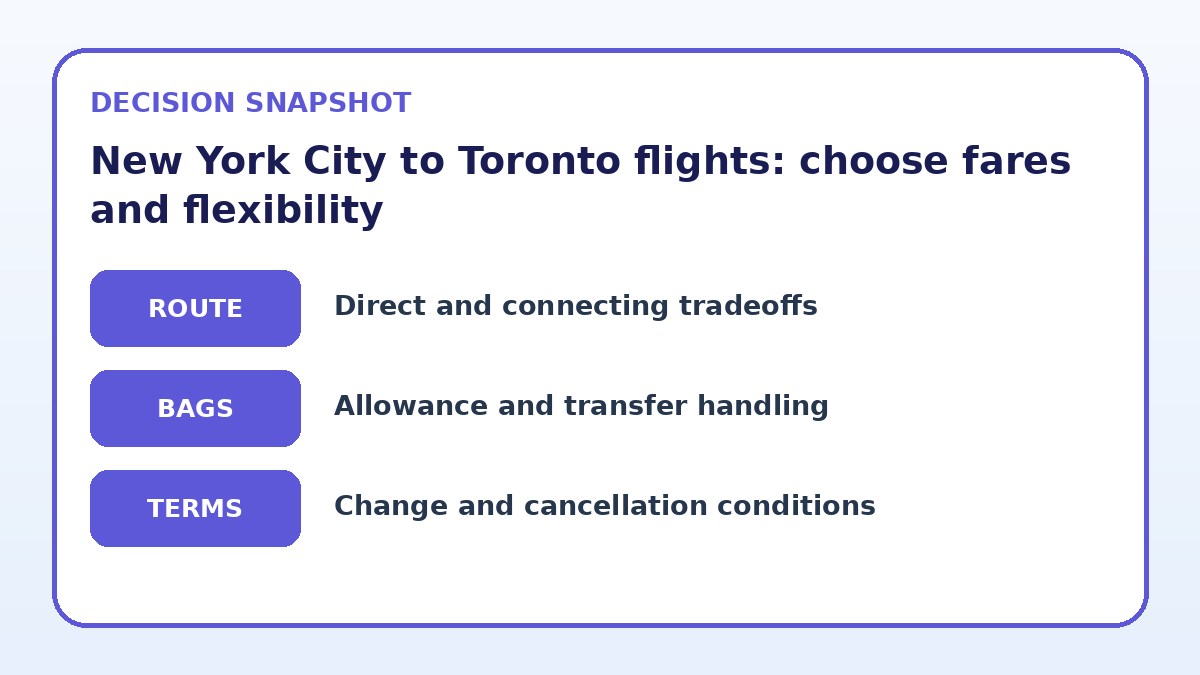
Routing: direct versus connecting options
When planning New York City to Toronto travel, routing is the first decision that affects both schedule reliability and fare. Direct flights (when available) reduce the chance of missed connections and simplify baggage handling — important if you have a tight, single-day meeting. Connecting itineraries can offer lower fares or different airport pairings, but add transfer time and exposure to delays in both origin and connecting cities. For business travelers, weigh how a missed connection would disrupt your day: is there buffer time, or would you miss a critical meeting?
To compare options, list acceptable departure and arrival windows for your meeting day, then check schedules that meet those windows. If multiple airports are viable in New York (e.g., difference in your tolerance for ground travel), include transfer time to and from each airport in your routing decision. When considering connections, note minimum connection times on the provider’s site and whether the itinerary is protected as a single ticket; separate tickets increase baggage and missed-connection risk and usually leave you responsible for rebooking.
Baggage and connection risk: who bears the responsibility?
Baggage rules and liability for missed connections vary by fare and booking structure. On a single-ticket itinerary where all segments are on one reservation, airlines generally accept responsibility for missed connections and will rebook you, though the outcome depends on the carrier’s policy and available space. Separate tickets or mixed-carrier itineraries typically place the risk on the traveler: if a delay on the first leg causes you to miss the second, you may need to pay for a new seat. For business travelers carrying important luggage or presentation equipment, prefer bookings that protect checked items through to final arrival.
Before booking, verify baggage allowances and overlimit fees on the airline’s final booking page, and check whether through-check is available for connecting segments. If you anticipate carrying fragile or high-value equipment, consider shipping it separately or selecting a fare class that includes priority handling. Also review any published minimum connection times and whether the carrier offers rebooking provisions for missed connections; when in doubt, call the airline’s customer service with your specific itinerary and ask how they would handle a delayed inbound leg.
Compare flight-selection strategies
| Flight strategy | Best for | Risk to check |
|---|---|---|
| Buy a refundable business fare | Travelers needing maximum flexibility and simple refunds | Higher upfront cost but minimal rebooking hassle and straightforward refunds |
| Choose a change-permitted nonrefundable fare | Those who expect possible changes but can accept fees or fare differences | Lower base price than refundable fares, but changes may incur fees and fare gap charges |
| Purchase the lowest basic economy fare | Fixed schedules and strict budget constraints where flexibility is unnecessary | Lowest upfront price with limited or no changes, possible baggage restrictions and high rebooking cost |
| Book a connecting itinerary on separate tickets | Travelers prioritizing cost-savings and willing to accept self-managed connections | Potentially cheaper but increases risk for missed connections and separate baggage handling |
Recheck the complete itinerary
Confirm airports, connection handling, baggage, and change conditions before deciding.
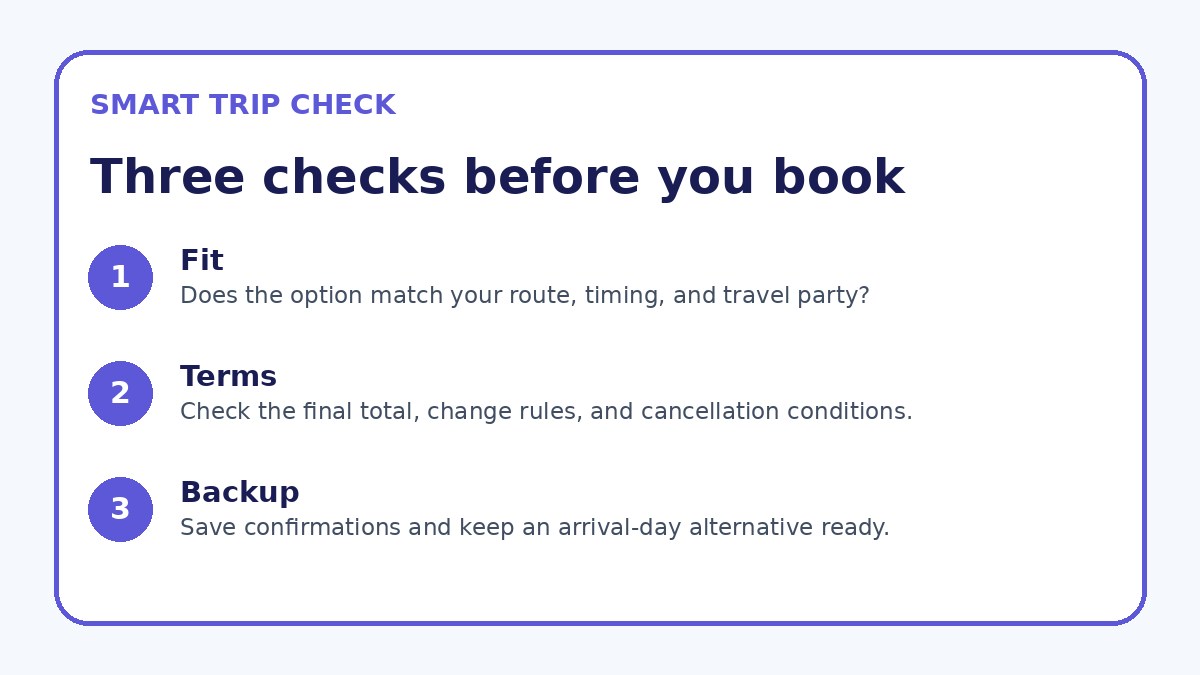
Schedule fit: matching flight times to meeting needs
Business travel is about timing: choose flights that align with your meeting schedule while allowing a realistic buffer for delays, immigration, and ground transfer. Early arrivals let you prepare and reduce stress, but may require a red-eye or early-morning departure that affects your prior night and productivity. Late returns might be acceptable if your schedule allows remote work afterward. When comparing itineraries, consider local traffic patterns and peak immigration times at Toronto’s arrival airport, and factor in travel time from the airport to your meeting location.
If your meeting time is immovable, build in a contingency window based on the routing risk. For example, aim to arrive with several hours between landing and the meeting if connections or ground transfers are involved. Conversely, if you have flexibility, look for slightly later or cheaper flights that include soft change options. Use your company’s travel policy and any internal rebooking procedures as a baseline: some employers prefer refundable fares or allow day-of changes only with specific fare codes, so verify policy alignment before purchase.
Flight details to verify
- Gather exact traveler names as on passports, passport numbers, and preferred loyalty program numbers before checking fares.
- Set firm departure and arrival time windows tied to your meeting schedule to filter direct and connecting options.
- On the airline booking page, expand fare rules and copy or screenshot change, cancellation, and refund clauses for your records.
- Confirm whether your corporate travel policy requires refundable fares or specific fare codes before finalizing payment.
- Check baggage allowances and whether checked items will be through-checked on connecting itineraries in one reservation.
- If using a third-party site like Trip.com, verify the final fare conditions on the airline’s booking page before accepting any ticket.
Fare conditions: change fees, refunds, and waivers
Fare rules — not just the headline price — determine your true cost exposure. Many lower fare classes restrict changes or issue travel credits instead of refunds; higher fare classes usually allow free or low-cost changes and full refunds. Always read the airline’s published fare conditions on the booking page before purchase: note whether changes incur a monetary fee, whether you must pay any fare difference, and how refunds are processed (cash, card reversal, or voucher). Pay attention to time limits for cancellations and how name corrections are handled.
Also confirm whether the airline or booking channel lists exceptional waivers for events (strikes, severe weather) and how those waivers are applied. If you book through a corporate portal or travel management company, verify how their fees and policies interact with the carrier’s rules. Trip.com can be used as one place to compare current availability and conditions, but always verify the final terms on the airline’s booking page — that final page is where the binding fare rules and any ancillary fees will be displayed.
Flight Guide questions travelers ask
Should I prioritize refundable tickets for short business trips to Toronto?
Refundable tickets give the cleanest path for changes and reimbursements, reducing time spent on calls or corporate approvals. If your meetings often move or you expect cancellations, refundable fares can be worth the extra cost because they eliminate the need to pay change fees or chase credit vouchers. If your schedule is stable and your employer limits refundable bookings, a change-permitted nonrefundable fare with a modest fee could be a middle ground. Always check what your company travel policy reimburses and factor administrative time into your decision.
How do I evaluate connection risk when comparing itineraries?
Start by determining whether the itinerary is a single ticket covering all segments; that typically offers protection if an inbound delay causes a missed connection. Check minimum connection times and realistic transfer durations, including immigration and customs when applicable. For separate tickets, assume you are responsible for rebooking if you miss the onward flight. Consider time of day — morning flights often recover from delays better — and have backup options listed by time and price before you travel so you can act quickly if rebooking is needed.
What exactly should I verify on the airline’s final booking page?
On the final booking page, expand the fare rules and read change, cancellation, and refund sections verbatim: note any listed change fees, whether a fare difference applies, and the form of refund (card refund or travel credit). Confirm baggage allowance, carry-on rules, seat assignment policies, and whether through-check of luggage is included for connections. If your company requires specific fare classes or invoice details, verify those fields are present. Save or screenshot the final terms and the booking confirmation for future reference.
Final decision note
For New York City to Toronto business travel, the right ticket balances routing convenience, baggage and connection protection, and fare conditions that match your likely changes. Start decisions by fixing your meeting window and traveler details, then compare direct versus connecting options for schedule fit and transfer risk. Read fare rules on the carrier’s final booking page — not just summary lines — to confirm change fees, refund options, and baggage policies. If your meetings are unpredictable, favor refundable or change-permitted fares; if they are fixed, a lower-fare class may be acceptable but prepare contingency plans. Keep documentation of the fare rules and confirmation so rebooking or refunds proceed quickly when plans shift.
Continue planning
Check current options and final conditions
Use the provider page to confirm live availability, the final total, cancellation terms, and every condition that matters to your trip.
This evergreen planning guide was created with AI-assisted drafting and a structured quality review. It does not display live prices, schedules, availability, visa guidance, or provider rankings. Verify current details before booking. Some links are affiliate links; we may earn a commission at no additional cost to you.