For a business traveler choosing New York City to Los Angeles flights, the core tradeoff is route versus fare flexibility: direct schedules and convenient airports often cost more but reduce connection and baggage risk, while lower fares frequently come with stricter change and cancellation terms. Before you book, decide whether time certainty (fewer connections, reliable departure times) or price flexibility (lower base fare with paid changes) matters most for this trip. This guide gives the practical answer up front: if your meetings are time-sensitive, prioritize refundable or flexible-change fares and direct routings where available; if your schedule is firm and you can commit dates, a lower restricted fare may be acceptable after checking exact penalty rules. Read on to compare routing, baggage and connection risk, schedule fit, and fare conditions so you can prepare exact dates and traveler details before checking live options.

See live routes for your exact travel day
Compare direct and connecting choices with the same baggage and traveler details.

Routing: direct versus connecting and where you land
When comparing New York City to Los Angeles flights, routing is the first practical decision. Nonstop flights between the metro areas minimize risk of missed connections and are usually the fastest option door-to-door; however, nonstop options may depart from multiple New York airports and arrive at different Los Angeles airports. Before booking, decide which departure and arrival airports work best for ground transfers and meeting locations so you can weigh slightly higher fares for a single nonstop against potential hotel or ride costs tied to an alternate airport.
Also confirm whether an itinerary is marketed as nonstop or requires a change of aircraft en route; some schedules show a single flight number with a technical stop. On the airline’s final booking page verify transfer requirements, minimum connection times if a connection is included, and whether you’ll need to recheck baggage during a connection. These facts affect both schedule reliability and the fare conditions you should expect for changes or cancellations.
Baggage and connection risk: how rules affect your meeting day
For business travel, late or lost baggage can derail a productive day. Flexible fares sometimes include checked bags and priority handling; lower fares may exclude checked baggage and treat connections as separate segments with different baggage transfer responsibilities. When evaluating options, check the fare’s baggage allowance and whether through-checked baggage is included on connecting itineraries. If you're using separate tickets, assume baggage may not transfer automatically unless the airline explicitly confirms otherwise on the booking page.
Connection risk also ties directly to the change and cancellation calculus. Tight connections increase the odds you’ll need to change flights; examine alternative rebooking options offered by the carrier for missed connections due to delays. Confirm whether the airline allows the same-day standby, provides guaranteed rebookings for their delays, or requires a change fee plus fare difference. These operational policies are frequently updated—verify them on the airline’s official site or your corporate travel tool before purchase.
Compare flight-selection strategies
| Flight strategy | Best for | Risk to check |
|---|---|---|
| Book a nonstop flexible/refundable fare | Travelers with critical meeting timetables who need minimal disruption risk. | Higher upfront cost for reduced rebooking stress and simpler baggage handling. |
| Book a nonstop restrictive (basic) fare | Travelers with firm schedules and low probability of needing changes. | Lower price but limited or costly change/cancellation options and fewer inclusions. |
| Book a connecting itinerary to save on fare | Cost-conscious travelers willing to accept connection time and higher delay risk. | Lower ticket cost can mean higher chance of missed meetings and baggage transfer issues. |
| Buy a low-fare ticket plus separate flexible protection | Travelers who want to balance low base fares with 3rd-party flexibility or insurance. | Added complexity—verify coverage scope and that protections work with your specific flight rules. |
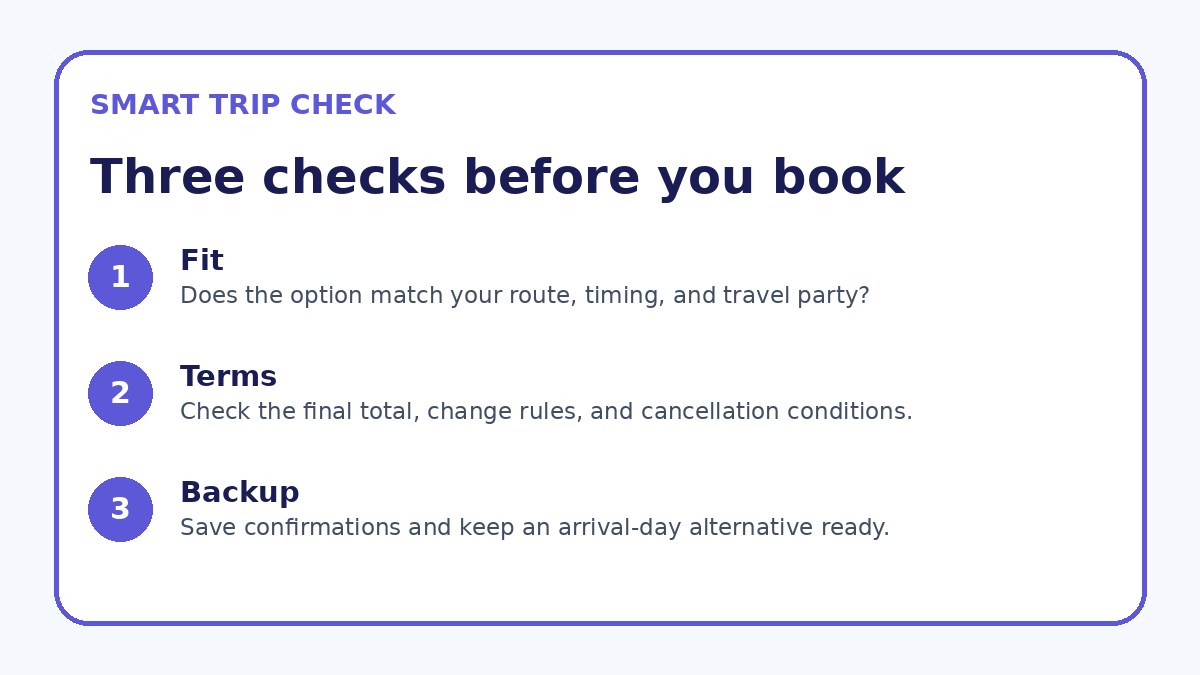
Recheck the complete itinerary
Confirm airports, connection handling, baggage, and change conditions before deciding.
Schedule fit: timing, flexibility windows, and buffers
Business trips require a schedule that accommodates meetings, commute time to airports, and contingency for delays. When choosing flights, map door-to-door travel time for each option and prefer itineraries with buffers around critical meetings. If your return flight is the day after a late meeting, avoid red-eye arrivals into airports with limited ground transport early morning. Flexible fares let you rebook without large penalties when meetings run long; restricted fares require pre-planned buffers because changes can be costly or limited.
Also consider corporate policies and credit card protections that might provide limited flexibility benefits; some corporate tickets include waived change fees or additional support. When comparing options, prepare the exact traveler details—frequent flyer number, corporate discount code, and preferred payment card—so you can test how carrier waivers or elite status affect rebooking rights during the live booking process. Always check the carrier’s specific language about same-day changes and intra-airline rebook priorities on the final booking page.
Flight details to verify
- Confirm your exact travel dates, full traveler name as on ID, and any corporate or frequent-flyer numbers before price-checking fares.
- Open the fare rules on the carrier’s final booking page and note change fees, refund policy, and how refunds or credits are issued.
- Compare nonstop and connecting options including arrival/departure airports and minimum connection times for each itinerary.
- Verify baggage allowance and whether checked bags are included and through-checked on connecting itineraries.
- If using a reseller, check the reseller’s change/cancellation terms in addition to the airline’s rules and save screenshots of both.
- Decide in advance whether you need refundable or change-friendly tickets and set a maximum acceptable penalty cost to guide booking.
Fare conditions: what to verify on the booking page
Fare rules determine your practical options if plans change. Before you click buy, open the fare rules on the booking page and check these items: change fee amount, whether fare difference applies, refundability, deadline for free name corrections or cancellations, and whether credits expire. Many airlines have multiple change policies depending on booking class, route, and whether the ticket was bought with a corporate rate, so don’t rely on generic statements—read the specific rule tied to the fare you’re selecting.
Also verify how refunds are processed (original form of payment or travel credit), whether service or administrative fees apply for changes, and how long credits remain valid. If you use a third-party agent or aggregator—Trip.com can be used to compare live availability—confirm whether the reseller imposes its own change or cancellation terms in addition to the airline’s. Save screenshots of the fare conditions and a copy of the final receipt; they’re useful if you need to dispute a charge or request an exception.
Flight Guide questions travelers ask
How do I quickly compare change fees across different fare classes for the NYC–LAX route?
To compare change fees efficiently, pull identical itineraries for each fare class and open the detailed fare rule or fare conditions link on the booking page; that rule text lists change fees, whether a fare difference applies, and refundability. Repeat the same check on the airline’s official site even if you started on an aggregator—carriers sometimes show the most authoritative fare rules there. Record the effective total cost of a hypothetical rebooking (current ticket price plus change fee plus projected fare difference) to make apples-to-apples comparisons.
If I buy the cheapest fare and later need to change my flight, what should I expect?
With the least expensive fares expect strict limitations: a change fee, requirement to pay any fare difference, or only receiving credit instead of a refund. Some low fares are nonrefundable and allow only reissue in the form of travel credit with an expiration date. Before booking, verify whether the airline offers a discounted flexible-upgrade at purchase, if your corporate policy waives fees, or if travel insurance or a third-party protection plan will cover change costs; ensure any protection explicitly covers the ticket’s fare class.
Can I rely on same-day standby or rebooking if my outbound flight from New York is delayed and I miss a connection to Los Angeles?
Policies vary by carrier: some airlines prioritize rebooking for their own delays and may offer same-day rebooking or standby without additional fees, while others treat rebookings per the fare rule (change fees and fare differences). If you booked separate carriers on a single itinerary, your protection is weaker and you may be treated as a no-show. For crucial connections, verify the airline’s promise for missed connections due to delays and whether they will rebook you onto the next flight without penalty—confirm the specific language on their operational or contract of carriage pages.
Final decision note
Selecting New York City to Los Angeles flights as a business traveler is a balance between schedule certainty and fare flexibility. Start by mapping exact dates, airports, and ground-transfer times, then read the fare rules tied to the exact itinerary you plan to buy: change fees, refund handling, baggage inclusion, and reissue limitations all determine how usable a ticket is when plans shift. Prioritize nonstop flexible fares when time is mission-critical; consider lower fares plus purchased protections when cost control is your priority. Before finalizing any purchase, verify rules on the carrier’s booking page (and reseller terms if applicable), save the fare rule text, and keep traveler details handy so rebooking is quick if you need it.
Continue planning
Check current options and final conditions
Use the provider page to confirm live availability, the final total, cancellation terms, and every condition that matters to your trip.
This evergreen planning guide was created with AI-assisted drafting and a structured quality review. It does not display live prices, schedules, availability, visa guidance, or provider rankings. Verify current details before booking. Some links are affiliate links; we may earn a commission at no additional cost to you.