If you're flying from New York City to Los Angeles for the first time, the practical move is to assemble a short, precise pre-booking checklist before opening any airline or travel site. The top tradeoff you’ll face is route versus fare: nonstops save time but may cost more or have stricter baggage and change rules; connecting flights can lower fares but add missed-connection risk and longer total travel time. This article gives you a compact, step-by-step way to prepare exact dates, traveler details, and priorities so you can compare live options efficiently. Gather your travel window, preferred airports in both cities, the number of travelers, and any special needs first. Use those fixed inputs to test different routing and fare conditions on booking pages and verify baggage allowances, change/cancellation policies, and connection minimums before you pay.

See live routes for your exact travel day
Compare direct and connecting choices with the same baggage and traveler details.
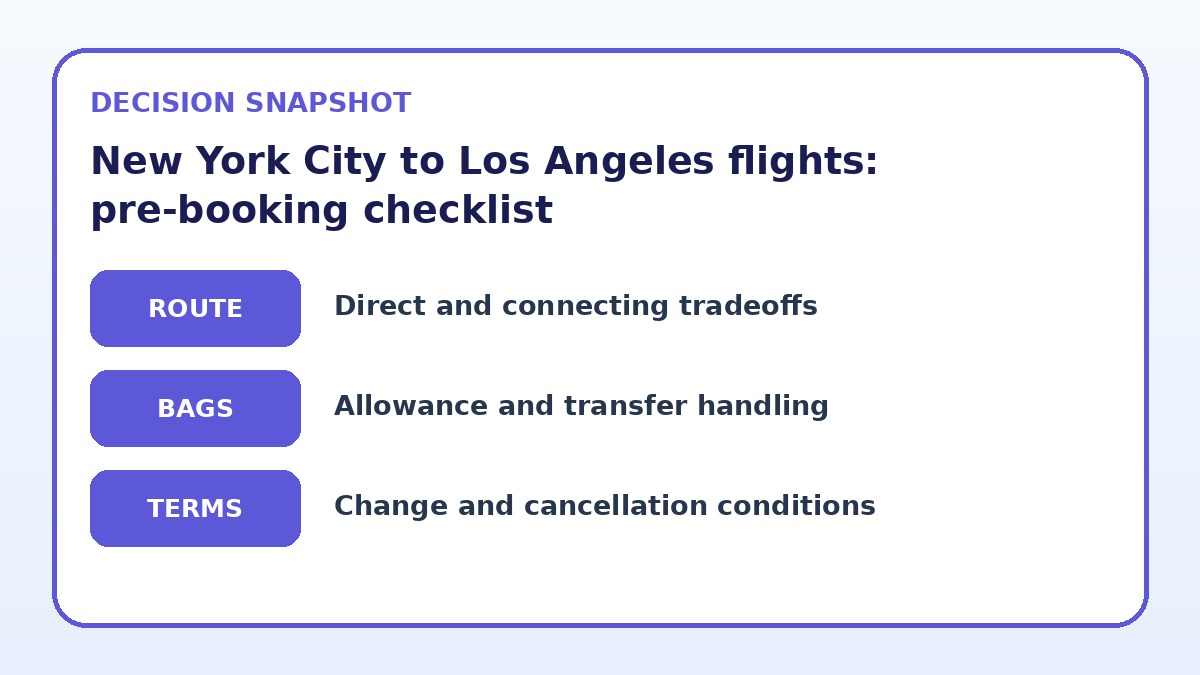
Routing: choosing between nonstop and connecting options
Start by listing the airports you can realistically use in New York City (for example, the ones you can reach in a given time) and the Los Angeles-area airports you’ll accept. Nonstop flights are usually faster and reduce the likelihood of missed connections or baggage mishandling, but they can come with less flexible fare rules. When you compare itineraries, put total travel time, number of connections, and minimum connection times into a single view so you don't choose a flight that looks cheap on paper but eats up hours in an unfamiliar airport.
To compare direct and connecting options objectively, run searches twice: once filtered for nonstop only, and once including one- or two-stop itineraries. Note that some multi-leg itineraries combine carriers and have different baggage and change rules for each segment; if that’s the case, check the operating carrier for every leg on the airline’s official booking page. Write down the transfer airports and minimum connection windows to decide whether the savings are worth added risk and travel time.
Baggage and connection risk: what to verify before buying
Before you commit, verify baggage allowances for both carry-on and checked luggage on the airline’s final booking page and in the fare conditions document. Low-fare economy tickets often restrict carry-ons or charge for the first checked bag; these fees and size limits change by carrier and by fare bucket. If you plan to check bags when connecting on separate tickets, assume you’ll need to collect and recheck luggage—confirm this with the airlines involved and build extra time for transfer.
For connections, map the arrival and departure terminals and whether the transfer requires security re-screening or an inter-terminal shuttle. If an itinerary mixes carriers, ask whether the reservation is protected by a single ticket or an independent segment—only a single-ticket booking usually gives airline protection for missed connections. If you see separate confirmation numbers for each leg, plan for gate-to-gate risk and give yourself cushion time between flights.
Compare flight-selection strategies
| Flight strategy | Best for | Risk to check |
|---|---|---|
| Nonstop premium fares | Travelers prioritizing speed, minimal connection risk, and simpler baggage handling. | Higher upfront cost and possibly stricter fare rules or fewer included extras. |
| Nonstop basic/discount fares | Solo travelers who accept carry-on only and want the shortest travel time for less money. | Reduced flexibility, possible carry-on or seat selection restrictions, and add-on fees for bags. |
| Connecting flights on a single ticket | Travelers seeking lower fares with airline protection for missed connections. | Longer total travel time and potential for tight layovers depending on routing. |
| Separate tickets or mixed carriers | Price-conscious travelers willing to manage transfers and assume baggage/connection risk. | No airline protection for missed connections; you must allow significant transfer time and recheck luggage. |
Recheck the complete itinerary
Confirm airports, connection handling, baggage, and change conditions before deciding.
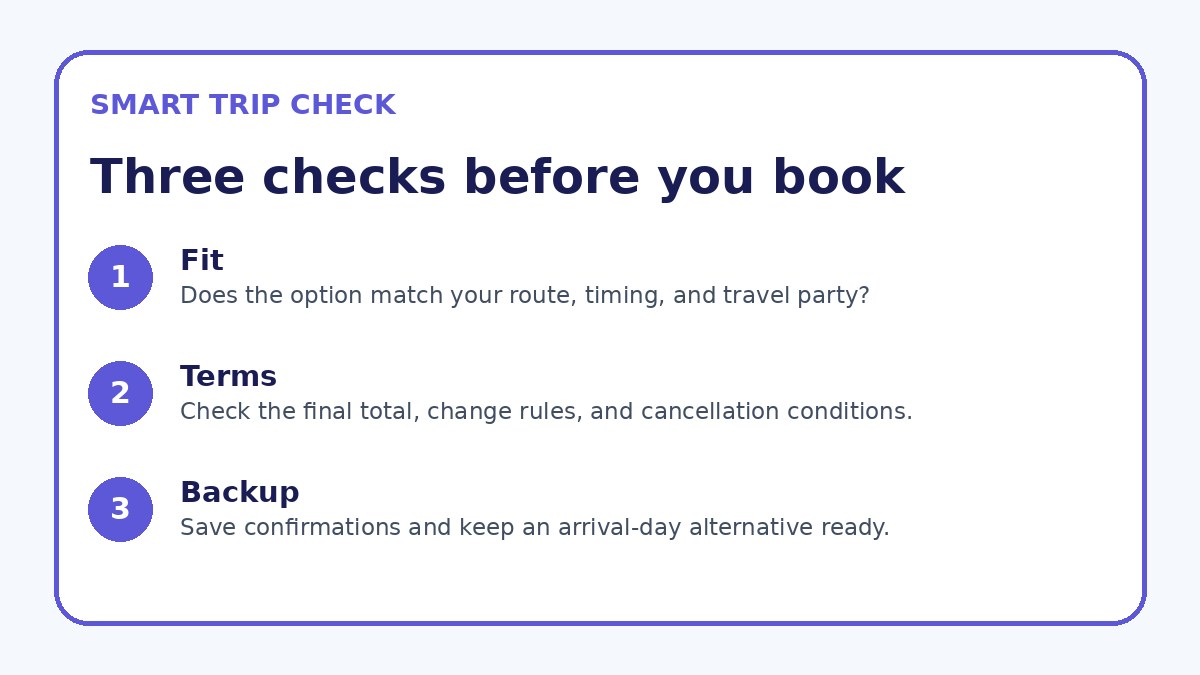
Schedule fit: matching flight times to your plan
Think beyond flight duration and focus on when you need to arrive in Los Angeles. Consider local traffic, check-in times, and how jet lag or late arrivals will affect your first day. Early-morning departures from New York may require waking much earlier and dealing with rush-hour travel to the airport; evening arrivals in Los Angeles mean more time lost to local transit or rideshare waits. Create a timeline from your home or hotel in New York to your final Los Angeles destination and test different flight arrival scenarios to find the most practical schedule.
Also factor in domestic time zone changes and how they intersect with planned activities. If you must attend an event or meeting on arrival day, prioritize arrival windows that provide at least two to three hours buffer after scheduled touchdown. When comparing itineraries, write down exact gate arrival times and add anticipated immigration/customs or ground-transport time if you need to connect onward from the Los Angeles airport.
Flight details to verify
- Choose exact outbound and return dates and record full traveler details (full names, birthdates for children, and any loyalty numbers) before searching fares.
- Select acceptable origin and destination airports, then note ground travel time to each airport for realistic door-to-door comparisons.
- Search for nonstop and for one-stop itineraries; write down total travel time, layover airports, and terminal transfer requirements for each option.
- Open the airline’s fare rules from the booking page and copy change, cancellation, refund, and baggage allowance text into your notes for direct comparison.
- If booking connecting flights, confirm whether both segments are on one ticket; if not, plan extra transfer time and assume baggage must be reclaimed and rechecked.
- Before final payment, verify seat selection, carry-on size limits, checked luggage rules, and any required traveler ID (e.g., REAL ID) on the airline’s official checkout page.
Fare conditions: what the fine print actually covers
When you find a candidate fare, click through to the full fare rules before you finalize the booking. Look for explicit language about change fees, refunds, advance seat selection, and whether the fare includes a checked bag. Discount fares may appear cheaper but impose penalties or nonrefundable policies that make later changes expensive. If flexibility matters—because your dates might shift or you may add a traveler—look for fares labeled as flexible or that allow free changes; then verify the exact procedure and any fees on the airline’s own page.
Also check how the carrier handles involuntary schedule changes and cancellations. The airline’s contract of carriage will explain rebooking options and whether you can get a voucher or refund. If you're comparing options across platforms, verify final price, seat availability, and baggage rules on the airline’s booking page before you provide payment. Trip.com is one place to compare live availability, but always confirm policies on the airline’s official page before purchase.
Flight Guide questions travelers ask
Should I always pick a nonstop flight between New York City and Los Angeles?
Not always. Nonstops reduce the risk of missed connections and often save hours, which is valuable for short trips or tight schedules. But nonstop fares can be more expensive and sometimes come with less flexible change rules. If your priority is budget and you can accept longer travel time, a connection could be appealing—especially on a single-ticket itinerary that provides protection for missed connections. Evaluate the time value you place on convenience versus the potential savings, and verify baggage and change policies before booking.
How much connection time should I allow when booking a one-stop itinerary?
Allow at least the minimum connection time listed by the booking platform as a baseline, but add extra cushion for checked bags, terminal transfers, security re-screening, or delays. If the transfer requires moving between terminals or reclaiming luggage, plan substantially more time. When in doubt, prefer longer layovers that give you breathing room; check whether both legs are on the same ticket—single-ticket itineraries usually give you protection and a clearer rebooking path if the first flight is delayed.
What exact baggage details must I verify before purchase?
Check three things on the airline’s official booking or policy pages: what’s allowed free for carry-on and checked bags (size and weight limits), the fees for the first and subsequent checked bags, and whether your fare permits complimentary carry-on or seat selection. If your trip includes connections on different carriers, confirm which carrier’s baggage rules apply to each segment and whether you must reclaim and recheck luggage. Copy the relevant fare rule lines or take screenshots so you have the information available if a dispute arises.
Final decision note
Planning New York City to Los Angeles flights efficiently means doing a few precise tasks before you search: lock in dates and traveler names, choose which airports you’ll accept, and decide whether you value time or cost more. Use those inputs to run parallel searches for nonstop versus connecting options, then verify fare rules, baggage allowances, and connection protections directly on the carrier’s booking page. Keep a short written comparison of total travel time, layovers, baggage policy, and change fees for each contender. With that checklist in hand, you’ll avoid common surprises at checkout and make a booking that matches your priorities and practical needs.
Continue planning
Check current options and final conditions
Use the provider page to confirm live availability, the final total, cancellation terms, and every condition that matters to your trip.
This evergreen planning guide was created with AI-assisted drafting and a structured quality review. It does not display live prices, schedules, availability, visa guidance, or provider rankings. Verify current details before booking. Some links are affiliate links; we may earn a commission at no additional cost to you.