If you and your partner want freedom to change plans, prioritize tickets that allow date or passenger-name changes with minimal penalties. For many couples traveling from Mexico City to Puebla, the central trade is between lower-cost, restrictive tickets and more flexible fares that cost more but save stress when plans shift. Begin by deciding how likely you are to change travel days, travel times, or traveler names (important if one person might join later). Look at three things on any booking page: change fees and whether taxes are refunded, whether you can change the travel date without rebooking, and how seat selection or coach class changes are handled. These rules are what matter most for couples—especially when coordinating arrival times, side trips, or work commitments. Below I compare common flexibility features, explain the tradeoffs, and give a clear checklist so you can pick the right ticket for your relationship and schedule style.
See current options before you compare the details
Availability and final conditions change. Open Trip.com now or keep reading for the practical comparison.
Types of tickets and what flexibility really means
Ticket rules vary by provider, but flexibility usually refers to three distinct rights: date/time changes, traveler-name changes, and refunds. Date or time changes let you move your outbound or return without buying a new ticket; provider pages will specify whether changes are allowed free, for a fee, or not at all. Name changes are less common — some operators allow transferring a ticket to another person for a fee, while others treat tickets as non-transferable. Refunds are a separate issue: fully refundable tickets return the fare (sometimes minus a handling charge), while non-refundable fares offer no cash back but may provide a voucher.
For couples, the practical impact is this: if you expect any chance of rescheduling, a ticket that permits free or cheap date changes is worth considering. If both partners can travel only on fixed dates, a non-flexible fare saves money. Always look beyond the headline label like “flexible” or “basic” and read the specific change and refund terms on the provider’s booking page. Verify whether policies apply per passenger or per booking, because a single passenger change fee can double your cost for two people.
When to favor flexibility: common couple scenarios
Choose flexible or semi-flexible tickets when one partner’s work schedule is uncertain, when you plan to combine this trip with additional stops, or when weather and events could force a date shift. If you’re traveling for a special occasion that can’t move, flexible tickets reduce the stress of last-minute changes and often let you change only the person traveling if plans diverge. Couples who value spontaneity—arriving a day later to extend a weekend, or returning earlier to meet obligations—should weigh the cost of flexibility against the likelihood of making changes.
If both partners are locked into specific dates—tour bookings, a fixed event, or limited vacation time—the potential savings of a non-flexible fare may be worth accepting the risk. Also consider the directionality of risk: sometimes it’s enough for just one ticket to be flexible (for the partner with uncertain plans) while the other buys the cheaper fixed fare. That hybrid approach combines savings with a safety net, but requires careful coordination since providers may still require both passengers be on the same train or bus for assigned seats.
| Approach | Best for | Tradeoff to check |
|---|---|---|
| Fully flexible fares | Couples with uncertain schedules who value stress-free changes | Higher upfront cost but low fees for date, time, or passenger changes |
| Semi-flexible fares | Couples likely to make small adjustments (one date change or a swap) | Moderate price with limited free changes and restricted refundability |
| Non-flexible budget fares | Couples with fixed, confirmed travel dates seeking lowest base fare | Lowest price but costly or impossible to change without new booking |
| Mixed approach (one flexible, one basic) | Pairs where only one partner has uncertain plans | Balances cost and protection but requires managing two different tickets |
Ready to check the option that fits your plan?
Use your exact dates and traveler details so the provider page can show the current total and conditions.
How to compare flexibility across booking options
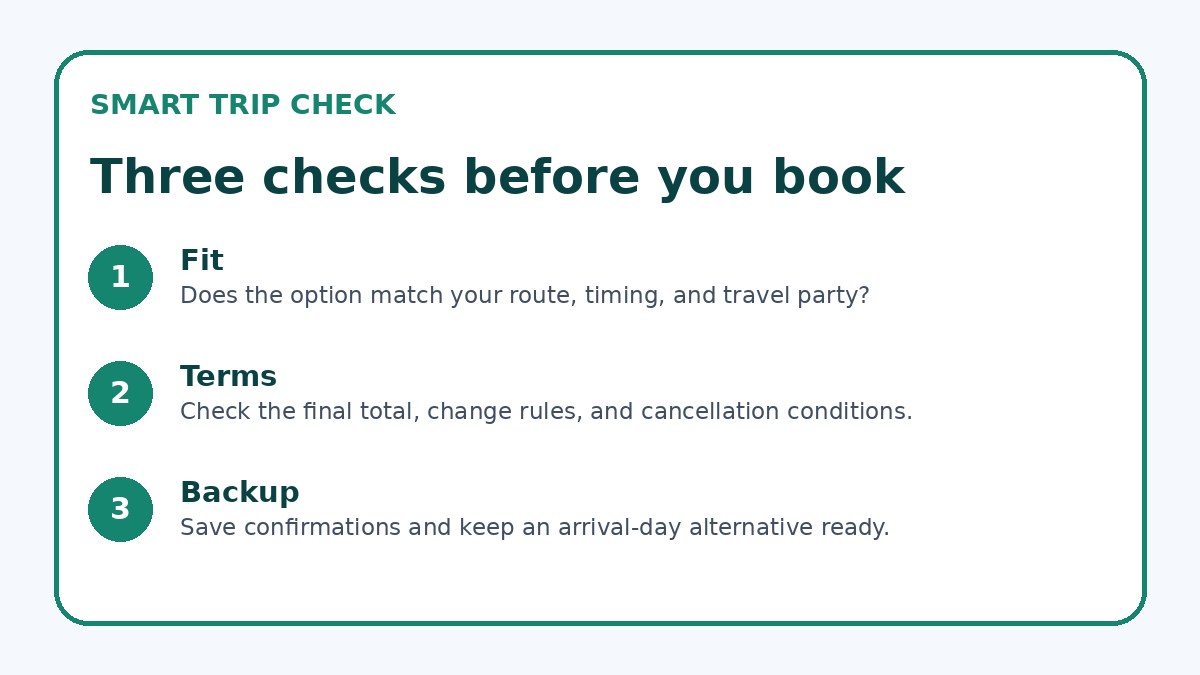
First, set your decision criteria: change fees (amount and timing), refundability, name-change policy, and seat-selection rules. On each booking page, find the fare rules or terms and check the fine print for specific windows (e.g., free changes up to 24 hours before departure) and whether fees are per person. If connecting options exist, compare whether changes apply to the entire itinerary or each leg separately—multiple legs usually mean multiple change fees. When terms are unclear, use customer service chat or phone to confirm in writing, and save screenshots of the final booking terms.
Next, compare total cost scenarios, not just base fare. Calculate the fare plus potential change fees you might face if you expect one change or two. Factor in convenience: a slightly higher fare that allows simple online changes may be preferable to a lower fare that forces you to cancel and rebook via an agent. If you find multiple providers, including intercity buses, trains, or private shuttles, compare their flexibility features side-by-side. Trip.com can be used once to compare live availability and terms, but always verify the final rules on the provider’s official booking page before paying.
Before you book
- Confirm whether changes are allowed online or require a phone/station visit and note the applicable contact method.
- Check if fees are charged per passenger or per booking and calculate worst-case rebooking costs for both travelers.
- Verify whether refunds are returned as cash, card reversal, or travel voucher and the timeframe for processing.
- If seat selection matters, confirm whether your chosen fare includes adjacent seats or if seat assignment is first-come.
- Save screenshots of the fare rules and final booking page showing change/refund policies immediately after purchase.
- Compare at least two providers and verify their final terms on the provider’s official booking page before payment.
Practical booking tips for couples traveling Mexico City to Puebla
Book tickets in the lead-up to travel when you have the clearest sense of commitments, but don’t delay if flexibility is required and inventory is limited. When choosing seats, pick seats together or adjacent if the system allows per-passenger selection; some cheaper fares don’t include seat selection and may separate you. If you anticipate splitting the trip (one partner staying longer), check whether the operator allows partial itinerary changes without affecting both passengers. Consider buying travel insurance that covers unforeseen interruptions; read the policy to confirm coverage for your specific reasons for change.
At booking time, save all confirmations and fare-rule screenshots and note the exact contact channel for changes (website form, phone number, or station desk). If a name-change option exists, confirm the allowed documentation and time frame for making the change. For last-minute shifts, check whether the provider has a same-day reissue or standby option and be prepared for limited space. Finally, coordinate with local transport options in Puebla—if you need to arrive at a particular time for a hotel check-in or event, prioritize fares that guarantee an arrival window rather than the absolute cheapest departure.
Frequently asked questions
Can I transfer my ticket to my partner if only one of us can make the trip?
Transferability depends on the operator and fare class. Some providers allow name changes for a fee, while many non-transferable fares require a new ticket for the substitute traveler. Check the fare rules for allowed name changes, the time window for making that change, and required ID or documentation. If the policy is unclear, contact the provider’s customer service and request written confirmation. For couples, buying a fare that explicitly permits name changes is the safest choice when one person’s attendance is uncertain.
If I buy two cheaper tickets, can we swap seats or combine flexibility later?
Buying two separate basic tickets can save money but makes combined flexibility harder. Seat changes and reissues usually apply per ticket, so you can’t easily combine them later without paying separate change fees for each passenger. If you want the option to move one traveler without affecting the other, consider one flexible and one basic ticket or buy a fare that lets you change dates for individual passengers. Always read whether seat assignments can be adjusted after purchase and whether such adjustments incur a fee.
What should we verify on the provider’s final booking page before paying?
On the final booking page, confirm the exact change fees, refund policy, name-change rules, and whether changes apply to single legs or the entire itinerary. Check timing restrictions (for example, free changes up to 24 hours before departure) and whether refunds are partial, full, or voucher-based. Note any applied taxes or service charges that differ from the base fare. If connections are part of your route, verify whether changing one leg forces changes or fees on the others. Save or screenshot this page as proof of terms.
Final planning note
For couples traveling Mexico City to Puebla, the right ticket depends on how likely plans will shift and how much you value simplicity over upfront savings. If either partner has uncertain commitments, lean toward fares that allow date or name changes with clear, modest fees — sometimes a modest extra cost is cheaper than last-minute rebooking. When your dates are firm, low-cost, non-flexible fares make sense, but remember to factor in potential change costs. Always verify the fare rules on the provider’s final booking page, save screenshots, and consider buying complementary travel insurance if your reason for change might be covered. With these checks you and your partner can choose the ticket mix that fits your flexibility needs and travel budget.
Continue planning
Check current options and final conditions
Use the provider page to confirm live availability, the final total, cancellation terms, and every condition that matters to your trip.
This evergreen planning guide was created with AI-assisted drafting and a structured quality review. It does not display live prices, schedules, availability, visa guidance, or provider rankings. Verify current details before booking. Some links are affiliate links; we may earn a commission at no additional cost to you.