
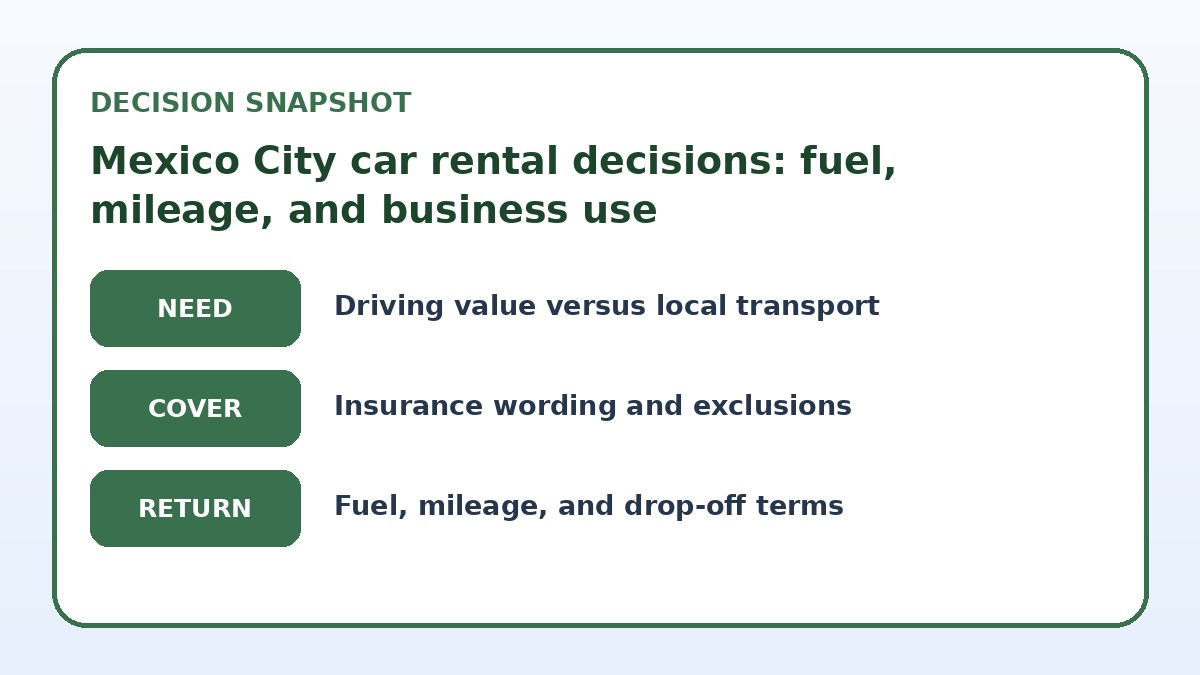
If you’re renting a car in Mexico City for business, the practical first step is to confirm three things before you book: the fuel policy (full-to-full or prepay), how mileage is measured and charged, and whether the rental agreement allows business use and cross-state travel. These details affect your out-of-pocket costs, how you fill and return the vehicle, and whether you need extra insurance or written permission from the rental company. Ask for clear language on the final booking page and on the rental agreement you’ll sign at pickup — that document controls charges like refueling fees, per-kilometer overages, and odometer checks. Finally, keep digital and paper copies of the contract, fuel receipts, and any odometer photos; they’ll make expense reporting and dispute resolution much simpler.
See current options before you compare the details
Availability and final conditions change. Open Trip.com now or keep reading for the practical comparison.
Understand fuel policies and real costs
Rental companies commonly offer a few fuel options: full-to-full, pre-purchase, or return-empty with a refueling charge. Full-to-full means you pick up a tank filled and are expected to return it similarly; this minimizes surprise charges because the company refuels at local pump prices only if you fail to do so. Pre-purchase plans let you buy a tank up front; they can be convenient if you need immediate departure or expect to return empty, but unused fuel is rarely refunded at pump prices. Return-empty options are generally the most expensive because the vendor sets the refueling rate and service fee.
For business travelers, the difference matters because refueling surcharges and administrative fees may not be reimbursable by your employer or might complicate expense documentation. Ask the booking page or agent to show how refuel charges appear on the final invoice and whether the rental company accepts fuel receipts to remove a refueling surcharge. If your itinerary includes remote meetings or long drives beyond Mexico City, a full-to-full policy plus documented fuel receipts gives the cleanest paper trail for corporate expense claims.
Mileage limits, overage charges, and territorial rules
Check whether the rate includes unlimited mileage or a fixed daily/weekly mileage allowance. For intra-city or short regional trips within the Mexico City metropolitan area, mileage limits are rarely a problem. But if you plan drives to Puebla, Toluca, or other states, per-kilometer overage fees can add up quickly. The contract should state the per-kilometer or per-mile charge after the allowance is exceeded; request that figure in writing before you finalize the booking so you can model expected charges against alternative transport options.
Also confirm the permitted territory. Some rental agreements restrict travel across state lines, into neighboring countries, or on specific roads. If your business travel requires crossing state borders or visiting airports or client sites outside the capital, ask whether those trips need prior authorization, additional insurance, or a cross-border permit. Verify these territorial details on the final booking page and on the actual rental agreement you sign at pickup — companies sometimes include regional exceptions or required addenda that aren’t obvious in summary pricing.
| Approach | Best for | Tradeoff to check |
|---|---|---|
| Full-to-full fuel policy | Travelers who want transparent, pump-price refueling and simple expense receipts. | You must refuel before return to avoid high vendor refueling fees and produce receipts. |
| Pre-purchase fuel | Busy itineraries where refueling before return would be impractical. | Likely no refund for unused fuel and less precise cost tracking for expense reports. |
| Unlimited mileage | Regional business trips with long drives or uncertain distances. | May come with higher daily rates; check territorial restrictions that can still apply. |
| Mileage allowance with per-km overage | Short city-only trips where overall distance is predictable. | Risk of significant additional charges if your route or meetings change last-minute. |
Ready to check the option that fits your plan?
Use your exact dates and traveler details so the provider page can show the current total and conditions.

Insurance, liability and business-use clauses
Insurance terms interact with fuel and mileage rules because some coverages are contingent on authorized use and proper refueling. Standard collision damage waivers and liability options vary by provider; corporate policies or corporate cards sometimes include primary or secondary coverage but often exclude commercial use. Before relying on a company card or corporate policy, read the rental agreement’s definition of business use and any exclusions. If the contract prohibits commercial activity or requires a corporate addendum, arrange that paperwork through your company’s travel or legal team.
Additionally, note how insurance claims and disputes over charges are handled. If a rental company disputes odometer readings, fuel level on return, or alleged overages, your evidence — photographs, timestamps, fuel receipts — will be crucial. Get clarity on the company’s inspection procedure at pickup and drop-off and whether you’ll receive a final invoice immediately or by email. For liability or collision incidents, know the local procedures for police reports and incident documentation so you can comply quickly while travelling for work.
Before you book
- Before booking, read the rental agreement’s fuel policy language and note whether it’s full-to-full, prepaid, or return-empty.
- Confirm mileage terms and any per-kilometer charges or territorial restrictions on the provider’s final booking page.
- Request written confirmation that business use is allowed and what documentation (corporate letter, account number) is required.
- At pickup, photograph the odometer reading and fuel gauge and ask the agent to initial or stamp the pick-up inspection sheet.
- Keep all fuel receipts and a copy of the final rental invoice to match against corporate expense forms.
- On return, refuel according to the agreed policy, obtain a stamped receipt, and secure a final invoice showing odometer and fuel adjustments.
Practical steps at pickup and return
At pickup, insist on a walk-around inspection and have the agent note any existing damage, fuel level, and odometer reading on the contract. Photograph the vehicle with timestamps showing the odometer and fuel gauge; take at least two angles and keep copies in your expense files. Confirm the return location and process — for example, whether the company inspects vehicles on-site at any hour or requires a staffed return — and ask how late returns or early returns affect fuel and mileage charges.
On return, refuel at a recognizable pump and keep the receipt, fill to the same level recorded at pickup if you agreed to full-to-full, and collect a final invoice showing odometer and fuel adjustments before leaving the lot. If the rental company bills later, monitor your account and compare charges to your receipts and photos; escalate discrepancies promptly with the company’s documented claims process. These steps make expense reporting straightforward and reduce the chance of unexpected corporate card charges.
Frequently asked questions
Should I prepay for fuel or do full-to-full for a day trip in Mexico City?
For short, predictable day trips within Mexico City, full-to-full is usually better for expense clarity: you refuel at a local pump, keep the receipt, and avoid vendor surcharges. Prepay can be convenient if you can’t refuel before drop-off, but unused pre-purchased fuel is rarely reimbursed at pump prices. Check the rental contract to see how refuel charges appear on the final invoice and confirm that the company accepts receipts to remove any refueling surcharge.
Does unlimited mileage cover travel outside Mexico City to nearby states?
Unlimited mileage covers distance but not necessarily geographic limits. Many rental agreements allow travel across state lines, but some restrict travel to a certain territory or require advance authorization for out-of-state or cross-border trips. Confirm both the mileage policy and the permitted territory in the rental agreement and on the booking confirmation, and ask whether additional insurance, permits, or written authorization are required for the specific states or roads you plan to use.
How can I document fuel and mileage for corporate expense reports?
Take clear photos of the odometer and fuel gauge at pickup and drop-off, save every fuel receipt with date and liters, and request a final itemized invoice showing odometer readings and fuel adjustments. If your company requires mileage logs, note start and end odometer numbers, trip purposes, and destinations. If the rental bills later, compare charges to your receipts and contest discrepancies straight away using the company’s documented dispute process; keeping printed and digital copies speeds resolution.
Final planning note
When renting a car in Mexico City for business, small details in fuel and mileage rules determine both convenience and cost. Prioritize full-to-full when possible for clearer receipts, request written mileage terms if your itinerary goes beyond the capital, and verify business-use acceptance in the rental agreement. At pickup and return, document odometer and fuel levels with photos and keep all receipts; obtain a final invoice that itemizes fuel and mileage. These steps reduce surprises, simplify corporate reimbursements, and give you solid evidence if charges need to be disputed. Double-check the provider’s final booking page and the signed agreement at pickup before you drive away.
Continue planning
Check current options and final conditions
Use the provider page to confirm live availability, the final total, cancellation terms, and every condition that matters to your trip.
This evergreen planning guide was created with AI-assisted drafting and a structured quality review. It does not display live prices, schedules, availability, visa guidance, or provider rankings. Verify current details before booking. Some links are affiliate links; we may earn a commission at no additional cost to you.