Practical answer first: before you book any Melbourne travel deal, add up your full expected trip cost — flights or train fares, airport transfers, daily transport, accommodation extras, and a conservative daily spending estimate — and compare that total with alternative dates, neighborhoods, or a different length of stay. For solo travelers the headline price often misses fees and small per-night or per-transaction charges that matter more when you’re paying alone. This article explains which costs are commonly left off booking pages, how to verify provider details on final checkout pages, and decision criteria to weigh when a deal looks attractive but might not be the best value after you factor in the extras. Follow the checklists and comparison approach to make a confident booking decision for Melbourne.
See current options before you compare the details
Availability and final conditions change. Open Trip.com now or keep reading for the practical comparison.
Tallying the true transport cost
When you see a Melbourne travel deal for a flight or long-distance coach, don’t stop at the advertised fare. Airlines and carriers increasingly separate the base fare from mandatory taxes, luggage fees, seat selection charges, and payment surcharges — and those extras often appear only during the final booking steps. For rail or bus services, there can be premium fares for flexible tickets or reserved seating. As a solo traveller, these per-person add-ons have a direct impact on your final outlay, so always simulate a full booking up to the provider’s checkout screen to capture every compulsory fee and optional add-on you’re likely to want.
Airport transfers and inner-city travel matter just as much as the ticket. Compare official shuttle, taxi, rideshare, and public-transport options from Melbourne’s arrival point to your neighborhood and estimate their cost for the typical times you’ll travel (arrival, night out, airport return). If you plan to rely on daily trams, trains, or regional coaches, check whether a travel card or pass reduces per-journey costs and whether concession rules apply. Finally, factor in time-dependent costs such as late-night rides or extra luggage handling that aren’t obvious in the headline deal.
Adding accommodation extras and neighborhood tradeoffs
Room rates in Melbourne often exclude fees that increase the nightly cost: city taxes, cleaning fees, resort or service charges, and mandatory local tourist levies in some listings. Short-term rentals may add cleaning or key-exchange fees; hotels might tack on tourist or facility fees at checkout. Confirm what is refundable and what appears only when you reach the provider’s confirmation page, because prepay, non-refundable offers can look cheaper until you add cancellation protection or flexible options. As a solo traveller, you may prioritize safety and proximity over absolute savings, so weigh higher nightly rates in a better-connected neighborhood against lower fares in quieter, less central areas that increase your transport costs.
Neighborhood choice affects both time and money. Staying a little farther out can lower nightly rates but increase commuting time and expense; staying central usually saves on transport but can mean paying a premium for smaller rooms. Think beyond distance: check evening lighting, late-night eating options, and proximity to attractions or coworking spaces if you plan remote work. Use reliable maps and public-transport timetables at the provider’s final page to verify how many transfers and how much time a likely journey will take at the times you’ll travel, and include that in your total cost comparison.
| Approach | Best for | Tradeoff to check |
|---|---|---|
| Lowest upfront fare or rate | Travellers prioritizing minimal upfront spend and confident in fixed dates | Often restrictive cancellation terms and extra add-on fees that appear at checkout |
| Flexible fare or refundable booking | Solo travellers needing timetable flexibility or uncertain plans | Higher initial cost but simpler changes and refunds if plans shift |
| Central accommodation with higher nightly rate | Those wanting to save time on transit and enjoy evenings on foot | Less room space or amenities compared with cheaper, outer options |
| Cheaper outer-accommodation plus transport | Budget-focused travellers willing to commute | Saves on lodging but increases daily transport costs and time spent traveling |
Ready to check the option that fits your plan?
Use your exact dates and traveler details so the provider page can show the current total and conditions.
Daily spending, activities and contingency buffers
Estimate a realistic daily budget that includes food, coffee, museum or gallery entries, occasional guided tours, and small local purchases. Melbourne has a wide range of dining and entertainment prices, and a stated cheap neighborhood meal may be offset by fewer free or low-cost activities nearby. For paid attractions, check provider pages for ticket types, booking fees, and required time slots; some attractions have limited entry windows which may force you into pricier options. Budget a contingency buffer for unexpected costs such as longer rides, special dietary needs, or last-minute museum exhibitions.
Solo travellers should also plan for emergency funds and flexibility costs because there’s no shared expense split. Decide whether you prefer the lowest prepaid price with limited flexibility or a slightly higher fare with free changes and a reasonable refund policy. On provider pages verify fuel or service surcharges for car hires, minimum rental periods, and insurance options that affect the total. Finally, convert your expected totals into your home currency using current exchange estimates and include likely card or ATM fees so you’re not surprised when you pay.
Before you book
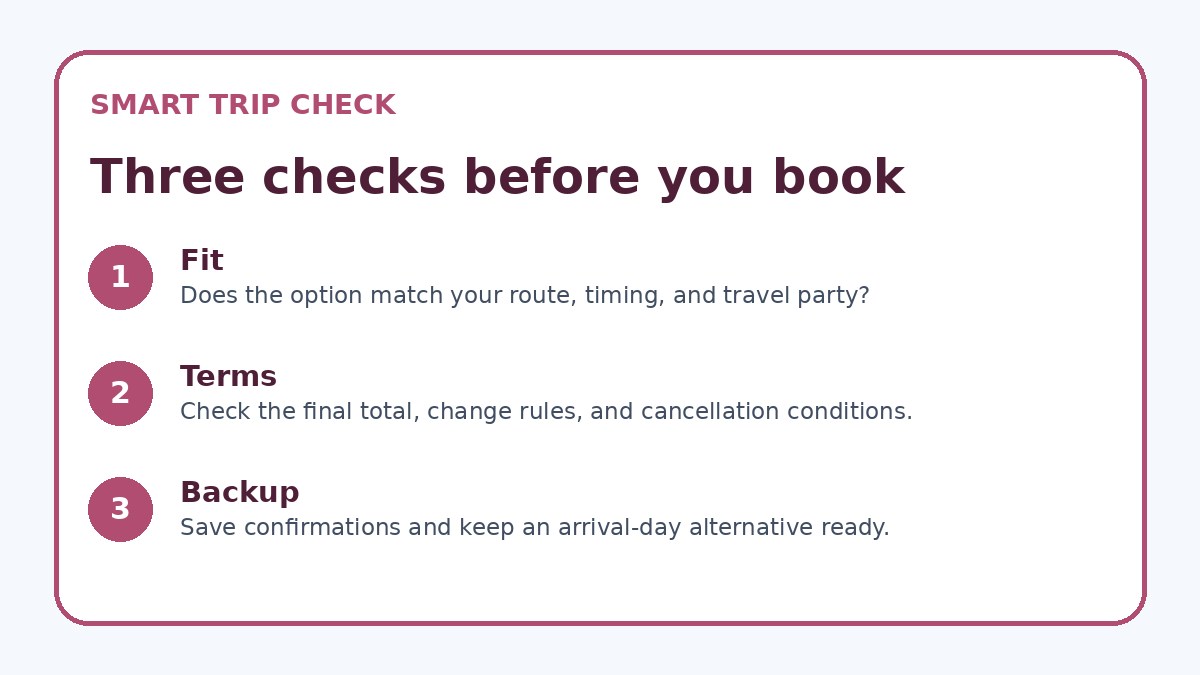
- Simulate a full booking on the provider’s checkout page and note every mandatory fee, optional add-on, and cancellation term before committing.
- Calculate airport-to-accommodation transfer costs for arrival and departure times you expect to travel, including late-night rates.
- Compare neighborhood transport links, average commute times, and evening accessibility instead of choosing only on nightly price.
- Estimate a realistic daily spend for meals, public transport, and attractions, then add a contingency buffer of at least 10–20%.
- Convert totals to your home currency and check your bank or card provider’s foreign transaction and ATM fees.
- Verify baggage, seat selection, and luggage transfer fees for flights or coaches on the final booking page before payment.
How to compare deals and verify the final checkout
Treat each booking as two steps: the headline search step where you shortlist options, and the checkout verification step where you calculate the final total. When you compare deals, create a compact spreadsheet or note listing base fare/room, mandatory taxes/fees, likely transport transfers, nightly extras, and a daily spending estimate. For flights and hotels always proceed to the provider’s own checkout page to confirm the exact taxes, baggage policies, cancellation terms, and any required local taxes. If a third-party site like Trip.com is showing availability, use it to compare options but verify every provider-specific fee and cancellation policy on the provider’s final booking page.
Decision criteria should balance money, time and flexibility. If a cheaper option saves only a small amount but adds long commutes or very restrictive change policies, it may not be worth the hassle. Conversely, if a higher-priced option bundles useful services such as airport transfers, breakfast, or free cancellations, its apparent premium can be better value for a solo traveller seeking convenience. Make your decision using the full-totals you prepared and choose the option that fits your comfort with risk, your schedule, and the amount of time you want to spend getting around Melbourne.
Frequently asked questions
How can a solo traveler quickly check if a Melbourne deal is actually a good value?
Start by creating a totals list: base fare or room rate, taxes and booking fees, transport to and from the airport, and a daily spend estimate for your planned activities. Simulate the full booking on the provider’s checkout page to capture fees that appear only at confirmation. Compare the total cost for your preferred travel dates and for nearby alternative dates or neighborhoods. Finally, weigh non-monetary factors — extra travel time, safety, and flexibility — because a slightly higher total might save time or reduce stress, which is valuable when you’re traveling solo.
What pitfalls should I verify on the provider’s final booking page?
Check the exact cancellation and change policy, mandatory taxes, credit card or payment surcharges, and any required local charges that aren’t visible earlier in the booking flow. For accommodation, look for cleaning fees, city levies, and whether breakfast or Wi‑Fi is actually included. For transport, confirm baggage allowances, seat selection fees, and whether transfers are refundable or chargeable. If something is ambiguous on the checkout page, contact the provider directly and save written confirmation before you pay.
Is it safer to choose flexible tickets or low-cost non-refundable options for Melbourne travel?
That depends on your risk tolerance and how likely your plans are to change. Flexible or refundable tickets cost more upfront but offer reassurance if dates shift, which can be worthwhile for solo travellers without companions to share consequences. Non-refundable bargains may be fine if your plans are firm and you’ve accounted for transfer and daily costs, but remember that changes often incur fees that can erase the initial savings. Review the exact change and refund terms at the provider’s checkout page to compare the real cost of flexibility.
Final planning note
For solo travellers, the best Melbourne travel deal is the one you understand fully — not just the advertised headline price. Take the time to simulate bookings to the checkout stage, add realistic transport and daily spending estimates, and weigh the value of flexibility against small savings. Choose a neighborhood that suits your priorities—time, safety, or cost—and compare a few date and lodging permutations so you can see how small adjustments change the total. Verifying fees, cancellation rules, and the final total on the provider’s booking page avoids unpleasant surprises and helps you book with more confidence for your Melbourne trip.
Continue planning
Check current options and final conditions
Use the provider page to confirm live availability, the final total, cancellation terms, and every condition that matters to your trip.
This evergreen planning guide was created with AI-assisted drafting and a structured quality review. It does not display live prices, schedules, availability, visa guidance, or provider rankings. Verify current details before booking. Some links are affiliate links; we may earn a commission at no additional cost to you.