If you need to book a Melbourne trip for business, set targeted price alerts but pair them with firm decision rules before you click purchase. The practical approach: configure separate alerts for flights, hotels, and airport transfers; pick a confirmation threshold (for example, a percentage drop or a target fare); and lock budget and flexibility constraints—then only act when an alert meets those pre-set criteria. This stops every notification from becoming an impulse buy.
Tradeoffs matter: tighter rules reduce impulse buys but may miss short-lived sales; looser rules catch more chances but push you to decide more often. For business travelers, factor in schedule certainty, preferred times, loyalty program benefits, and corporate travel policies. Below you’ll find step-by-step setup, how to compare alert types, what to verify on provider pages, and a short checklist you can use before hitting book.
See current options before you compare the details
Availability and final conditions change. Open Trip.com now or keep reading for the practical comparison.
How to set practical price alerts for Melbourne travel deals
Start by deciding what matters for your trip: fixed meeting times, departure windows, evening arrivals, loyalty credits, or hotel location. Create at least three alerts—one each for the outbound flight, return flight, and hotel. Use specific filters (exact airport pairs, preferred cabin class, refundable or changeable fares, and hotel room type) so alerts only notify you about options that meet business needs. If your company requires booking through a corporate travel portal, mirror those constraints in the alert rules.
Choose a trigger that reduces impulse behavior: a percentage drop (for instance, 10–15%), a target fare or nightly rate, or a maximum total trip cost that includes likely transfer and baggage fees. Set alert frequency to a digest—daily or hourly depending on lead time—to avoid notification fatigue. For multi-city trips or flexible dates, create separate alerts per segment so you can react to meaningful savings without having to re-evaluate the entire itinerary each time.
Decision rules to prevent impulse booking
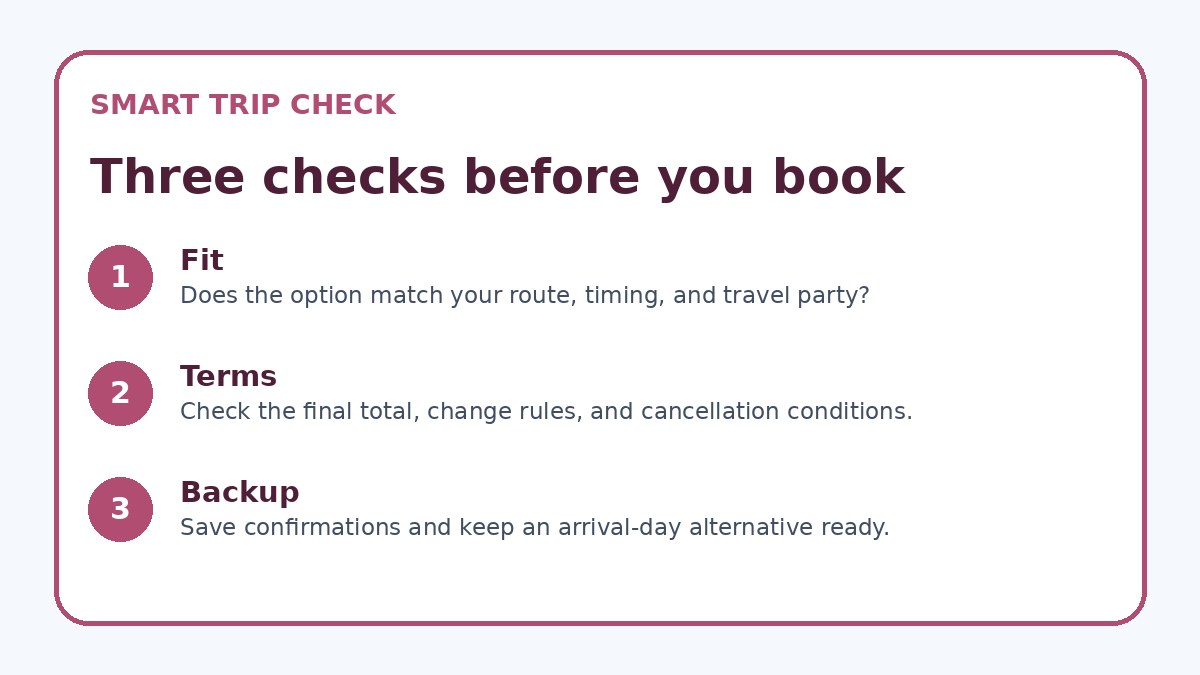
Before you book from any alert, run a quick checklist: does the option fit meeting times and transfer requirements? Are change and cancellation terms acceptable for a business schedule? Does selecting the alert price maintain loyalty program status or corporate policy compliance? If the answer to any of these is no, don’t book that alert just because the price is tempting.
Create a cooling-off rule to reduce snap decisions—wait a set time (for example, two hours or overnight) after an alert before completing a purchase, unless the booking window is closing or you’ll miss the fare. Use a delegated approver if your company has one, or keep a simple written note of why the fare met your criteria. These accountability steps convert impulsive reactions into deliberate choices aligned with travel objectives.
| Approach | Best for | Tradeoff to check |
|---|---|---|
| Strict trigger rules (tight percentage or fixed target price) | Travelers who want to avoid frequent decisions and minimize impulse buys | Misses some short-lived deals; requires patience or wider initial alert ranges |
| Loose trigger rules (broad alerts, frequent notifications) | Flexible schedules and those seeking many opportunities to save | Higher risk of impulsive bookings and more time spent evaluating alerts |
| Source diversity (alerts from airlines, hotels, and aggregators) | Travelers who need full market visibility before committing | More conflicting notifications; requires careful verification on booking pages |
| Policy-aligned alerts (matches corporate travel rules) | Business travelers who must comply with corporate booking policies | Fewer price opportunities; may show higher average fares but reduces approval friction |
Ready to check the option that fits your plan?
Use your exact dates and traveler details so the provider page can show the current total and conditions.
Comparing alert sources and what to verify on booking pages
Alert sources differ: airline and hotel direct alerts, metasearch engines, and travel agencies each show slightly different availability and terms. When an alert arrives, compare the same itinerary across at least two sources (the provider’s site and a reputable aggregator). Verify the fare or rate basis on the provider’s final booking page; that page is the authoritative source for cancellation rules, change fees, baggage allowances, loyalty crediting, and any ancillary charges that affect total trip cost.
Do not assume the alert’s headline price includes all components. Always check what’s excluded—seat selection, checked bags, city taxes, or resort fees—and add them into your decision threshold. If your corporate travel policy mandates refundable fares or specific suppliers, confirm the offer satisfies those rules before booking. If you use Trip.com as a comparison tool, treat it as an additional data point and still verify conditions on the supplier’s final booking page.
Before you book
- Confirm the alerted itinerary matches your meeting times and local transfer windows before booking.
- Open the provider’s final booking page and verify cancellation, change fees, and refund rules explicitly.
- Add likely ancillaries—baggage, seat selection, and airport transfers—to the headline price to assess total cost.
- Check corporate travel policy and loyalty program crediting on the booking page before confirming purchase.
- Apply a cooling-off rule (e.g., wait overnight) unless the fare’s booking window forces immediate action.
- If you must book quickly, document why the alert met your pre-set criteria and save confirmation for compliance.
Timing and flexibility strategies for business trips to Melbourne
Business travel often prioritizes schedule certainty over marginal savings. If your meetings are fixed, prioritize refundable fares or those with minimal change penalties and use alerts to monitor for price improvements that still meet those conditions. For flexible meetings, maintain an alert that targets lower fares and allow a small window for change—this lets you capture savings while keeping a buffer for schedule tweaks.
Consider the cost of flexibility: a cheaper, non-refundable fare can be counterproductive if plans change and you must rebook at higher last-minute rates. Compare the value of a slightly higher flexible fare against the expected probability of itinerary changes, factoring in time lost and corporate reimbursement rules. Use alerts to flag both refundable and non-refundable options so you can compare total risk-adjusted costs rather than bare headline prices.
Frequently asked questions
How far in advance should I set alerts for Melbourne flights and hotels?
For business trips, start alerts as soon as dates are likely, even if tentative—this gives market context and shows price trends. For flights, many professionals monitor fares 6–12 weeks ahead for domestic Oceania routes and longer for international legs, but the ideal lead time depends on your flexibility. For hotels, alerts can be useful from several weeks out, especially near conferences or major local events. Use your pre-defined trigger—if an alert meets it, book if it also meets schedule and corporate constraints.
If an alert shows a lower price on an aggregator than on the supplier site, which should I trust?
Treat the supplier’s final booking page as authoritative for price and terms. Aggregators are useful to discover offers quickly, but availability and fees sometimes differ when you reach checkout. Always open the booking flow on the supplier’s site or the agency’s checkout and verify the exact fare basis, cancellation policy, and included services before accepting. If booking through an agency, confirm their cancellation and dispute resolution terms as well.
How can I avoid missing a genuine short-window deal while preventing impulse buys?
Balance speed with rules: set a shorter cooling-off window for high-confidence alerts—say two hours—only when the deal meets tight criteria (refundable or aligns perfectly with your schedule and policy). For all other alerts, use longer waits and require two checks: a price trigger and a policy/compliance check. If you have a delegated approver, get quick clearance before purchase; if not, keep a simple decision log explaining why the fare met your preset threshold so you can act quickly without later second-guessing.
Final planning note
Price alerts are powerful for business travel to Melbourne when used with deliberate decision rules. The practical routine: segment alerts by trip element, use specific filters, set a clear trigger, and require verification on the final booking page. Balance flexibility and certainty by choosing refundable options when schedule risk is high and by using alerts to monitor improvements otherwise. Most importantly, pair every alert with a cooling-off or approval step so you make defensible, policy-compliant bookings rather than impulse purchases. With those practices you’ll capture meaningful savings without sacrificing reliability.
Continue planning
Check current options and final conditions
Use the provider page to confirm live availability, the final total, cancellation terms, and every condition that matters to your trip.
This evergreen planning guide was created with AI-assisted drafting and a structured quality review. It does not display live prices, schedules, availability, visa guidance, or provider rankings. Verify current details before booking. Some links are affiliate links; we may earn a commission at no additional cost to you.