Practical answer up front: driving in Melbourne can help you reach the Great Ocean Road, Mornington Peninsula, and regional wineries more efficiently, but only if the rental insurance wording fits your risk tolerance and planned routes. Before you commit, read the policy sections that define the insurer’s liability limit, what counts as an excluded driver or region, whether off-road or ferry use is permitted, and the conditions for damage waivers and credit-card coverage. Pickup and return logistics—airport surcharges, night return penalties, and fuel rules—affect whether the convenience is worth the cost. If the wording leaves ambiguity on third-party liability, tyre and windscreen cover, or cross-border travel, pick a non-driving fallback such as trains, trams, rideshares, or guided day tours. Below I’ll unpack how to judge the crucial insurance clauses, compare mobility approaches for solo travellers, and give a checklist for final verification before booking.
Does driving add value to a solo Melbourne itinerary?
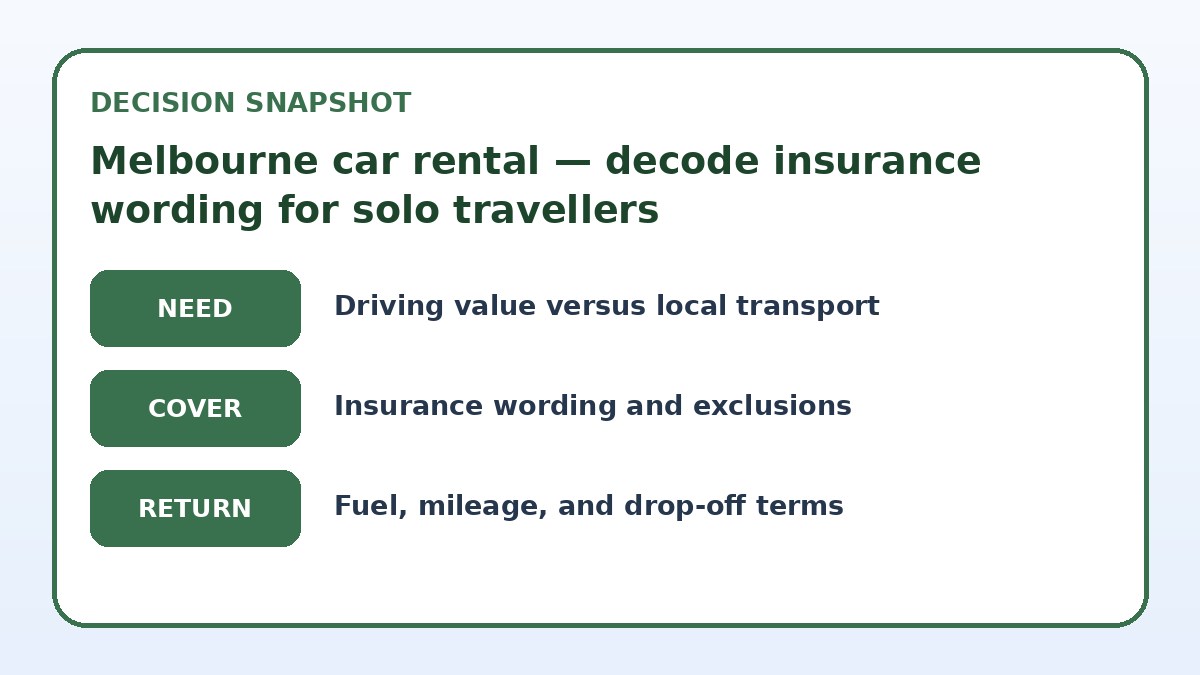
Driving gives clear advantages for day and multi-day trips outside central Melbourne. If your plan includes the Great Ocean Road, wineries in the Yarra Valley, or flexible hops between coastal towns, a car is often more efficient than regional trains and buses. However, within central Melbourne and inner suburbs the city’s tram and train network is dense, parking can be limited or costly, and traffic congestion eats time. Consider whether time savings, route flexibility, and luggage needs outweigh city driving hassles such as permit zones and one-way streets.
Deciding to drive hinges on where you'll go most days. For purely inner-city stays and a few short day trips, public transport plus an occasional taxi or rideshare often costs less and reduces stress. For multi-stop regional loops or early/late departures that public transport doesn't serve, a car can materially improve your itinerary. Make a basic route map of your intended day trips, estimate driving time versus public transport time, and then weigh that against the clarity and limits of the rental insurance wording you find.
Decide whether driving earns its place
| Mobility strategy | Best for | Cost or friction to check |
|---|---|---|
| Rent a car with full collision and tyre cover | Solo travellers planning long regional drives who value route flexibility and quick access to multiple sites. | Higher daily cost and more pickup/return paperwork; must confirm exact excess, exclusions, and off-road allowances on booking pages. |
| Public transport and trams plus occasional rideshare | City-focused itineraries and budget-conscious solo travellers who prefer to avoid rental paperwork and parking hassles. | Less flexibility for remote day trips and limited service hours outside metropolitan areas; tour bookings may still be needed. |
| Guided day tours and regional transfers | Solo travellers who want structured itineraries, local guides, and door-to-door convenience without handling insurance wording. | Fixed schedules and less personal flexibility; may visit multiple places faster but with less time at each stop than self-driving. |
| Short-term hire or car-share for single legs | Those who need a vehicle briefly for last-mile access or specific errands without a multi-day rental commitment. | Limited vehicle choice, possible usage caps, and varying insurance terms that you must check per booking; cost can scale quickly. |
Check live rental choices only after the route test
Use the exact driver, dates, pickup point, and return plan to compare current conditions.
Reading insurance wording: the clauses that truly matter
Start with definitions: named driver, insured vehicle, and territory. The policy must clearly state whether additional drivers can be added, whether cross-border travel (for example, into another state) is allowed, and what constitutes an excluded use like off-road driving. Next, locate the liability limits and excess (deductible): the excess is what you would pay after a claim. Some vendors advertise 'Zero excess' but then require third-party insurance or impose other restrictions. If the policy mentions 'loss of use' or administrative fees, note how and when those apply; they can appear after repairs.
Pay special attention to exclusions for tyres, windscreen, rims, and underbody—the common gaps in basic waivers. Also check whether coverage is voided by using the vehicle for unsealed roads, competitions, or towing. For solo travellers, clarify roadside assistance terms and whether breakdowns are covered without immediate penalties. Finally, carefully read any credit-card coverage fine print: many cards require you to decline the vendor’s collision-damage waiver at pickup, and they may not cover underbody or tyre damage. When in doubt, ask the rental company to point you to the exact clause on their booking page that permits or denies a specific use.
Compare the full rental conditions
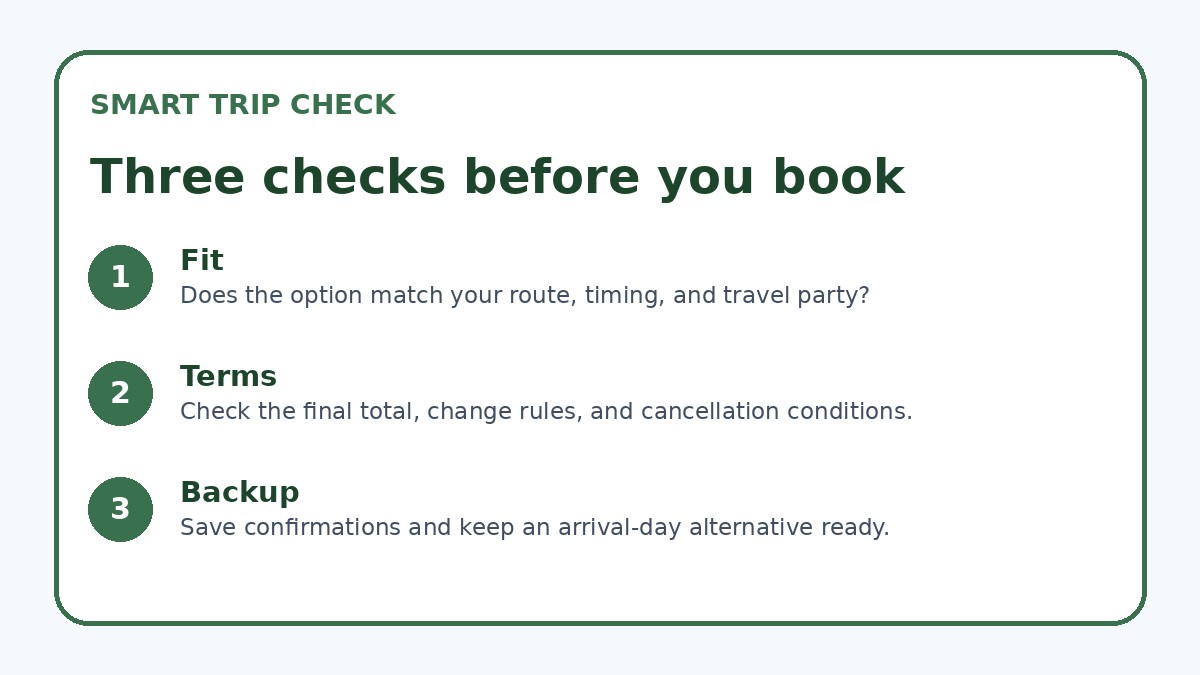
Confirm insurance wording, exclusions, deposit, fuel, mileage, and return terms on the final page.
Pickup, return and practical friction that affects your choice
Pickup and return terms can change the calculus of renting more than insurance wording does. Airport pickups often carry extra fees and can involve offsite shuttles that add time and cost, while after-hours return or one-way drop-offs may trigger penalties. Read the section that explains fuel policy (full-to-full versus pre-purchase), fuel charges for missed refuels, and what constitutes 'clean' return to avoid cleaning fees. Ask what paperwork they require at pickup—full licence, international permit, credit card imprint—and whether cross-checking with ID can delay or block rental.
Inspect the vehicle and document existing damage on the rental agreement. If the insurer’s coverage depends on timely reporting, follow those steps exactly at the counter. Photograph all sides of the car, odometer, and fuel level at pickup and drop-off. If your itinerary includes unsealed roads or long rural stretches, confirm whether the rental company and insurer accept that usage; some policies require a specific add-on for gravel-road use. Confirm on the provider’s final booking page any time windows and late-return fees to avoid surprises when you’re solo and juggling transport connections.
Car rental terms to verify
- Open the rental provider’s full insurance PDF and note the liability limit, excess amount, and any listed exclusions before you book.
- Confirm whether your credit card offers collision coverage and exactly what it excludes; check the card issuer’s policy wording for Australia-specific clauses.
- Ask the rental company in writing if travel onto unsealed roads, ferries, or across state borders is permitted under the policy.
- Photograph vehicle condition, dashboard odometer, and fuel level at pickup; submit photos to the company if the app or email allows it.
- Verify pickup/return windows and any after-hours fees on the booking page, and plan buffer time for shuttle transfers from airports.
- Save the insurer’s roadside assistance number and note how claims should be reported (timeline and required documentation) on the policy page.
Non-driving fallback: how to keep your itinerary flexible without a car
If insurance wording or pickup friction makes driving unattractive, you can still get around Melbourne and see nearby regions without a hire car. Melbourne’s public transport network of trains, trams and buses covers central city and many suburbs; long-distance V/Line trains and coaches serve Geelong, Ballarat and Bendigo. For coastal and wine-country day trips, guided day tours and private transfers offer door-to-door service without you needing to interpret complicated insurance clauses. Rideshares and taxis are easy for short hops or when you need direct airport transfers.
When choosing non-driving options, compare total journey time, door-to-door cost, and flexibility. Guided tours are convenient for solo travellers who want a structured itinerary and local commentary, but they lock you into set schedules. Public transport is cheapest in many inner-city cases but may require transfers and careful timetabling. Use a combination—public transport for city days, a guided day tour for a specialized regional visit, and rideshare for early-morning or late-night transfers—to replicate much of the freedom of a car without insurance risk.
Car Rental & Road Trip questions travelers ask
If a rental advertises 'fully insured', can I assume I won’t pay anything if I damage the car?
No—'fully insured' is marketing language that can hide exclusions and excesses. Always read the policy to find the excess amount (what you pay after a claim), and the specific exclusions for tyres, windscreen, underbody or off-road use. Check whether loss-of-use or administrative fees apply while the car is being repaired. If you rely on a credit card for coverage, confirm whether the card requires declining the vendor’s collision-damage waiver at pickup and whether it excludes certain damage types. Only when the contract explicitly limits your out-of-pocket liability to a stated amount with named inclusions can you be confident.
How do I know if my credit card or a third-party insurer will actually cover a claim?
Read the certificate of insurance or card benefits guide for Australia-specific terms and compare them against the rental company’s contract. Important points are driver age limits, whether the card covers underbody/tyre/windshield damage, and whether it requires you to decline the rental company’s CDW at the counter. Also verify claim procedures: some cards require you to pay the vendor fully and claim reimbursement, others engage directly. If the card insurer’s wording conflicts with the rental agreement, request written confirmation from either party and save all receipts and inspection records for a potential claim.
What exactly should I check in the booking page to avoid surprises at pickup?
On the provider’s final booking page, check named-driver rules, age surcharges, accepted ID and licence types, fuel policy, airport or offsite pickup fees, and the stated excess and exclusions. Look for clauses about after-hours returns, cleaning fees, and loss-of-use charges. If any phrase is ambiguous—words like 'occasional off-road use' or 'normal wear'—ask for a precise definition in writing. Also confirm whether additional covers (tyre, windscreen, underbody, roadside assistance) can be added and at what cost; keep screenshots or a saved copy of the final terms for proof at pickup.
Final decision note
For many solo travellers, driving around Melbourne and its nearby regions offers tangible benefits—speed, schedule control and access to quieter coastal and rural destinations. Those benefits, however, depend on clear, favourable insurance wording and manageable pickup/return terms. Before you book, read the policy for liability limits, excesses, tyre and windscreen exclusions, and permitted road types. If the contract leaves ambiguity or imposes steep excesses, consider public transport, guided tours, or a mix of rideshare and short-term hire instead. Use the checklist above, save booking-page screenshots, and ask the provider to point you to the exact clause that addresses your main concerns so you can make an informed decision without surprises.
Continue planning
Check current options and final conditions
Use the provider page to confirm live availability, the final total, cancellation terms, and every condition that matters to your trip.
This evergreen planning guide was created with AI-assisted drafting and a structured quality review. It does not display live prices, schedules, availability, visa guidance, or provider rankings. Verify current details before booking. Some links are affiliate links; we may earn a commission at no additional cost to you.