If you’re arriving at Ninoy Aquino International Airport and need to reach Manila’s districts for the first time, start by choosing between a metered taxi or a pre-arranged airport transfer if you value door-to-door ease, or public shuttle and bus options for a lower-cost alternative. Decide first whether you want the quickest route to a nearby hotel, the cheapest way into town, or the simplest option when carrying lots of luggage. Your choice will depend on time of day, how many people are traveling, how close your accommodation is to major roads, and how comfortable you feel navigating Manila’s traffic and sidewalks. Read on to compare the tradeoffs and learn exactly what to check on the provider’s booking page before you commit.
Main transfer options and how to pick one
Metered taxis, app-based rides, private pre-booked transfers, and shared shuttles are the typical choices. For most first-time visitors, the decision comes down to balancing convenience, cost, and certainty. A metered taxi or ride-hail service lets you leave the terminal quickly and choose your precise drop-off. A private transfer booked in advance gives a fixed meeting point and predictable pickup, which reduces the stress of finding a ride when you’re tired or unfamiliar with local signs. Shared shuttles and airport buses can be much cheaper but may involve extra walking, longer stops, and fixed drop locations.
When choosing, ask yourself: are you traveling during peak traffic hours, are you comfortable giving directions in English or Tagalog, and how much luggage do you carry? If your hotel is in central Manila districts like Makati or Ermita, direct door-to-door options usually save time despite higher cost. If you’re heading to an outer district or are budget-conscious, look for shuttle services or buses that stop near major transit hubs, then take a short taxi for the final leg. Whatever you pick, verify pickup points and allowed baggage on the provider’s booking page before finalizing.
How to handle luggage, accessibility, and group size
Luggage and group size strongly influence which transfer makes sense. A standard metered taxi suits solo travelers or pairs with one or two medium suitcases. Larger groups or those with oversized bags benefit from booking a van or private transfer so everyone fits comfortably and luggage stays with you. Be aware that not every vehicle type is available immediately at the terminal—larger vehicles are often pre-book-only. If you or someone in your group needs step-free access, confirm accessibility details directly with the operator; airports and local drivers have varying capabilities and policies.
If you’re booking an app-based ride, choose the vehicle category that matches your luggage and passenger count, and confirm that the pick-up point at the terminal is one the app supports. For private transfers, clearly state the number and size of bags during booking and ask about meet-and-greet services so the driver will be waiting where you exit. If you plan to split into multiple vehicles to save money, weigh the convenience loss: coordinating groups in a busy terminal can add time and confusion.
| Approach | Best for | Tradeoff to check |
|---|---|---|
| Metered taxi or ride-hail | Travelers wanting quick, direct door-to-door service. | Can be pricier during traffic; confirm meter use or app pickup point. |
| Pre-booked private transfer | Groups, lots of luggage, or arrivals late at night. | Higher upfront cost; verify pickup procedure and vehicle size on booking page. |
| Airport shuttle or bus | Budget travelers and solo passengers heading to major hubs. | Longer journey with fixed stops; may require a short taxi at the end. |
| Split approach (shuttle + short taxi) | Cost-conscious travelers who don’t mind a short final connection. | More logistics and transfers; coordinate luggage and timing carefully. |
Safety, payments, and paperwork to verify
Safety and payment expectations should be handled before you travel. For taxis, make sure drivers use the meter or agree a fare that you are comfortable with before starting the trip. With app-based services, check that your pickup pin and terminal curbside zone match the driver’s location. For private transfers, confirm the driver’s contact details, the vehicle registration, and how the supplier handles flight delays so you aren’t left waiting if your arrival is late. Always carry a copy of your hotel address and a phone number in case directions are needed.
On the payment side, verify which methods are accepted—cash, card, or prepaid online—and whether taxes or airport surcharges are included. If you book through an online marketplace or operator, read the cancellation and change policy carefully and check whether refunds are available for rescheduled flights. Trip.com can be used to compare current availability and conditions, but always confirm the operator’s own terms on their final booking page to avoid surprises.
Before you book
- Confirm which airport terminal you arrive at and note the official curbside pickup zones for your chosen transfer type.
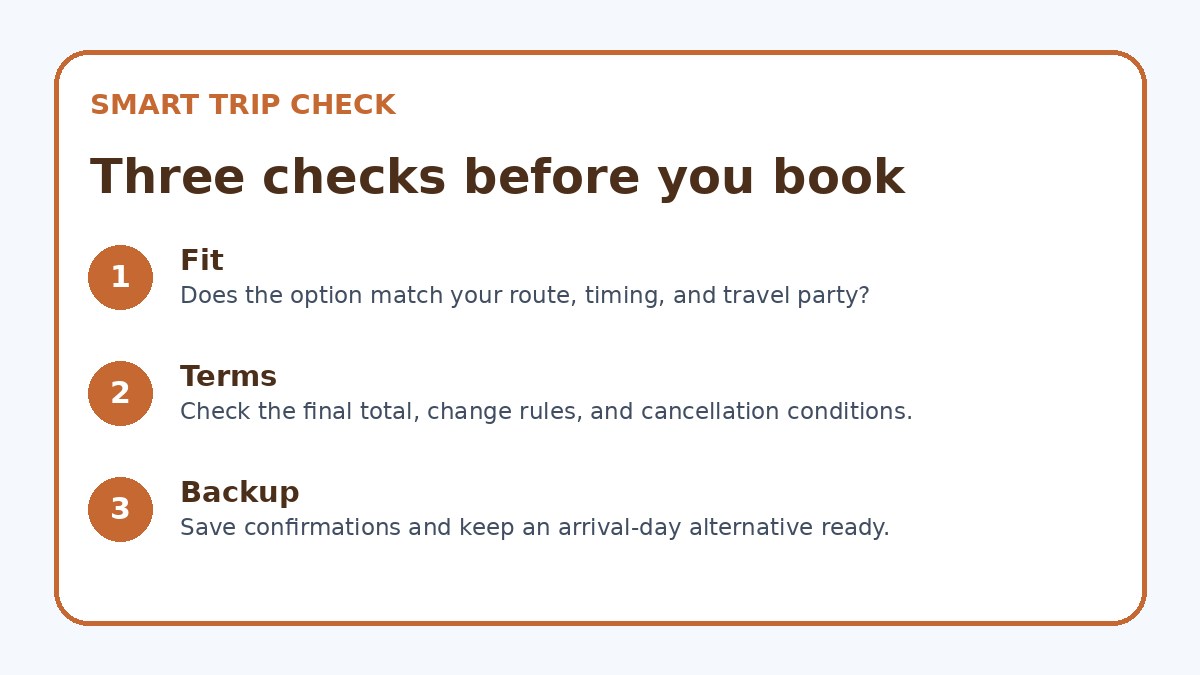
- Check the vehicle size and luggage allowance when booking a private transfer or app ride and update the operator if your bags are oversized.
- Save the driver or operator contact number and the meeting-point description in your phone and on paper before exiting arrivals.
- Verify accepted payment methods and whether airport surcharges, tolls, or service fees are included on the operator’s final booking page.
- Plan for peak-hour traffic by adding buffer time to onward connections and communicate any flight delays to your transfer provider.
- Keep your hotel name, local address, and a working local SIM or roaming data to show drivers or use mapping apps if needed.
Timing your arrival: traffic, flight connections, and backups
Manila’s traffic patterns can make travel times vary widely. If you arrive during morning or evening rush hours, travel to central districts can take much longer than midday. For that reason, first-time visitors should allow large time buffers when scheduling onward plans such as check-in or tours. When you have a tight connection—like continuing by bus or transfer to another island—plan for potential delays and identify a backup plan, such as a later bus or an alternative drop-off near a transit hub.
If your itinerary includes a domestic connection after landing in Manila, don’t assume a same-terminal transfer is immediate; check which terminals serve your next flight and whether you’ll need to move between terminals. Keep clear copies of your onward tickets and confirm the terminal transfer options before arrival. As a final precaution, note nearby hotels close to the airport and central terminals in case you decide to rest overnight instead of rushing to meet a tight connection.
Frequently asked questions
Is it safe to take a metered taxi from Manila airport?
Yes, many visitors use metered taxis from the airport. To improve safety and predictability, use licensed airport taxis or a reliable app-based service, insist the meter is used, and note the vehicle number before you leave the terminal. If an agreed fare is offered instead of a meter, confirm the price in writing or through the app. For extra assurance, choose an operator with a visible booking confirmation and driver details—verify those on the operator’s booking page so you know who will meet you.
How do I find the correct pickup point inside the airport?
Pickup points vary by terminal and by service type. Look for official signs in the arrivals hall that indicate taxi, rideshare, or shuttle areas. If you booked a private transfer, the confirmation should name the expected meeting point—confirm where to meet the driver and any signboard details. With app-based rides, match the app’s pickup pin to the terminal curbside zone before requesting a driver. If you’re unsure, follow airport staff guidance or contact the operator directly using the phone number on your booking confirmation.
Should I pre-book a transfer or arrive and find one at the airport?
Pre-booking gives peace of mind if you have tight timing, lots of luggage, or arrive late, and ensures the vehicle type you need is waiting. Finding a taxi at the airport can be faster and sometimes cheaper for solo travelers who are comfortable negotiating and confident the meter will be used. Weigh convenience against flexibility: if you prefer to see options on arrival and possibly save money, plan a short fallback like a creditable airport taxi rank. Whatever you choose, confirm cancellation and flight-delay policies on the provider’s booking page if you pre-book.
Final planning note
For first-time visitors to Manila, the optimal airport transfer depends on your priorities: save time with a direct taxi or pre-booked transfer, or save money by using shuttles and buses combined with a short taxi. Think about luggage, group size, terminal pickup logistics, and traffic when deciding. Before you commit, verify the vehicle type, meeting point, payment options, and the operator’s handling of flight delays on the final booking page. Use that information to pick the option that minimizes stress on arrival so your trip into the city starts smoothly.
Continue planning
Check current options and final conditions
Use the provider page to confirm live availability, the final total, cancellation terms, and every condition that matters to your trip.
This evergreen planning guide was created with AI-assisted drafting and a structured quality review. It does not display live prices, schedules, availability, visa guidance, or provider rankings. Verify current details before booking. Some links are affiliate links; we may earn a commission at no additional cost to you.