
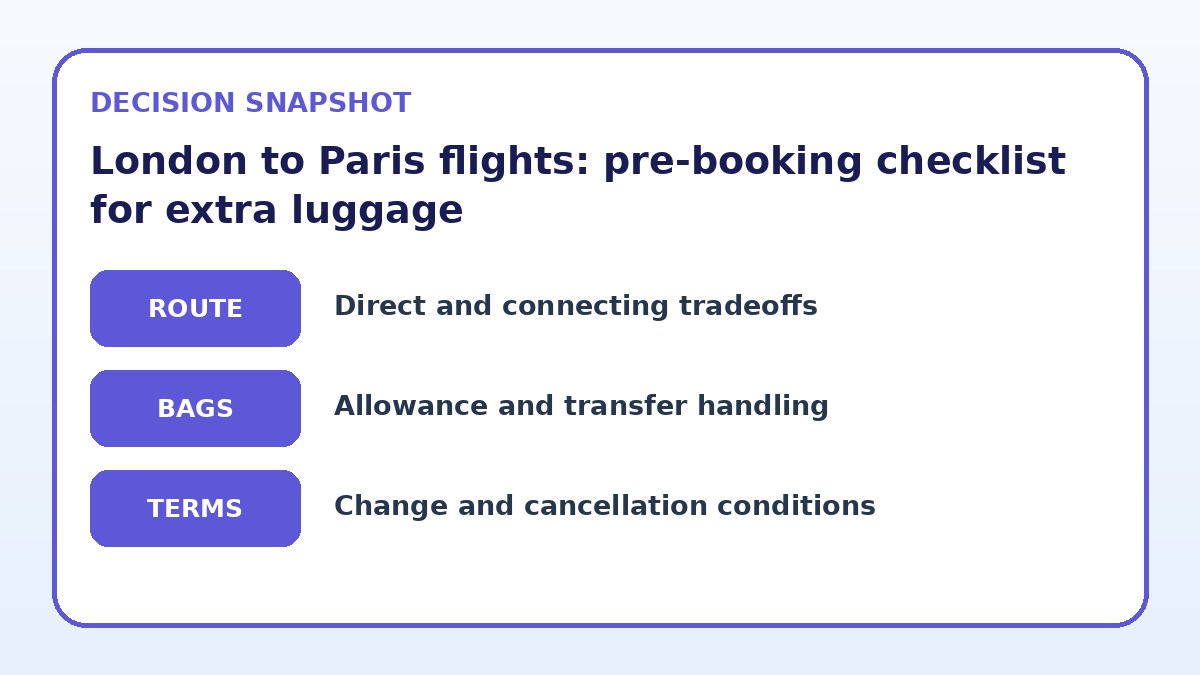
If you’re travelling from London to Paris with extra luggage, get the logistics right before you hit book. Prioritise which travel mode suits your baggage: short-haul flights, Eurostar trains, and ferries or combinations each have different weight, size, and handling rules. Start by checking carrier baggage allowances and add-on fees on the booking page, compare total door-to-door time including airport transfers and security, and confirm how connections will be handled if you choose a routing with a change. Consider where you’ll check or carry items during short transfers and whether you need delivery or oversized-baggage services. This checklist helps you gather the facts you must verify on provider pages so you can compare options fairly and avoid surprises at check-in.
See current options before you compare the details
Availability and final conditions change. Open Trip.com now or keep reading for the practical comparison.
Baggage rules and fees: what to verify on booking pages
Different carriers and transport modes define bags by weight, linear dimensions, and count. On the operator’s final booking page, confirm the exact allowance for carry-on and checked baggage, including maximum dimensions and weight per item. Look for language about overweight and oversize penalties, and whether fees are per segment or applied to the whole itinerary. If bookings can combine separate operators (for example, a low-cost flight plus a rail leg), verify each provider’s rules rather than relying on a single summary.
Also check whether you must pre-purchase extra allowance online to get the lowest fee, and whether any booking class or fare type includes free checked bags. If you plan to travel with sports gear, musical instruments, or oddly shaped items, find the dedicated policy for special items and whether advance notice or crate requirements apply. Finally, note any size restrictions for cabin storage—aircraft or train models may limit usable overhead or under-seat space, which affects whether larger carry-ons count as checked pieces.
Direct vs connecting options: tradeoffs for heavy baggage
Direct services reduce handling steps and risk of missed transfers, but may differ in luggage rules and price. When comparing direct versus connecting itineraries, evaluate total door-to-door time, number of baggage handlings, and whether an airline or operator offers through-checked luggage across connections. If connections are on separate tickets, the second carrier may not accept a checked bag through from the first; that often means reclaiming and re-checking luggage and allowing extra transfer time.
Connections can unlock lower fares or better schedules but bring extra coordination: minimum connection times, terminal changes, and different bag policies matter. For rail-air combinations (for example, a flight from London with a connecting train in Paris or vice versa), verify how luggage is transferred at each step and if staff will move items through customs or security. If you choose connections, build buffer time and prefer providers who explicitly handle transfer baggage or offer a single-ticket contract that covers mishandled luggage.
| Approach | Best for | Tradeoff to check |
|---|---|---|
| Book a direct flight | Travelers prioritising fewer handlings and shorter transit risk | May be costlier or have stricter baggage allowances than multi-leg options |
| Book connecting flights on one ticket | Travelers wanting potential savings and protected transfers | Longer total travel time and more baggage handlings, but provider responsibility for through-checked bags |
| Mix modes (flight plus rail) | Travelers balancing price and city-center access | Different baggage rules per operator; plan extra time for transfers and re-checking |
| Ship luggage ahead or use forwarding | Travelers carrying bulky or irregular items who want to travel light | Added cost and lead time; requires trust in pickup/delivery windows and claims process |
Ready to check the option that fits your plan?
Use your exact dates and traveler details so the provider page can show the current total and conditions.
Transfers, terminals and ground logistics
Map your arrival and departure points before booking: London has multiple airports and international rail terminals, while Paris has several airports and major rail stations. Confirm which terminals serve your chosen flights and how long transfers take between terminals or stations when changing modes. Look for operator guidance on transfer times with checked luggage and whether airport shuttles, trains, or private transfers have size restrictions or require advance booking for large items.
Also consider the ground experience: elevators, escalators, luggage trolleys, and porter services can make a big difference when you have bulky bags. If you’ll use public transport in either city, check carriage rules for oversized luggage on trains and buses. For convenience, research luggage storage and drop-off points at major terminals—short-term storage can let you explore between connections without hauling extra bags, but verify size and weight limits as well as opening hours on the provider’s site.
Before you book
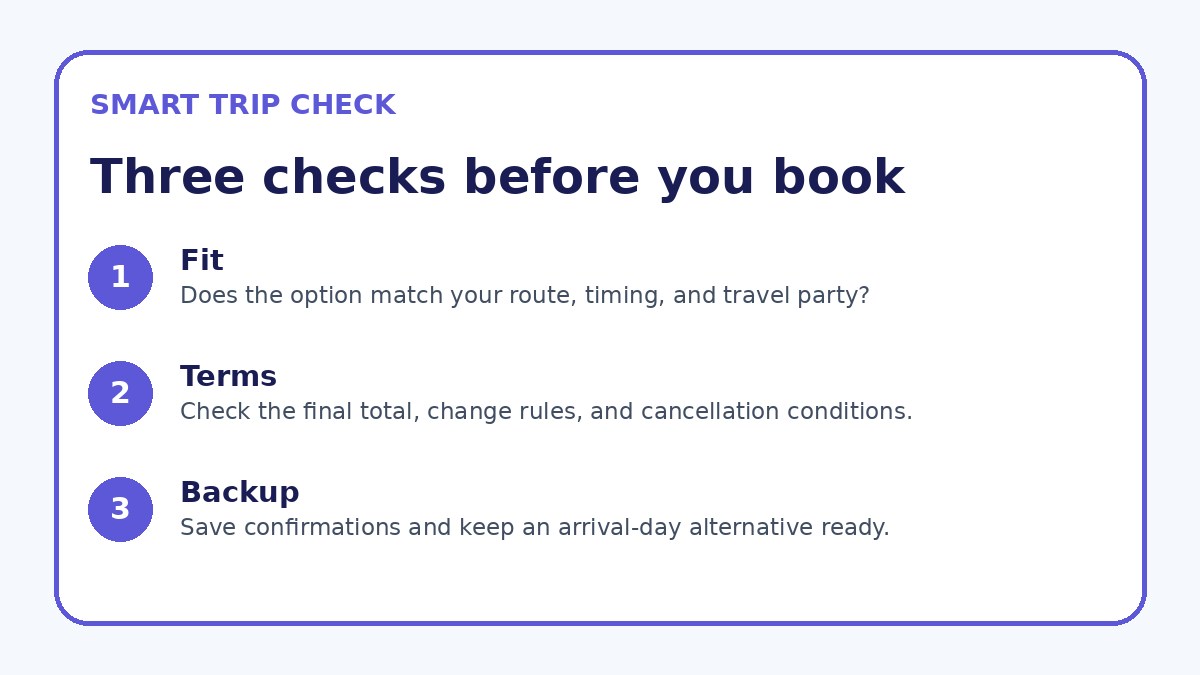
- On the operator’s final booking page, confirm exact checked and carry-on size and weight limits for each leg of your itinerary.
- If your trip includes separate tickets or operators, verify whether checked baggage is through-checked or must be reclaimed and re-checked.
- Compare total door-to-door time, accounting for recommended minimum connection times and transfers between terminals or stations.
- Check ground transfer options and luggage handling features (trolleys, elevators, porter service) at departure and arrival points.
- Get written confirmation of any special-item policy (sports gear, instruments) and any required advance notice or packaging rules.
- If considering shipping, obtain pickup/delivery windows, insurance terms, and prohibited-item lists from the courier’s booking page before you finalize travel.
Alternatives to checked baggage: shipping and consolidation
Shipping baggage or using courier and luggage-forwarding services can ease the stress of carrying heavy items through airports and stations. Before booking, compare door-to-door timelines, pickup/drop-off windows, and insurance options; confirm exactly what the service covers and how claims are handled on the provider’s terms. Ensure the courier accepts the items you plan to ship—some services restrict batteries, perishable goods, or high-value items.
Consolidation and packing strategies are practical if shipping isn’t an option: use soft-sided bags that fit varied dimensions, compressibles, and modular packing cubes to meet airline or train limits. If you plan to split gear between passengers to fall under per-person allowances, check each traveller’s allowance and confirm the operator permits redistribution at check-in. For peace of mind, carry essential items, documents, and a change of clothes in a small cabin bag that complies with the stricter of the two carriers’ cabin rules.
Frequently asked questions
Should I always choose a direct flight from London to Paris if I have extra luggage?
Not necessarily. Direct flights reduce the number of times your bags are handled, lowering the chance of misrouting, but they can have stricter baggage allowances or limited space for oversized items. Compare the direct option’s baggage rules and fees against a connecting itinerary that may permit cheaper or more generous allowances. If the connection is on the same ticket and the operator guarantees through-checked baggage, a connection can still be convenient—just allow extra transfer time and check the provider’s transfer luggage policy on the booking page.
How much transfer time should I allow between connections when travelling with bulky bags?
Allow more buffer than the minimum transfer time quoted by carriers, especially when you must reclaim and re-check luggage or move between terminals or stations. Consider the time needed for disembarkation, passport control, baggage reclaim, transit between terminals, and security re-screening. If transfers involve different operators or separate tickets, add contingency for delays. When possible, choose connections with official minimum connection times that explicitly accommodate passengers with checked baggage or select protected single-ticket itineraries that handle baggage transfers for you.
Is shipping luggage ahead a reliable solution for oversized items?
Shipping can be reliable but requires careful planning. Verify the courier’s accepted item types, weight and dimension limits, pickup and delivery windows, and insurance policy on their booking page. Factor in customs rules and documentation if your shipment crosses borders beyond the UK–France route or involves restricted items. Shipping adds cost and introduces delivery timing risk, so choose a provider with clear tracking and claims procedures, and schedule pickup early enough to absorb potential delays. Consider splitting essentials into carry-on to cover any late deliveries.
Final planning note
Travelling London to Paris with extra luggage is manageable when you assemble the right facts before booking. Check baggage allowances and fees on each operator’s final booking page, confirm whether connections involve through-checked luggage, and map transfers between terminals and stations with luggage handling in mind. Decide whether convenience (direct services, porter-backed transfers) or cost (connecting itineraries, shipping) matters more, and build buffer time where policy or logistics introduce risk. Use this checklist to compare options side-by-side, and consult the carriers’ booking pages and Trip.com or similar comparison tools for live availability and the provider details you must verify prior to purchase.
Continue planning
Check current options and final conditions
Use the provider page to confirm live availability, the final total, cancellation terms, and every condition that matters to your trip.
This evergreen planning guide was created with AI-assisted drafting and a structured quality review. It does not display live prices, schedules, availability, visa guidance, or provider rankings. Verify current details before booking. Some links are affiliate links; we may earn a commission at no additional cost to you.