For many business travelers, the first question isn’t whether rental cars exist in London but whether driving actually improves your schedule. If your meetings are inside central London or near well-connected stations, public transport and rideshares often beat driving. But if you have multiple out-of-center meetings, equipment to carry, or tight multi-site logistics, a rental can still be the most efficient option. This article gives a practical decision: when to rent and what pickup and return terms will most affect your trip—key clauses in insurance, fuel and mileage, airport vs city pickup, and stopwatch costs around returns. Read on to weigh tradeoffs and confirm the few things to check on the final booking page.

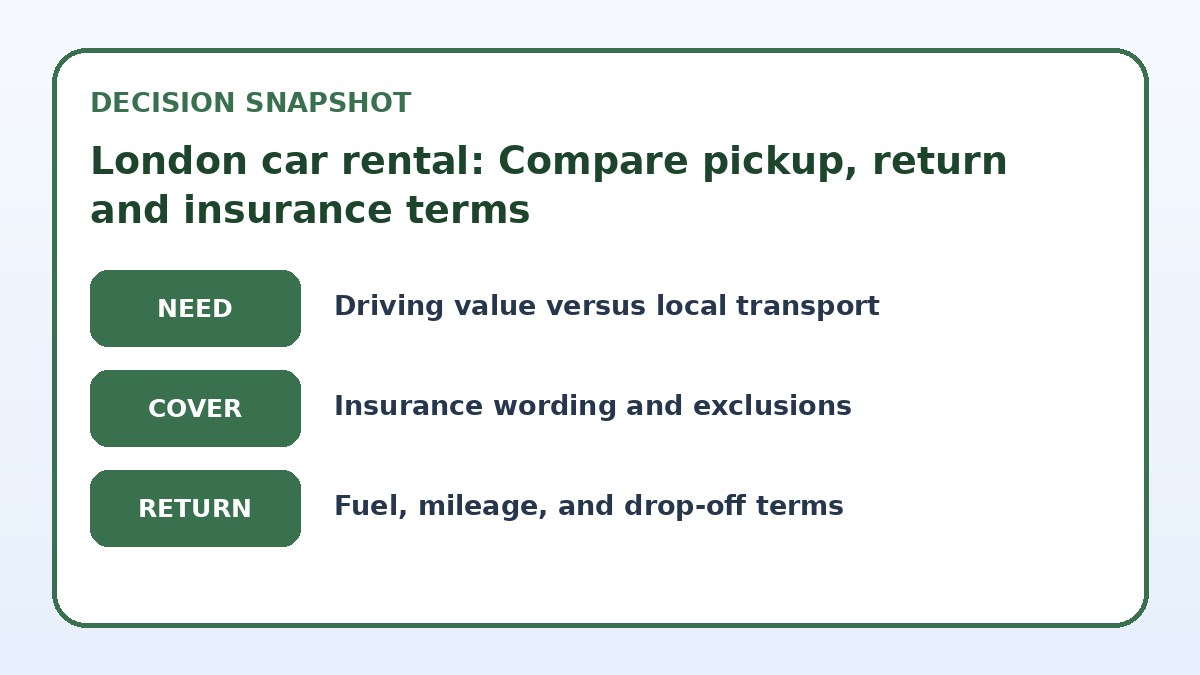
Does driving actually improve your London itinerary?
Start by mapping appointments, hotels and likely evening logistics to estimate door-to-door times. Central London reduces the appeal of a car: congestion, limited parking, congestion charge zones and frequent traffic make taxis, the Underground and cycling efficient for short hops. Conversely, if your meetings are spread across outer boroughs, industrial parks, or counties surrounding London — or you must visit several sites in a single day with equipment — a car can cut transfer hours. Think in minutes per transfer rather than distance: a 20-minute tube plus 10-minute walk can beat a 40-minute drive with parking time.
Consider cost per hour of productivity, not only rental rate. Parking, congestion charges, fuel, and the administrative time to collect and return the vehicle reduce net benefit. Also weigh arrival mode: if you arrive at a major airport late at night, car pickup adds time if the rental desk is off-site or requires shuttles. Finally, factor in driver fatigue and local navigation stress: if you prefer to avoid these, assign the role to a colleague or opt for non-driving alternatives.
Decide whether driving earns its place
| Mobility strategy | Best for | Cost or friction to check |
|---|---|---|
| Rent a car for the full trip | Multi-site, suburban meetings with heavy luggage or equipment | Higher total cost, parking and congestion exposure; more pickup/return logistics to manage |
| One-way rental between airports or hubs | Point-to-point travel where time savings outweigh drop-off fees | Possible steep drop fees and limited return locations; must verify one-way availability |
| Short-term hire only on needed days | Mostly central itinerary with occasional suburban visits | Requires accurate planning and flexible scheduling; may need last-minute booking |
| No car: public transport, taxis and chauffeur services | Dense central London schedules and short intra-city transfers | Less control over timing for multi-site days and potentially higher per-trip costs for remote sites |
Check live rental choices only after the route test
Use the exact driver, dates, pickup point, and return plan to compare current conditions.
Pickup terms that make or break a business day
Pickup details determine whether you start your day on time. On the booking page verify the exact pickup address (terminal counter, off-airport lot, or kiosk), the opening hours, and whether you need to reserve a specific pickup window. Ask whether a shuttle service operates and how long the transfer normally takes, and check whether the supplier requires digital or printed documents at collection. Confirm identification requirements — including which national driving licences are accepted — and whether a passport, proof of return travel, or employer authorization letter is needed for business rentals.
Also study hold amounts and pre-authorizations on cards: many companies place a security hold equal to the deposit plus estimated costs, and business cards issued by companies can be treated differently than personal cards. Check the company’s stated wait policy for delayed flights, as fees can apply if you miss the reserved window. If you need the car immediately upon landing, look for options with counters inside the terminal, or pre-arrange faster pick-up processes to avoid shuttle waits or queueing during peak times.
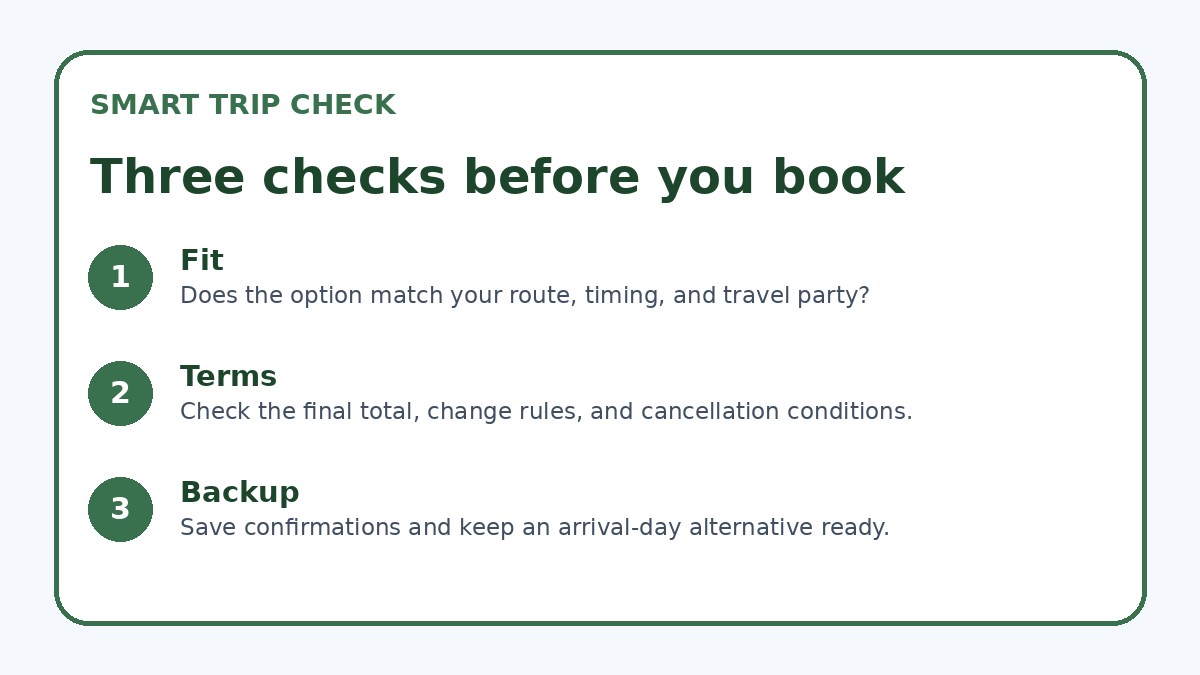
Compare the full rental conditions
Confirm insurance wording, exclusions, deposit, fuel, mileage, and return terms on the final page.
Return friction: timing, location and post-rental charges
Return policies create the most unexpected business-day delays. Verify exactly where to return the vehicle — the same counter, a dedicated off-airport lot, or a separate drop box for after-hours returns — and whether a staff inspection is required or the car is accepted with keys in a drop box. Clarify the allowed return window and the duration of any free grace period. Missing a slot, returning after hours without staff, or returning to the wrong location can trigger late fees, towing, or extra transport time back to the terminal.
Read the fine print on fuel policies and damage tolerances. A full-to-full policy is clearer and usually fairer for business travelers; mileage caps or per-mile surcharges should be identified if your itinerary includes long drives. Also inspect wording around cleaning, pet hair, and smoking penalties that can incur disproportionate charges. For one-way returns, confirm drop fees and restrictions — not all providers permit cross-border or certain city drop-offs without advance disclosure.
Car rental terms to verify
- Confirm exact pickup location, opening hours and any required shuttle transfer before you book the vehicle.
- Verify accepted driver documentation, including which national licences and permits are allowed for business rentals.
- Check the security hold amount and whether your company card or personal card will be used for pre-authorization.
- Read insurance wording: deductible/excess, whether business use is covered, and how credit-card coverage interacts with the rental policy.
- Clarify fuel policy, allowed mileage, and cleaning/damage thresholds that can trigger extra fees on return.
- Note the return process: staffed inspection or drop box, grace period length, and any one-way or late-return charges.
Insurance wording and a practical non-driving fallback
Insurance and liability clauses deserve careful reading: check the excess (deductible) amount you’d be liable for after a claim, whether collision damage waiver (CDW) or theft protection is included, and if the policy covers business use. Determine whether credit-card provided coverage is primary or secondary — that affects whether you must claim through the rental company first — and whether any drivers beyond the primary must be declared to maintain coverage. Also look for territory restrictions that could invalidate cover when crossing into certain regions.
If driving is a marginal gain, have a non-driving backup. For central meetings, plan public-transport routes between venues, pre-book point-to-point minicabs for late returns, and identify reliable chauffeur services for same-day multi-stop itineraries. Keep an eye on real-time options: apps that book executive taxis or short-term van hires can replace a full rental when you need occasional vehicle access. Reserving a car only for days when it clearly improves productivity reduces cost and friction while keeping options open.
Car Rental & Road Trip questions travelers ask
Will my company credit card cover the rental hold and insurance for a London business trip?
Company card policies vary widely. Before booking, ask your card administrator whether the card will be used for pre-authorizations and whether the card issuer provides rental-car insurance — and whether that coverage is primary or secondary. Many corporate cards require you to decline the rental company’s CDW to access card-provided coverage, which can leave you liable until a claim is processed. Always get written confirmation from your finance team, and when on the rental page check the supplier’s insurance section for exact wording you must meet to keep the card benefit valid.
What should I do if my flight is delayed and I miss the pickup window?
Contact the rental company immediately using the contact details on your reservation and the provider’s terminal instructions. Some companies hold cars for a grace period if notified, while others may treat a no-show as a cancellation and reassign the vehicle. If the desk closes overnight, confirm whether after-hours pickups are possible and whether a shuttle will still operate. On the booking page, look for explicit late-arrival policies and any associated fees so you can decide whether to rebook or accept alternative transfer solutions like a taxi or temporary car hire.
How do I avoid unexpected return charges when dropping off a rental in London?
Document the vehicle’s condition at pickup and again at return: take timestamped photos of all sides, the interior and the fuel gauge. Choose a clear fuel policy — preferably full-to-full — and refill before returning to avoid operator fuel charges. Confirm the exact drop-off location and whether staff will inspect the car or accept keys in a drop box, and ask for a written return receipt. Finally, save the booking confirmation and any inspection paperwork; if a charge appears later, these documents speed dispute resolution with the supplier or your corporate card provider.
Final decision note
For business travelers, deciding to rent in London is a balance of time saved versus added logistics. If your schedule hits multiple non-central locations or involves bulky gear, a rental can be efficient — but only if pickup and return terms are clear and match your arrival times. Before you book, compare pickup location, pre-authorization demands, insurance wording, and return procedures; these clauses determine whether a rental will be an asset or an administrative burden. If driving looks marginal, plan a robust non-driving fallback using public transit, executive taxis or short-term hires for occasional needs. Verify all critical terms on the supplier’s final booking page and consider Trip.com as one place to compare current availability before you commit.
Continue planning
Check current options and final conditions
Use the provider page to confirm live availability, the final total, cancellation terms, and every condition that matters to your trip.
This evergreen planning guide was created with AI-assisted drafting and a structured quality review. It does not display live prices, schedules, availability, visa guidance, or provider rankings. Verify current details before booking. Some links are affiliate links; we may earn a commission at no additional cost to you.