If you need a practical recommendation: prioritize the shinkansen-style fast train if you value speed, central terminals, and low transfer hassle; pick a long-distance coach for lower cost and late-night flexibility; consider a ferry-plus-train combination only if you want a scenic break and accept extra transfers. Solo travelers should weigh where each option starts and finishes, how your luggage moves between modes, and how much buffer you need for connections. This article compares door-to-door practicality — from leaving your Tokyo accommodation to arriving at your Kyoto door — and explains how to judge terminal fit, luggage and transfer friction, timing flexibility, and what to do if services are disrupted. Use the decision checklist and comparison rows to match your priorities to the route approach you’ll actually book.
Terminal fit and door-to-door ease
Begin by mapping which terminals each option uses and how those terminals connect with your Tokyo and Kyoto accommodations. Trains typically run from major city stations that are integrated with local metro lines and taxis; that reduces last-mile friction because you can walk, take a subway or grab a cab with minimal luggage juggling. Coaches usually depart from dedicated bus terminals or highway bus stops that may be a short ride from central stations; that matters if your hotel is near a train station because an extra transfer adds effort and time. For mixed routes that include ferries, verify both the port approach and the distance from the receiving port to the nearest rail hub, since ports are often separated from city centers.
Think through arrival-side fit as well: does the service drop you near your Kyoto hotel or at a transit hub that requires additional transfers? If you plan to arrive late, check whether taxis are readily available and whether your accommodation accepts late check-ins. Luggage-handling facilities (lockers, left-luggage counters) at stations can ease a multi-leg day; if you intend to stop en route, find lockers or a left-luggage service at the transfer point. Wherever possible, choose an itinerary that minimizes hand-carrying and repeat check-ins — that’s especially valuable when traveling alone.
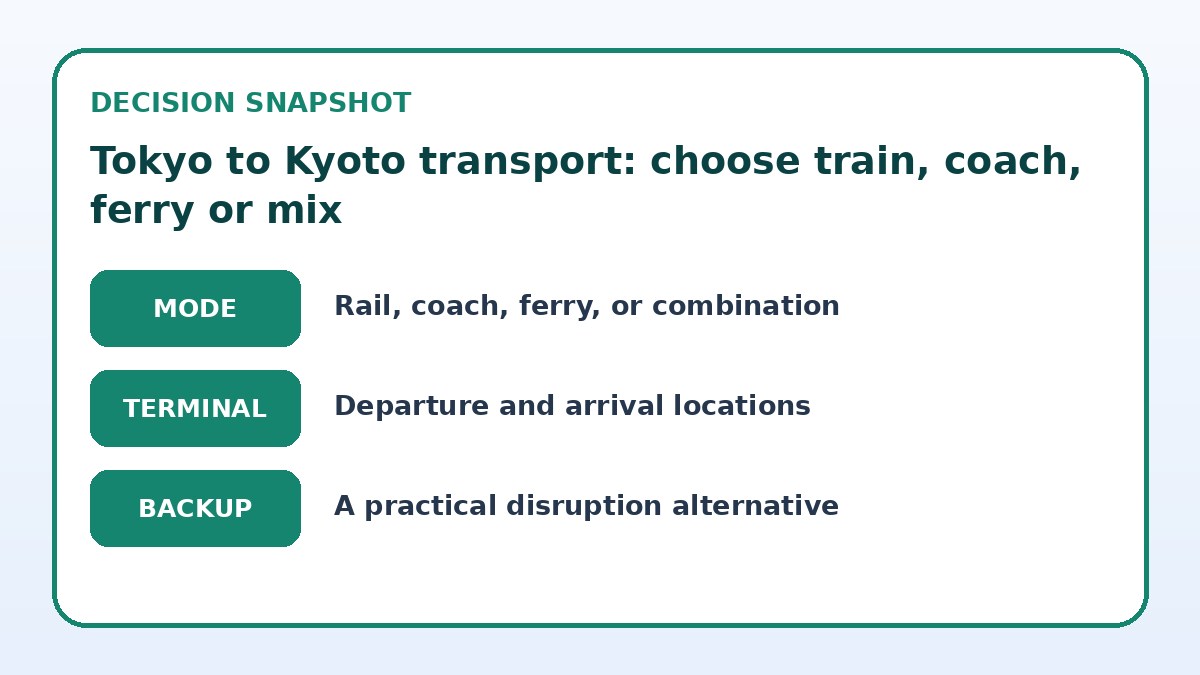
Choose the end-to-end journey plan
| Journey approach | Best for | Friction to check |
|---|---|---|
| Direct high-speed train (single-leg) | Solo travelers prioritizing speed, central stations, and low transfer complexity. | Higher base cost and potential seat sell-out on popular departures; check rebooking rules before booking. |
| Long-distance coach (direct or express) | Budget-conscious solo travelers who accept peripheral terminals and longer journey time. | Less central drop-off, fewer departures, and higher vulnerability to road traffic delays. |
| Ferry plus rail combination | Travelers seeking a scenic break and who don’t mind extra transfers and slower travel pace. | Additional transfers and luggage handling; limited frequency means tight schedules are risky. |
| Mixed ticketing: split legs by mode | Those who want to balance cost and experience, or match departure windows to plans. | Requires careful timing and buffers; separate tickets can complicate disruption recovery and luggage flow. |
Check live intercity options
Look beyond the ride itself and compare terminals, transfers, luggage, and arrival fit.
Luggage, transfers and solo-traveler friction
How much luggage you bring can change the best mode. Trains often provide overhead racks and luggage areas in carriages plus platform-level access for easy boarding; many stations have station staff who will assist with directions. Coaches vary: some have large underfloor luggage bays where you hand your bags to staff, reducing onboard clutter, while others expect you to manage bags in cramped bays and handle them yourself. Ferry travel involves moving luggage on and off the ship and between vessel and terminal; if your plan mixes ferry and rail, expect at least one manual transfer between modes and plan time for it.
For solo travelers, the number of handoffs matters more than total time. Each transfer is a moment of vulnerability — lost time, missed connections, or mislaid bags. Choose options with clear, staffed transfer points or single-ticket connections that allow through-checking if available. When a through-checked option doesn’t exist, build a 30–60 minute buffer for local transfers and baggage handling at every junction. If you rely on public transport at night, verify night service levels or budget for a taxi for the final mile.
Timing flexibility and planning windows
Decide whether you prioritise fixed departure times or flexible, inexpensive travel. Trains, especially premium intercity services, run frequent departures and often maintain predictable running times, which reduces the need for long buffers. However, popular departures can sell out and seating options vary; prioritize an earlier departure if you need a margin for delays. Coaches may have fewer daily departures but sometimes offer late-night departures that let you save daytime hours on travel; check how coach schedules align with your arrival and departure needs in both cities.
Mixed ferry routes typically require more planning because seas and port timetables govern departures; passenger ferries may not run as frequently as trains or coaches, so missing one can mean a long wait. If your schedule is tight, prefer direct rail where possible. Solo travelers who value flexibility can combine a train outbound and a coach return (or vice versa) to use different time windows and potentially lower overall cost while keeping at least one simple, low-transfer leg in the itinerary.
Compare the practical alternatives
Use the final page to confirm what is actually offered on your dates and save a workable fallback.
Intercity travel checklist
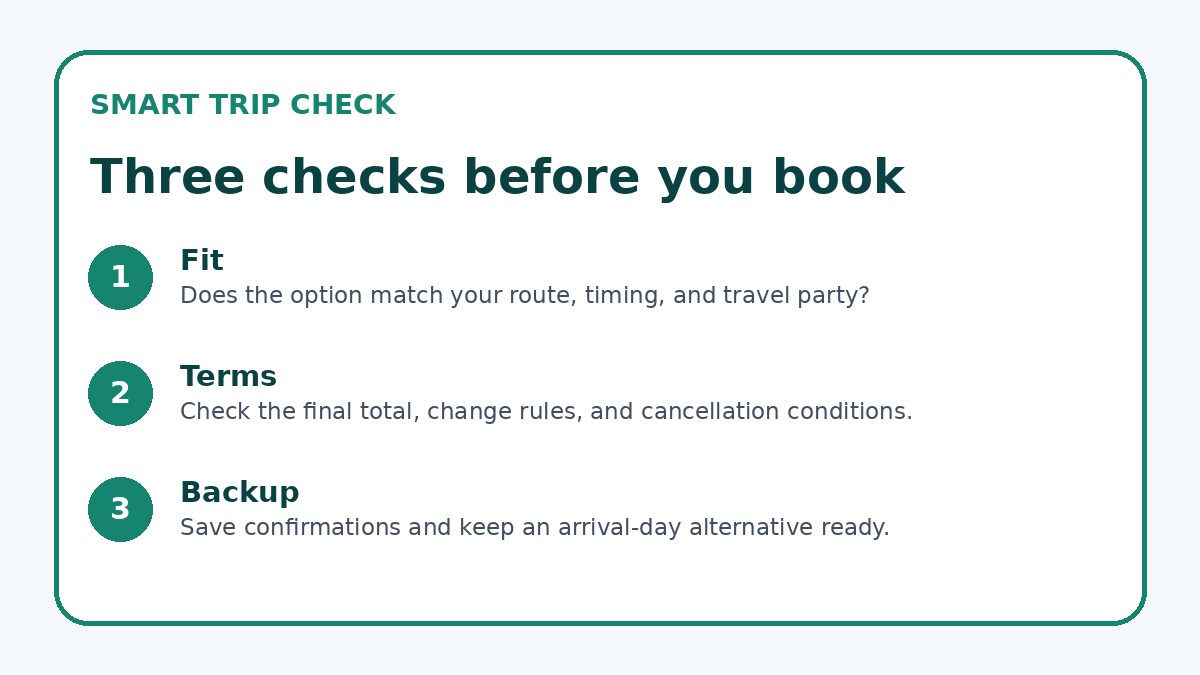
- Confirm the exact departure and arrival terminals for each leg and map last-mile transit options to your accommodation.
- Check luggage allowances, whether through-checking is available, and where station lockers or left-luggage services operate.
- Build realistic connection buffers of at least 30–60 minutes between modes, increasing the buffer for nighttime or ferry legs.
- Verify rebooking, cancellation, and refund rules on the operator’s booking page before purchasing any ticket.
- Plan a simple disruption fallback for each leg (later train, alternate coach, taxi budget) and store local contact numbers.
- Download or print booking confirmations and a map of transfer points so you can navigate without relying on mobile data.
Disruption backups and what to verify before booking
Prepare a realistic backup plan for each option. For trains, check whether alternate departures exist on the same day and how easy it is to rebook if you miss a service; for some ticket types you may need to buy a new ticket to change. For coaches, note the next scheduled coach and whether the carrier publishes live status; for ferries, research what happens to passengers when services are cancelled for weather and whether operators offer rebooking or refunds. In every case, plan a realistic margin to your onward commitments in Kyoto in case of delay.
Before you book, verify these live details on the operator’s official booking page or a respected aggregator such as Trip.com: departure and arrival terminals, luggage allowances and rules for through-checking, last-mile transit options, and the operator’s rebooking and refund policies for disruptions. If your itinerary involves multiple operators, learn the transfer points and whether a single ticket or luggage-through option exists. Finally, keep digital and printed copies of reservations and local contact numbers for carrier help desks — they speed resolution if a disruption happens.
Rail & Intercity Transport questions travelers ask
Is the train always the fastest way to travel from Tokyo to Kyoto?
Trains are typically the fastest direct land option because they run on dedicated tracks and use express services; however, actual door-to-door time depends on where you start and finish in each city and the transfers required. If your accommodation is far from a main station, a coach that departs closer to your area could have a similar door-to-door time. Always compare total travel time including the local transit and transfer waits rather than only the vehicle’s running time. Verify schedules and terminal locations on the operator’s booking pages.
Can I combine a ferry with trains without too much hassle as a solo traveler?
Yes, but expect extra handling and planning. Ferries introduce port terminals and scheduled sailings that may not align with rail timetables, so mixed itineraries often mean at least one additional transfer. If you carry heavy luggage, check whether ferries and the connecting rail provider offer assisted transfers or locker storage at the port. Build larger connection buffers for ferry legs and confirm refund or rebooking provisions for weather-related cancellations on the operator’s site before you buy any tickets.
What should solo travelers do if a service is delayed or cancelled mid-journey?
First, contact the carrier at the departure or arrival point and ask about rebooking, standby options, or refunds — staff can often advise on the next available service. If connections are tight, move to the next practical option (another train, coach, or a taxi) rather than waiting in uncertainty; use your disruption fallback plan. Keep receipts for any necessary extra expenses in case you need reimbursement under a ticket’s terms. For mixed tickets across operators, understand that each operator’s policy may differ, so verify rules before booking and keep contact numbers handy.
Final decision note
For most solo travelers prioritising speed, convenience and minimal transfers, a direct fast train-style service between Tokyo and Kyoto offers the clearest door-to-door benefit. Coaches are a pragmatic alternative when budget or late-night departures matter, but they usually move the arrival or departure point away from the city centre. A ferry-inclusive route adds variety and scenery but increases transfer friction and scheduling risk. Whichever approach you pick, focus on terminal fit, luggage handling, realistic buffers, and an explicit disruption backup. Verify live schedules, terminals, luggage rules, and rebooking options on the operator’s booking page (or a comparator such as Trip.com) before committing, and use the checklist to finalise a solo-friendly itinerary.
Continue planning
Check current options and final conditions
Use the provider page to confirm live availability, the final total, cancellation terms, and every condition that matters to your trip.
This evergreen planning guide was created with AI-assisted drafting and a structured quality review. It does not display live prices, schedules, availability, visa guidance, or provider rankings. Verify current details before booking. Some links are affiliate links; we may earn a commission at no additional cost to you.