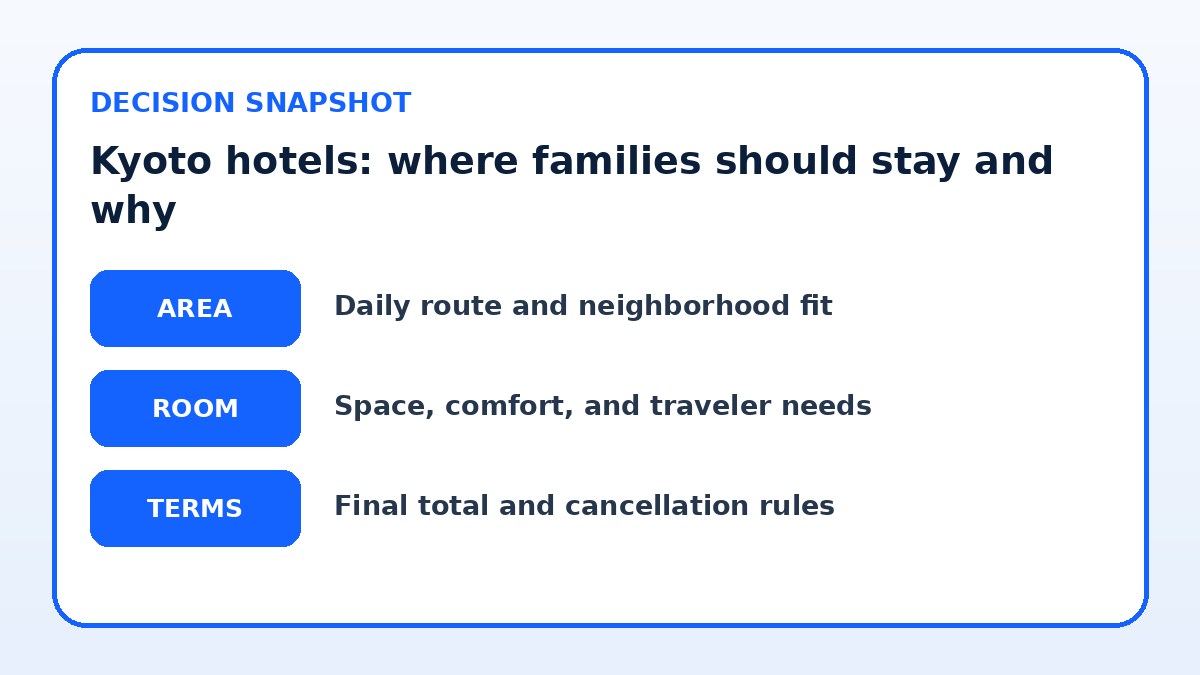
Pick the neighborhood first, then the hotel. For families in Kyoto the most important choice is not a single property but the area you’ll use as home base each day — it determines how you’ll move between temples, food markets, playgrounds and train stations. Choose a central, walkable ward if you want short daily routes and fewer transfers; choose a quieter residential area if you value kid-friendly streets and bigger rooms; choose a ryokan cluster for a cultural experience that may require more local transport. Below I give a practical shortlisting method: match your family’s mobility, meal needs, and sight priorities to four common neighborhood approaches. After that you’ll find how daily-route friction affects itineraries, what room and party features to prioritize, and the specific booking terms to verify on a hotel or booking site before committing.

Check live stays in the areas that fit
Use your dates and party size to compare current rooms after you narrow the neighborhood fit.
Neighborhood fit: who in the family and what you’ll do each day
Start by listing who’s traveling and the day-by-day activity style you want. Are you packing in three temple visits plus a market stop every day, or planning long relaxed mornings with playground time and one major afternoon trip? A high-energy sightseeing schedule favors staying near the Kawaramachi–Gion–Downtown spine or close to Kyoto Station for quick rail links. Families that need nap breaks, quieter evenings and space to spread out should favor residential neighborhoods with larger rooms and parks nearby. Consider whether a member uses a stroller, needs step-free access, or has mobility limits — areas with stone-flagged alleys and stairs (common around historic sites) can slow you down.
Also think about meal needs and rhythm. Do you want easy evening options for picky eaters, or are you happy cooking in a kitchenette? Proximity to convenience stores, family-friendly izakaya, and supermarkets matters more with young children than proximity to a landmark. If breakfasts must be quick, look for hotels that include a family buffet or are within a short walk of cafés. Factor in seasonal issues: cherry-blossom crowds or autumn foliage weekends can turn a short walk into a long, slow shuffle with children, so a slightly more distant but quieter neighborhood may be preferable on busy dates.
Choose an area-selection strategy
| Area approach | Best for | Tradeoff to check |
|---|---|---|
| Stay near Kyoto Station or a major transport hub | Families planning frequent day trips or with lots of luggage and mobility needs | Less historic atmosphere and potentially more traffic noise despite very short transfers. |
| Stay in central Gion/Kawaramachi (historic city center) | Families prioritizing walkable access to temples, markets, and evening dining | Narrow streets and crowds increase walking time with strollers and can be noisy in evenings. |
| Stay in quieter residential wards (e.g., northern or eastern neighborhoods) | Families who want larger rooms, parks nearby, and calm evenings | Daily trips to major sights may require more transfers or longer rides. |
| Stay near cultural ryokan clusters or temple precincts | Families seeking a traditional Japanese lodging experience and morning temple walks | Smaller rooms and steps; may require planning for meals and transport outside the neighborhood. |
Daily-route friction: how neighborhood choice changes travel time and stress
Map the common routes you’ll take each day — from hotel to morning attraction, lunch area, afternoon plan and evening dinner — then imagine those routes with a stroller or tired kids. Staying near a main subway or the JR lines reduces transfers for day trips to Arashiyama, Nara or Osaka; close proximity to busier transport hubs can save walking but may mean noise. Historic lanes, while charming, often lack curb cuts and are slower to navigate. If you plan multiple out-of-ward day trips, prioritize a location with easy access to Kyoto Station or a major subway line even if that neighborhood is less atmospheric.
Pay attention to last-mile communication: taxis in Kyoto are plentiful but can be expensive for repeated short hops; check whether your hotel concierge can reliably call a car or provide kid seats. In compact neighborhoods, many top temples and food streets are walkable, reducing transit time but increasing walking distance. Balance the convenience of a central hub, which shortens long-trip travel, against the benefit of a quieter, family-oriented street where you’ll spend most downtime. Make a simple daily-route sketch before you book to spot avoidable transfer points.
Now compare like with like
Keep the same dates, guests, room needs, and cancellation preferences while you compare the final choices.
Room and party needs: what to check on listings before you book
Before you hit the booking button, confirm the room layout and sleeping options for your party. Look for explicit family-room descriptions, bed configurations, and whether cribs or rollaway beds are available. Many Kyoto properties list room area in square meters; compare that number against how much floor space your family needs for nighttime routines and morning baggage. If you need a kitchenette or separate sleeping areas for babies and older kids, verify that with the property directly. Photograph-based listings can be misleading about scale — ask for photos of the exact room type or a floor plan if space is critical.
Also verify practical policies that affect families: age definitions for child rates, extra-person fees, and the hotel’s cancellation and modification rules. For ryokan stays, ask about tatami mat sleeping arrangements and whether Western-style beds are an option for younger children. Request information about onsite laundry, stroller storage, elevator access, and whether housekeeping times are flexible around naps. Remember to confirm any special requests or accessibility needs on the hotel’s live booking page or by email so there’s no last-minute mismatch between expectation and reality.

Hotel booking check before payment
- Sketch your typical day (morning, lunch, afternoon, evening) and mark transfer points to see which neighborhood minimizes friction.
- Confirm exact room type, bed configuration and square meters directly with the hotel or on its booking page.
- Check child-age definitions and extra-person fees so costs are clear before checkout on the final booking screen.
- Ask the hotel whether they can supply a crib, rollaway, or adjoining rooms and obtain written confirmation when possible.
- Verify elevator access, stroller storage and step-free routes from public transport to the property for mobility needs.
- Note check-in/out times and luggage-hold policies; request early check-in or late check-out if it will ease family logistics.
Final booking terms: what to verify on the provider page before payment
When you’re ready to book, verify four critical items on the property’s final page: the exact room type and any photos tied to that SKU, the cancellation and modification policy for your dates, whether child pricing applies automatically or needs to be added, and any mandatory local taxes or fees that appear at checkout. Don’t rely on third-party summaries for these details — open the hotel’s own booking page or contact them directly to confirm. If you use an aggregator, double-check that the room you selected includes the bed and bedding arrangement you expect.
Also confirm check-in and check-out windows, luggage holding policies and whether late arrivals are accepted without extra charges. If you’re traveling on a busy holiday, ask the property how they handle early check-ins or late check-outs for families with small children. For extra peace of mind, note the property’s stated method for handling special requests (cribs, adjacent rooms, dietary needs) and get a written confirmation when possible. If you decide to compare current availability, you can check Trip.com as one of several places to view live options, but always verify the booking terms on the hotel’s own page before finalizing.
Hotel Guide questions travelers ask
Which Kyoto neighborhood is easiest with a stroller or young children?
For strollers and young children prioritize flat, grid-like areas with wide sidewalks and close subway access. The central Kawaramachi–Downtown spine and neighborhoods near Kyoto Station have more continuous pavement and easier transit links than the winding alleys around some temples. Before you book, check maps for station exits, confirm elevator availability at nearby stations, and ask the hotel about step-free access from the street into the lobby. If a short walk is unavoidable, plan routes that avoid narrow, crowded lanes during peak hours.
Is it better for families to choose a ryokan or a Western-style hotel in Kyoto?
Ryokan offer cultural immersion and often include meals but typically have more compact rooms, tatami flooring and futon bedding that might be less convenient with small children. Western-style hotels usually provide larger rooms, fixed beds, and more predictable family-room options. Decide which matters more: cultural experience or practical space. If choosing a ryokan, confirm bedding arrangements, child policies, and meal times. If space and predictable routines are priorities, verify room size and bedding layout in a Western hotel listing.
How should families balance sightseeing ambitions with neighborhood choice?
List your must-see sites and estimate how many of them fall within walking distance of a single neighborhood. If most attractions require venturing across the city, a base near Kyoto Station or a subway line reduces transfer stress. If you plan relaxed days focused on one area—northern temples or the Gion area, for example—choose a neighborhood within that cluster and accept occasional longer day trips. Use a simple travel map to count transfers and walking distance with children; prioritize minimizing the number of transfers and steep walks over shorter raw distance.
Final decision note
Choosing where to stay in Kyoto for a family trip is a neighborhood decision as much as a hotel one. Match your daily habits—how far you’re willing to walk, whether you need quiet evenings, and how many day trips you’ll take—to one of the four neighborhood approaches above. Once you shortlist an area, prioritize room size, bed setup, and child policies when comparing specific hotels, and verify those details on the hotel’s live booking page before paying. With the area chosen first, you’ll narrow hundreds of properties to a manageable shortlist and make a family-friendly booking with far less stress.
Continue planning
Check current options and final conditions
Use the provider page to confirm live availability, the final total, cancellation terms, and every condition that matters to your trip.
This evergreen planning guide was created with AI-assisted drafting and a structured quality review. It does not display live prices, schedules, availability, visa guidance, or provider rankings. Verify current details before booking. Some links are affiliate links; we may earn a commission at no additional cost to you.