If you’re arriving in Kyoto carrying extra suitcases, instruments, or bulky gear, the fastest practical decision is this: choose a private transfer when door-to-door comfort, minimal handling, and predictable space matter; choose public transport when you want lower cost, shorter peak travel times on mixed routes, or the freedom to move independently within the city. Both approaches work for luggage, but they require different planning and priorities. This guide helps you weigh time, convenience, cost, and risk so you can pick the option that fits your itinerary and appetite for effort. Read on for concrete decision criteria, how to compare routes and vehicles, what to verify before booking, and a short checklist to follow at the airport and in Kyoto.
See current options before you compare the details
Availability and final conditions change. Open Trip.com now or keep reading for the practical comparison.
How extra luggage changes the usual Kyoto transfer decision
Luggage turns a routine transfer into a logistics problem. Small backpacks and one carry-on behave differently from surfboards, oversized suitcases, or multiple heavy bags. With extra luggage you should shift focus from headline travel times to the sequence of actions between door and platform: distance from arrival gate to baggage claim, carriage access (stairs, ramps, elevators), platform layouts, and how much you’ll carry during any transfer. These practical touches often determine whether a public train or airport bus remains viable or whether a private vehicle is worth the premium.
Also consider local last-mile needs inside Kyoto. Narrow streets, historical neighborhoods, and hotels without large loading zones can complicate private vehicle drop-offs, while public transport often stops closer to dense districts. Think about how and where you want to end up in Kyoto — a station, a hotel entrance, or a rental apartment — and map that final segment before choosing. That final connection frequently decides the total effort you’ll put into moving luggage around the city.
Private transfers: when they’re worth booking for heavy luggage
Book a private transfer when you value minimal handling, predictable timing, and assistance with bulky items. Private vans, taxis, or chauffeur services let you stay with your bags from airport curb to hotel door and often include help loading and unloading. For groups traveling with many suitcases, family gear, or oddly shaped items, a single vehicle that fits everything is less stressful than juggling multiple tickets, staircases, or platform crowds. Also consider late-night arrivals when public services are reduced; a pre-arranged vehicle removes uncertainty at odd hours.
But private transfers require verification: vehicle dimensions, luggage allowances, pickup point within the terminal, and any additional driver or parking rules. Different providers have specific policies about large items and pick-up procedures inside crowded terminals. Always check the provider’s booking page for the exact terminal collection point, whether the price includes tolls or waiting time, and what size of luggage is allowed. If you’re comparing options, ask for an explicit confirmation of vehicle type and confirm where the driver will meet you at the airport.
| Approach | Best for | Tradeoff to check |
|---|---|---|
| Private transfer | Travelers with many or oversized bags, groups, late arrivals, or those needing door-to-door service | Higher cost and need to confirm vehicle size, pickup location, and luggage policy on the booking page |
| Airport bus | Those carrying several suitcases who want a simple direct route to major stations or hotel zones | May require walking from the drop-off point and can be crowded; check luggage space and stop location |
| Train (regional/rapid) | Travelers prioritizing journey speed and predictable schedules who can manage stairs or elevators | Transfers and platform changes increase handling; verify transfer complexity and elevator access |
| Mixed public + luggage forwarding | Travelers who want lower effort on the city segments without paying for a full private transfer | Requires coordination, extra pickup times, and checking forwarding size/collection rules |
Ready to check the option that fits your plan?
Use your exact dates and traveler details so the provider page can show the current total and conditions.
Public transport: strategies for handling more bags efficiently
Public transport can be efficient if you plan realistically for luggage handling. Use elevators and accessible routes where available, travel outside peak commute hours to avoid packed trains, and choose airport buses if they offer direct station stops near your accommodation. When comparing train routes, check whether they require transfers that force you to carry bags between platforms. You can reduce strain by packing a wheeled suitcase with durable wheels and a lightweight backpack for essentials to keep with you on board.
Explore luggage services as part of a public-transport strategy: station coin lockers, luggage forwarding between airports and hotels, or porter services can bridge gaps. These services can let you take a faster train or walk more easily within Kyoto’s older districts. However, verify restrictions and pickup times on the provider page — some forwarding options need reservations or have size and content rules. Use these services selectively when the time saved outweighs the extra coordination.
Before you book
- Measure and photograph each large item; compare dimensions to the vehicle or baggage policy on the booking page before you reserve.
- Map terminal arrival gate to the baggage claim and nearest elevator using the airport’s official terminal map as soon as you land.
- If booking private, confirm pickup point, driver contact method, vehicle type, and exact luggage allowance on the final booking confirmation.
- If using public transport, identify elevators and barrier-free routes at each transfer station and note them in your phone maps.
- Reserve luggage forwarding or station lockers in advance if you need to travel light for a day; confirm pickup windows and ID requirements.
- Have a backup plan: install a local taxi app or save a private transfer provider’s contact, in case your planned route becomes impractical.
Making the final choice: practical checks and booking tips
Decide by comparing total door-to-door time, total cost for all travelers, and how much physical effort you can accept. Create a simple comparison: estimated wait and ride time for public transport plus transfer walking time and luggage handling versus private transfer pickup wait, driving time, and direct drop-off distance to your lodging. If traveling with elders, small children, or mobility constraints, lean toward private options even if they cost more. If you’re traveling light among several people sharing costs, public transport often scales well.
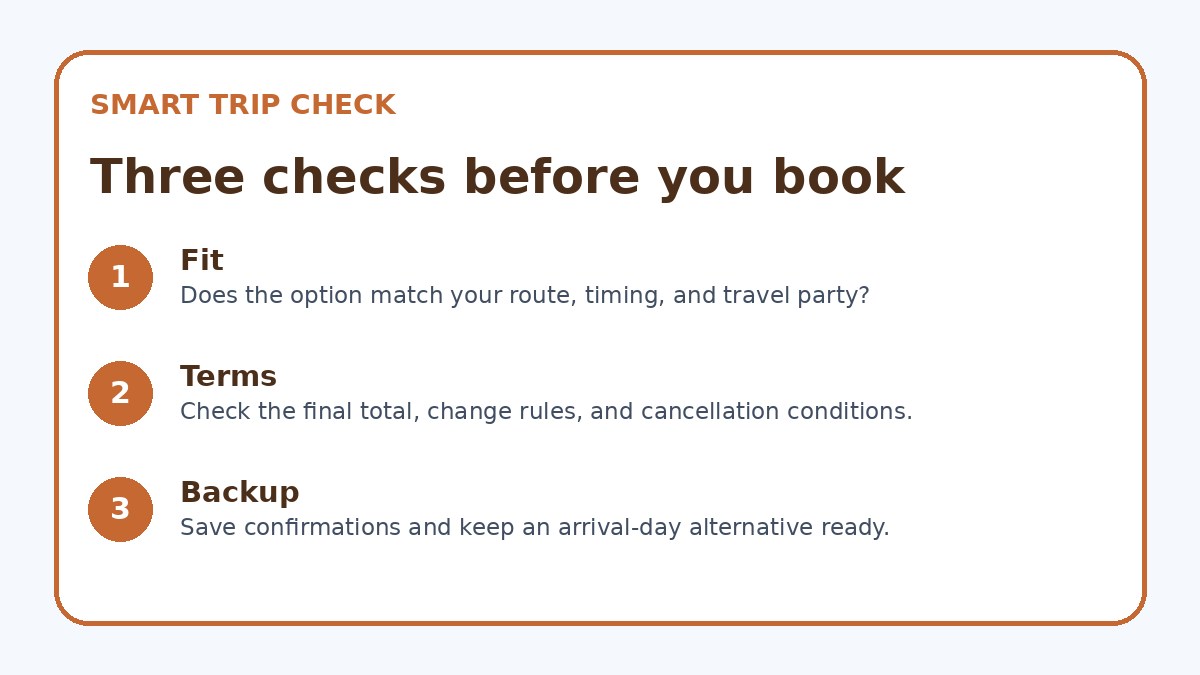
Before you book, verify essential facts on the service provider’s final booking page: allowed luggage dimensions, terminal pickup or drop-off locations, cancellation terms, and any additional surcharges for oversized items or waiting time. If using public routes, check platform access, elevator locations, and whether buses stop close to your accommodation. Consider having a backup plan: an app-based taxi or a late-night private service number handy if connections fail. For convenience, Trip.com can be used to compare current availability, but confirm details on the operator’s official page.
Frequently asked questions
Can I fit oversized items like sports equipment in Kyoto transfer vehicles?
It depends on the provider and vehicle type. Many private vans and large taxis accept oversized gear if you select an appropriate vehicle class, but dimensions and policies vary by company. For public transport, trains and buses usually accommodate wheeled suitcases but may restrict long or bulky items, especially during crowded periods. Always check the operator’s official booking page for exact permitted sizes, any need for a separate ticket for large items, and pickup or loading instructions. If in doubt, contact the provider before arrival to avoid surprises.
Is luggage forwarding worth using between Kansai airports and Kyoto?
Luggage forwarding can be worthwhile when you want to travel hands-free for several hours or during a city exploration without dragging bags. Forwarding services typically deliver to hotels or designated pickup points the day after collection, but each service sets its own delivery windows, size limits, and collection rules. Choose forwarding when the convenience outweighs the time and coordination required; verify pickup times and whether your accommodation accepts forwarded items. Always confirm specifics on the forwarding provider’s booking page, and keep tracking details until your bags are delivered.
How do I compare total door-to-door time between public and private options?
Estimate every step: time to clear immigration and baggage claim, time walking to the pickup point or platform, waiting time for the next vehicle, in-vehicle travel time, plus walking or taxi time from drop-off to your lodging. For public options, add typical transfer walking times and potential delays during peak hours. For private transfers, include expected driver waiting time and possible traffic variability. Make two simple sums (public vs private) and pick the option with the lower combined effort and acceptable schedule risk. Verify scheduled departure times and pickup details on each operator’s booking page before finalizing.
Final planning note
Choosing between public and private Kyoto airport transfer options when you carry extra luggage comes down to weighing effort, predictability, and cost. Private transfers minimize handling and uncertainty at the price of higher expense and the need to confirm vehicle and pickup details. Public transport can save money and sometimes time, but you must plan transfers, elevator access, and potential crowds. Run a quick door-to-door comparison for your arrival time, verify luggage rules on provider pages, and use luggage forwarding or station locker options when they reduce physical strain. With those checks complete, you’ll pick the option that fits your comfort level and schedule.
Continue planning
Check current options and final conditions
Use the provider page to confirm live availability, the final total, cancellation terms, and every condition that matters to your trip.
This evergreen planning guide was created with AI-assisted drafting and a structured quality review. It does not display live prices, schedules, availability, visa guidance, or provider rankings. Verify current details before booking. Some links are affiliate links; we may earn a commission at no additional cost to you.