If you need to get to Kuala Lumpur for work but want to avoid impulse bookings driven by every alert, the practical answer is to set clear rules and a short decision window. Create alerts for your preferred flight times, class of service, and a small selection of hotels near your meeting location; then use a two-step rule: verify total cost and schedule compatibility on the provider’s booking page, and freeze your choice for a fixed review period (24–72 hours) before confirming. This keeps you responsive to real opportunities while preventing reactive choices that clash with meeting times or company policy. The rest of the piece explains tradeoffs, how to tune alerts for business travel, what to compare when an offer appears, and which exact items to check on booking pages and itineraries.
See current options before you compare the details
Availability and final conditions change. Open Trip.com now or keep reading for the practical comparison.
Build alert filters that match business constraints
Business trips have priorities that leisure trips do not: arrival time before a first meeting, reliable connectivity, and corporate expense policy. Set alerts for specific airports (e.g., your home airport to Kuala Lumpur), narrow departure windows that match your available travel days, and the cabin class your company allows. For hotels, pick a short list of neighborhoods or transit links near your meetings rather than chasing the lowest nightly rate citywide. Narrowing filters reduces noise and increases the chance an alert represents a useful option rather than a tempting but impractical deal.
Also include operational filters that matter for work: non‑red-eye options if you need to be functional on arrival, or sufficient minimum connection times if changing flights. Many platforms let you exclude basic-economy fares or filter refundable rates—use those to align alerts with your company’s flexibility needs. If a provider offers flexible dates alerts, set a range of +/- one or two days from your preferred travel dates to reveal small savings without introducing disruptive schedule changes.
Use a staged decision process to avoid impulse booking
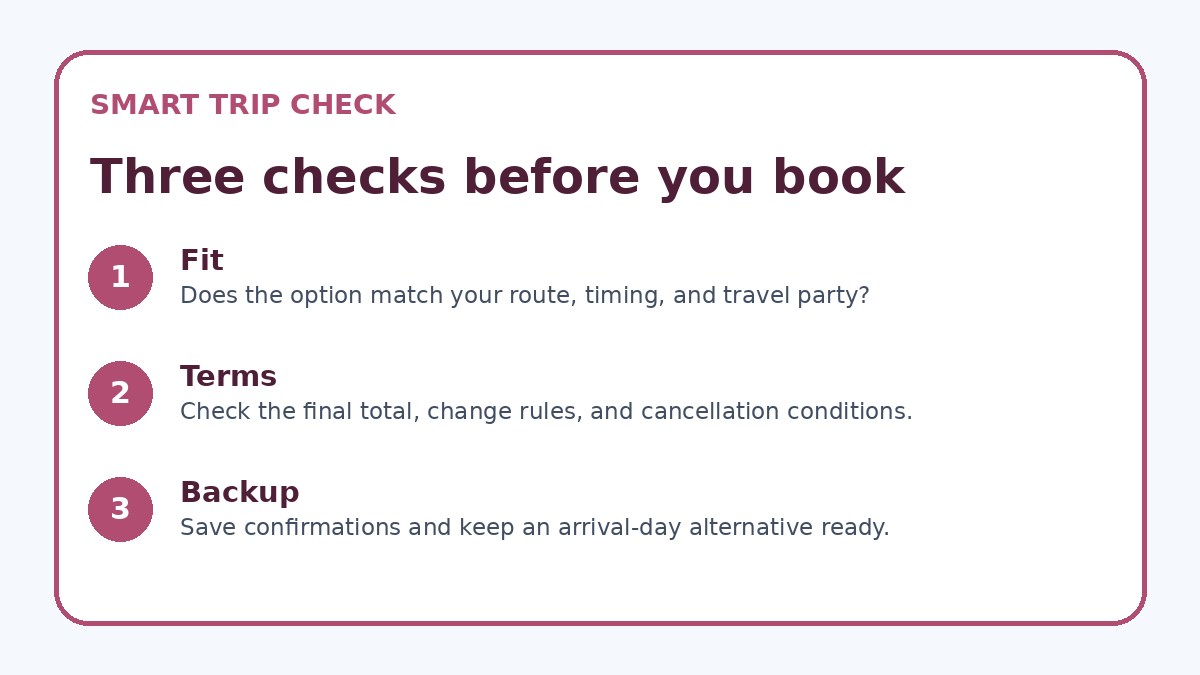
When an alert arrives, follow a short, repeatable checklist before booking: confirm total landed cost with taxes and baggage, ensure the flight itinerary matches your meeting window, and check whether the hotel rate shows the correct room type and cancellation policy. Open the final provider booking page to review the exact terms—many price discrepancies or fare rules only appear at checkout. If your company requires pre-approval, forward the screenshot and the booking‑page link as part of your staged decision.
Adopt a personal ‘cooling-off’ window—24 to 72 hours depending on how soon you must travel—before completing payment unless a verified corporate policy or a tight schedule forces immediate confirmation. During this time, re-scan alternative alerts and check whether similar fares remain. This prevents emotional responses to a single alert and gives you time to verify logistics like airport transfers and meeting timing.
| Approach | Best for | Tradeoff to check |
|---|---|---|
| Immediate-book on first alert | Travelers with last-minute schedules and no approval layers | Risks higher cost, overlooked restrictions, and potential mismatch with meeting times |
| Follow a short cooling-off period | Most business travelers balancing price and schedule certainty | May lose very short‑lived fares but reduces impulse mistakes |
| Flexible-date alert with +/- range | Travelers with some date flexibility seeking better deals | Introduces schedule variation that can complicate fixed meeting plans |
| Premium alert services or concierge | Frequent travelers who value curated options and time savings | Adds cost and still requires checking final booking terms and company policy |
Ready to check the option that fits your plan?
Use your exact dates and traveler details so the provider page can show the current total and conditions.
Compare direct and connecting options methodically
A cheaper connecting itinerary can be appealing, but for business travelers the real metric is reliability and total travel time, not just fare. When comparing direct and connecting options, calculate door-to-door time (including transfer to and from airports), the number of critical connections, and the buffer you need before meetings. Consider whether a connection leaves you vulnerable to missed transfers or suggests an overnight layover that would complicate your schedule. Also weigh recovery options—how easy is it to rebook or take another flight if disruption occurs?
Look beyond the ticket price: check baggage transfer policies for multi-carrier itineraries, whether the connection airport is prone to delays, and how tight the minimum connection times are shown on the booking page. If the provider shows multiple carriers, verify which carrier operates each leg and confirm baggage and change rules on the final checkout screen. For many business trips, a slightly higher fare with fewer risks can save time, stress, and possible expense later.
Before you book
- Set alerts for specific airports, preferred time windows, and allowed cabin class to filter irrelevant deals.
- Confirm total landed cost including taxes, fees, and baggage on the provider’s final booking page.
- Verify flight arrival and departure times align with meeting schedules and buffer for local transit.
- Check hotel room type, cancellation rules, and whether the listed rate includes taxes or service fees.
- Follow your company’s approval process and attach screenshots of the alert and booking page when requesting sign-off.
- Decide on a fixed cooling-off window (24–72 hours) before final purchase unless immediate booking is necessary.
What to verify on the booking page and with your company
Never finalize a booking without checking the provider’s final booking page for these specifics: the full breakdown of fare and taxes, baggage allowances, change and cancellation fees, exact hotel room type, and whether there are prepaid or refundable rate distinctions. Policies that appear in summary emails or alert snippets can omit critical clauses; the booking page is the authoritative source for terms. If you used a comparison site, cross-check the same itinerary on the airline’s or hotel’s site to confirm seat assignment rules or loyalty accrual.
Also confirm your company’s travel policy and any required approvals before you lock a fare. If pre-approval is required, include total landed cost and anticipated meeting times in the approval request. Keep screenshots of alerts and the final booking page in case a difference arises between the alert and the checkout price. If you want a quick third-party check, you may compare availability on Trip.com as one optional reference, but always trust the provider page for final terms.
Frequently asked questions
How long should I keep a price alert active before deciding?
Keep an alert active until you either book or decide the rule no longer fits your trip needs. For business travelers, combine active alerts with a personal decision window—typically 24 to 72 hours—once an attractive option appears. This lets you verify itinerary fit, company approval needs, and total landed cost. If your meeting schedule is flexible by a day or two, a longer alert window that monitors slight date shifts can reveal better rates; if dates are fixed, narrow the alert criteria to avoid irrelevant results.
If a low fare shows tight connections, is it ever worth taking?
Tight connections can be acceptable if you have buffers and contingency plans, but for most business trips they introduce unacceptable risk. Evaluate how much extra door-to-door time the cheaper route saves, the airport’s on-time performance, and whether rebooking options are clear on the provider’s checkout page. Consider the cost of a missed meeting or last-minute rebooking. Often, paying a bit more for a direct or well-timed connection buys reliability that preserves your schedule and reduces stress.
Can I rely on alert screenshots when requesting corporate approval?
Screenshots are useful, but approvals should reference the final booking page because alerts sometimes omit fees, baggage rules, or fare conditions. When requesting sign-off, include a screenshot of the alert, a link to the booking page, and the total landed cost shown at checkout. If your company requires invoices or pre-authorization, note any refundable versus nonrefundable elements visible on the provider’s page. This minimizes surprises and speeds approval when the fare is time-sensitive.
Final planning note
Price alerts are powerful tools for business travel to Kuala Lumpur when used with discipline. Narrow your alert criteria to the travel constraints that matter for work, adopt a short staged decision process to verify total costs and schedule fit, and always confirm the exact terms on the provider’s booking page before payment. Compare direct and connecting itineraries by door-to-door time and recovery options rather than ticket price alone. With the right filters, a consistent approval workflow, and a cooling-off habit, you can capture useful Kuala Lumpur travel deals without the downsides of impulse bookings.
Continue planning
Check current options and final conditions
Use the provider page to confirm live availability, the final total, cancellation terms, and every condition that matters to your trip.
This evergreen planning guide was created with AI-assisted drafting and a structured quality review. It does not display live prices, schedules, availability, visa guidance, or provider rankings. Verify current details before booking. Some links are affiliate links; we may earn a commission at no additional cost to you.