Practical answer up front: for most business travelers the fastest and least logistically complex option is an air connection between Kuala Lumpur and Singapore, provided you pick flight times and airports that match your meeting schedule and allow reliable transfer time at each end. If your company values predictable door‑to‑door timing, consider premium bus services or private car transfers — they reduce airport overhead but increase surface travel variables. To decide, compare total trip time (including transfers and boarding), the risk profile for delay, and how much you need working time en route. Use the provider’s official booking page to confirm exact schedules, baggage allowances, and check‑in or boarding requirements; you can also compare current availability and conditions on Trip.com as a single place to view options.
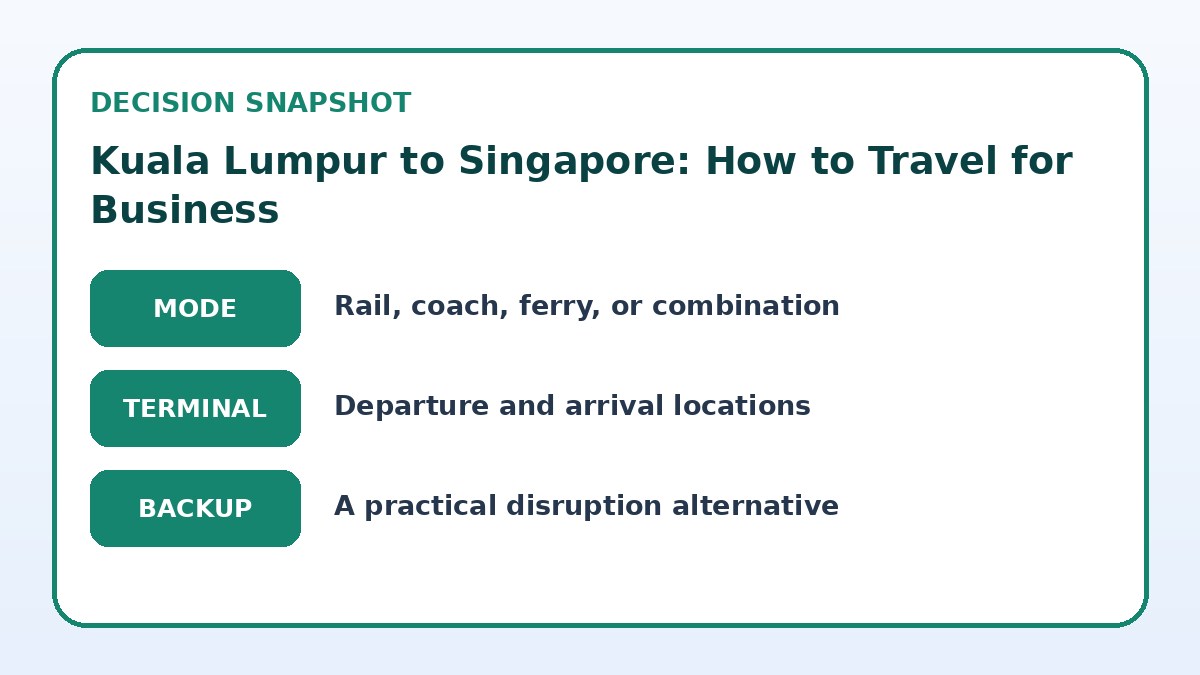
See current options before you compare the details
Availability and final conditions change. Open Trip.com now or keep reading for the practical comparison.
How to compare total door‑to‑door time
Business travelers should stop thinking only in terms of scheduled in‑motion hours and instead calculate door‑to‑door time: start with the time to reach your origin terminal, add recommended lead time for check‑in or boarding, include expected transfer or immigration formalities, and finish with travel from the arrival terminal to your meeting address. That full sequence reveals where each mode gains or loses—air may win on in‑motion speed but lose in terminal overhead; road options avoid terminal time but are susceptible to traffic or road checkpoints.
When comparing options, build a simple timeline for each: home/office to departure point, buffer for unexpected delays, the trip itself, and arrival transfer to your meeting. For repeat trips, log actual door‑to‑door durations you experience and refine future planning. If your company requires arrival windows (e.g., 60–90 minutes before a meeting), use those constraints to eliminate any option whose realistic timeline regularly fails to meet them.
Reliability and risk management for meetings
Reliability matters more than headline speed for business travel. Flights can be fastest but carry risks of delays, cancellations, and longer recovery windows if something goes wrong. Road transfers and premium coach services trade potential speed for fewer transfer points and simpler contingency steps: delayed arrival often means a later departure rather than an extended recovery process through airports and airlines.
Manage risk by evaluating the most important single failure mode for your trip—late arrival, lost luggage, or sudden schedule change—and choose the option that minimizes that risk. Book services with clear change or refund policies, add travel insurance or corporate trip protection if your employer offers it, and keep alternative contact and rescheduling procedures ready so you can pivot quickly if the unexpected happens.
| Approach | Best for | Tradeoff to check |
|---|---|---|
| Air travel | When minimizing in‑motion time and covering longer distances quickly | More terminal overhead and higher sensitivity to schedule changes or delays |
| Premium coach | Reliable door‑to‑door planning with less terminal complexity | Longer surface travel and variable traffic conditions |
| Private car transfer | Direct pickup/drop‑off, flexible timing, and confidentiality for sensitive calls | Potentially higher cost and exposure to road congestion |
| Hybrid booking (mix modes) | Balancing speed and predictability by selecting the optimal leg for each priority | More complex logistics and potential additional costs for transfers |
Ready to check the option that fits your plan?
Use your exact dates and traveler details so the provider page can show the current total and conditions.
Comfort, productivity and onboard amenities
For business travelers the ability to work en route is a major decision driver. If you need focused time, compare seat comfort, available workspace, power outlets, and connectivity across modes. Some premium buses and private transfer services advertise dedicated table space and steady internet; select flights and airport lounges can provide a quieter environment to prepare or debrief around a meeting.
Don’t forget the cumulative effect of multiple short interruptions—security, boarding, and transfers—which can fragment your working time even if the total trip appears brief. If you rely on video calls or prolonged document editing, prioritize a single uninterrupted block of travel time and verify onboard internet quality or plan to use offline files during transport.
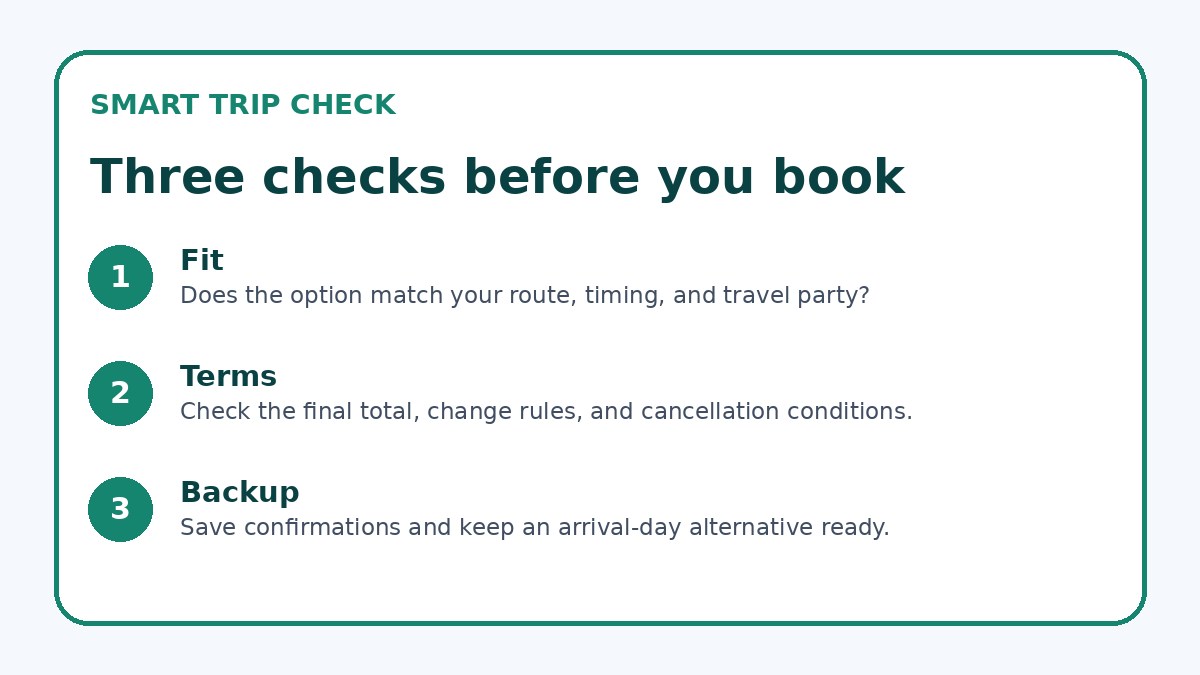
Before you book
- Map door‑to‑door timelines for each option including transfers, check‑in, and arrival commute to the meeting address
- Confirm refund/change policies, baggage rules, and check‑in times on the provider’s booking page before final payment
- Choose arrival windows with a safety buffer that reflects company tolerance for missed or delayed meetings
- Book transport with onboard power and connectivity if you must work en route, and test access before departure
- Pre‑arrange ground transfers at each end to reduce last‑mile uncertainty and confirm driver contact details
- Keep digital and printed copies of travel confirmations, and share an itinerary with your office and meeting host
Cost controls and company policy considerations
Expense policy often constrains which options are practical. When comparing fares or quotes, include ancillary costs such as airport transfers, parking, Wi‑Fi passes, and the value of your time. Some companies allow premium ground transfers in lieu of business‑class air when door‑to‑door predictability is a priority; others mandate the lowest available class. Align your booking choice with corporate travel policy and get pre‑approval when choosing an option outside standard rules.
If cost is fixed but timing is critical, use a hybrid approach: book economy air for the outbound leg when you must be there quickly and book a private car for flexible return travel, or vice versa. Before finalizing, verify refund and change terms on the provider’s booking page to ensure that the option remains workable if meeting times shift.
Frequently asked questions
Is flying always the fastest way between Kuala Lumpur and Singapore for business travelers?
Not always. Flying often minimizes the actual airborne time, but when you factor in time to reach the airport, recommended check‑in and security buffers, immigration, and the final journey from the arrival airport to your meeting, a surface option can be competitive—especially if the meeting is close to a highway or coach terminal. Compare door‑to‑door timelines for your specific origin and destination and remember to verify schedules and boarding rules on the provider’s booking page before you commit.
How should I decide between a premium coach and a private car transfer?
Choose based on priorities: if cost predictability and a fixed schedule matter, a reputable premium coach with reserved seating may be sufficient. If confidentiality, flexible pickup times, or multi‑stop itineraries are required, a private car gives direct control and point‑to‑point convenience. Factor in travel time variability from traffic and confirm cancellation terms and driver contact details prior to booking to avoid last‑minute surprises.
What should corporate travelers verify with their employer before booking?
Confirm permissible expense classes, preferred vendors, required approval processes for non‑standard bookings, and any corporate travel insurance coverage. Also check whether the company mandates specific arrival buffers before meetings and whether it will reimburse premium ground transfers or flexible air fares. Finally, verify any reporting or receipt documentation you must provide after travel to comply with company policy.
Final planning note
Choose the option that meets your primary business priorities: if minimizing elapsed door‑to‑door time is essential, prioritize air connections that align with your schedule and give yourself conservative transfer buffers. If predictable arrival windows and reduced terminal overhead are more valuable, premium coach services or private car transfers can deliver a simpler logistics chain and more productive onboard time. Always check the provider’s booking page for current schedules, fare rules, and change/cancellation terms before finalizing, and consider a hybrid approach when your outbound and return priorities differ.
Continue planning
Check current options and final conditions
Use the provider page to confirm live availability, the final total, cancellation terms, and every condition that matters to your trip.
This evergreen planning guide was created with AI-assisted drafting and a structured quality review. It does not display live prices, schedules, availability, visa guidance, or provider rankings. Verify current details before booking. Some links are affiliate links; we may earn a commission at no additional cost to you.