If you and your partner are deciding whether to rent a car in Jeju, the practical answer is: driving usually improves flexibility and scenery control, but only if you check fuel and mileage terms carefully before booking. Couples often assume the car equals freedom without noticing flat-rate mileage caps, fuel-return conditions, or insurance wording that can turn a scenic day into an unexpected charge. Read the fuel refill rules, per-day or per-trip mileage allowances, and how insurers treat mileage and off-road use. Also check pickup and return friction—airport counters versus downtown handoffs—and whether penalties apply for late drop-off or missing fuel receipts. If driving doesn’t suit your comfort level, there are reliable non-driving fallbacks like taxis, local buses, and guided day tours that keep you mobile without the risk of contract fines. This guide helps you decide, compare options, and prepare the exact questions to ask on the final booking page.

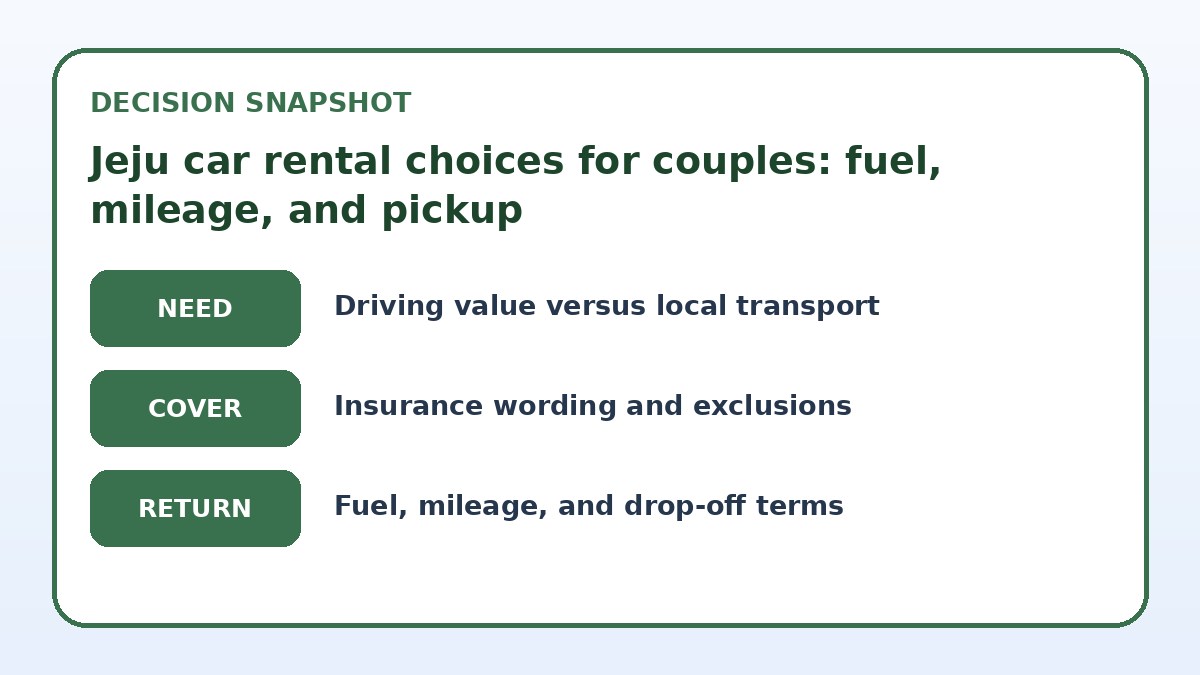
Does driving improve a couple’s Jeju trip?
Driving on Jeju genuinely adds flexibility for couples who want sunrise stops, late-evening drives, and detours to lesser-known waterfalls or coastal viewpoints. You control timing for meals and photo stops, carry picnic supplies, and avoid the inflexibility of fixed tour schedules. For two people sharing costs, a small-to-mid-size rental often works out reasonably when you factor in taxi fares for multiple short journeys. However, that freedom only stays affordable if fuel refilling and mileage rules are favorable—unexpected per-kilometre charges or punitive refuel surcharges can wipe out any perceived savings.
If both of you prefer relaxed navigation and one driver is comfortable with local roads, driving is a high-value choice. But if either partner is stressed by unfamiliar traffic patterns, narrow rural roads, or night driving, the benefits reduce quickly. Evaluate how your itinerary’s route density interacts with mileage allowances: a coast-to-mountain loop, multiple day trips, or island-wide exploration will consume kilometers faster than a base-and-explore plan. That calculation tells you whether you actually need a car or just occasional point-to-point transport.
Decide whether driving earns its place
| Mobility strategy | Best for | Cost or friction to check |
|---|---|---|
| Full rental for entire trip | Couples prioritizing total flexibility and frequent stops across Jeju. | Higher risk of mileage overage and fuel/refuel penalties unless terms are favorable. |
| Short-term rental for key days | Couples who want a few private driving days and to minimize mileage exposure. | More planning to synchronize rental days with itinerary peaks; may add pickup-return fees. |
| Public buses and local transport | Couples on a budget or who prefer not to handle driving responsibilities. | Less spontaneity and dependence on schedules; some remote sites require transfers or walking. |
| Taxis, ride-hailing, and guided tours | Couples wanting door-to-door convenience without rental contracts or insurance worries. | Costs can add up for many short trips; you lose vehicle storage and full control over timing. |
Check live rental choices only after the route test
Use the exact driver, dates, pickup point, and return plan to compare current conditions.
Fuel, mileage and insurance: the contract details to verify
The three contract items that most often cause disputes are fuel-return policy, mileage allowance, and insurance exclusions. Fuel-return can be full-to-full, pre-purchase, or charged at return with admin fees. Ask whether the company accepts fuel receipts from local stations, or if they charge their own top-up rate and a service fee—those fees can be substantial compared with self-refuelling. For mileage, confirm daily caps, overage rates per kilometre, and whether certain promotions appear unlimited but really include a fixed total allowance across the rental.
Insurance wording matters because some collision and theft protections are voided by exceeding mileage caps, driving on unpaved roads, or having an unauthorized driver behind the wheel. Read the excess/deductible amounts and what conditions increase them. If you rely on a credit-card or third-party insurance for cover, verify the rental firm’s accepted policies and whether any clauses specifically exclude claims when the vehicle has been driven beyond the agreed mileage or returned without specified fuel documentation. Always make a checklist of contract items to confirm at pickup and on the booking page.

Compare the full rental conditions
Confirm insurance wording, exclusions, deposit, fuel, mileage, and return terms on the final page.
Pickup, return friction and practical tips for couples
Pickup and return logistics can influence whether a rental is convenient for two people. Airport pickups are often convenient but may involve a shuttle from the terminal, counter queues, or limited staff late at night. Downtown offices may offer direct handovers or simpler paperwork, but could add time or require extra drop-off charges. For couples, decide who handles the handover, ensure both drivers are listed on the contract (with appropriate IDs), and photograph fuel level and dash odometer on pickup to avoid disputes at return. Ask whether the company provides a written fuel level and odometer reading at handover.
When returning the car, confirm acceptable final steps: where to refuel, whether to present receipts, and how late returns are managed. If you plan an early-morning flight or ferry, check after-hours return procedures—some companies lock keys in a dropbox, others charge for off-time service. For couples splitting tasks, designate one person to handle drop-off while the other collects luggage or arranges onward transport. Note any final inspection process and request a signed checklist or emailed confirmation to document condition and fuel/odometer status when you return the vehicle.
Car rental terms to verify
- Confirm fuel-return policy (full-to-full, pre-purchase, or pay-at-return) and ask how return top-ups are priced and invoiced.
- Check total and daily mileage allowances, overage rate per kilometre, and whether promotions include hidden caps.
- Verify insurance cover details: excess amounts, mileage-related exclusions, allowed drivers, and accepted third-party policies.
- Request documentation of pickup odometer reading and fuel level (photo or signed form) and keep a copy for return disputes.
- Ask about pickup and after-hours return procedures, including dropbox key policies and any late-drop fees.
- Plan a hybrid option before booking: price short rentals plus taxis/tours against a full rental including projected overage and fuel.
Non-driving fallback: options that keep a couple relaxed
If the contract’s fuel, mileage, or insurance terms look risky for your plans, adopt a non-driving strategy. Taxis and point-to-point apps offer door-to-door convenience without contract liability—ideal for short island hops or evening returns when one partner prefers not to drive. Local buses on Jeju cover major routes and are extremely cost-effective for couples willing to plan around schedules, though they limit spontaneous detours. For a middle ground, book guided day tours for complex routes like Hallasan or multiple coastal stops, combining local knowledge with transport and leaving contractual concerns to the operator.
Another option is a hybrid approach: rent a car for only the days you need the most flexibility—reserve one scenic driving day and use buses or taxis for the rest. This reduces total mileage and fuel exposure while keeping at least one private day for peak viewpoints. When using mixed transport, plan luggage logistics and carry a compact daypack so you can switch between car and public options without delays. Always price the hybrid against full rental costs after adding anticipated mileage fees and fuel surcharges to see which is cheaper and less stressful.
Car Rental & Road Trip questions travelers ask
How can couples avoid fuel refuel surcharges when returning a rental car in Jeju?
To avoid surcharges, aim to return the car with the exact fuel level required by the contract—usually full for full-to-full policies. If you cannot refuel before return, keep every fuel receipt and compare them to the provider’s required fuel type and station network. Ask at pickup whether self-refueling is accepted and whether they price top-ups by a flat fee or per-litre rate plus admin charges. If the company pre-sells a full tank, confirm whether they refund unused fuel when you return the tank partly full; the booking page should state their refund policy and acceptable proof.
What mileage allowance should couples realistically expect for a full circle of Jeju drives?
Expect that island-wide exploration with multiple coastal stops, Hallasan approaches, and photo detours will accumulate kilometres faster than city touring. Rather than assuming a standard allowance, estimate your planned daily routes and total kilometres, then compare that number to the rental’s daily and total caps. If the allotment is unclear on the booking page, request the specific per-day limit and overage rate. Where mileage caps look tight, consider either reducing driving days or choosing a rental with unlimited mileage, but verify unlimited wording carefully on the final booking page to avoid hidden aggregate limits.
If my partner and I share driving, what contract details must both of us confirm?
Make sure every person who will drive is listed as an authorized driver on the rental agreement and that each meets age and license requirements the company specifies. Confirm whether adding a second driver carries an extra fee and whether the insurance coverage applies to all authorized drivers. Check the contract for any clauses that void coverage if an unlisted person drives or if the driver uses certain roads. At pickup, provide both drivers’ original IDs and licenses and request that both names appear on the rental paperwork to avoid denied claims later.
Final decision note
For couples deciding whether to rent in Jeju, the honest guiding question is whether the added flexibility outweighs the contract risks. If your itinerary includes many stops, early starts, and scenic detours, a rental is likely worth it—but only after you confirm fuel-return rules, mileage allowances, and insurance exclusions. If those terms look restrictive or unclear, reduce exposure by renting for selected days or leaning on taxis, buses, and guided tours. At pickup, document odometer and fuel levels and keep all receipts. Finally, use the provider’s final booking page to verify exact wording on fuel charges, mileage caps, and accepted insurance so you leave no surprises at return.
Continue planning
Check current options and final conditions
Use the provider page to confirm live availability, the final total, cancellation terms, and every condition that matters to your trip.
This evergreen planning guide was created with AI-assisted drafting and a structured quality review. It does not display live prices, schedules, availability, visa guidance, or provider rankings. Verify current details before booking. Some links are affiliate links; we may earn a commission at no additional cost to you.