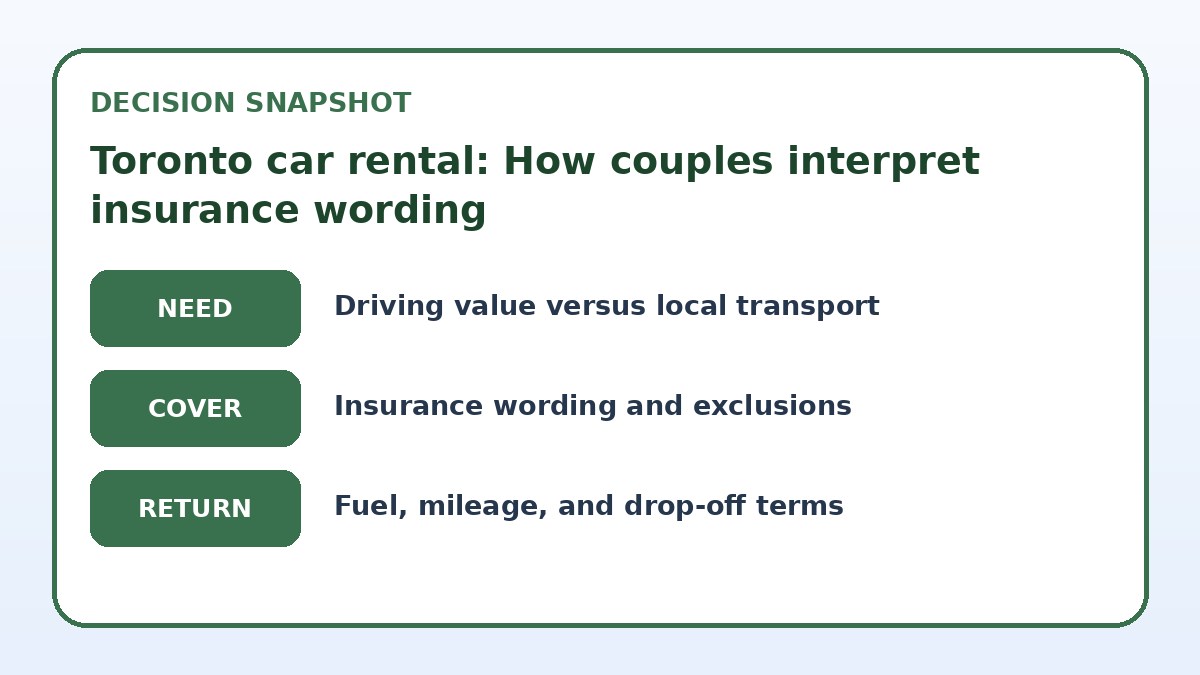
Decide first: does driving actually improve your Toronto trip? For most couples based in the city center, public transit plus a few ride-hails or short rentals often beats the hassle of parking and distance-based insurance exposure. But if you plan day trips to the Niagara region, Prince Edward County, or cottage country, a car can be worth it. The practical answer: rent when your itinerary depends on flexible, off-transit stops; otherwise consider non-driving options. This guide focuses on the insurance wording that commonly confuses couples — liability limits, collision damage waivers, loss of use, and named driver rules — and explains which phrases to verify on the provider’s final booking page before you complete payment.
Route value: when a car genuinely helps a couple
A car earns its keep when your couple’s plan includes multiple, dispersed stops where transit is slow or infrequent — wineries, beaches, and small towns outside Toronto. Driving gives freedom to leave on your schedule, carry picnic gear, or make spontaneous side trips. However, the benefit depends on where you’re staying: downtown Toronto has dense transit, bike lanes, and short ride-hail times that often make a car unnecessary and expensive to park.
To decide, map the main destinations and time costs for each using transit, ride-hail, and driving. Compare not just distance but parking availability, overnight lot fees, and likely traffic during your stays. If most attractions cluster inside the city core, skip the car. If several day trips extend beyond transit corridors and would require costly transfers or long timetables, a rental could save time and let you enjoy quieter, romantic drives together.
Decide whether driving earns its place
| Mobility strategy | Best for | Cost or friction to check |
|---|---|---|
| Full-day private rental with added driver | Couples planning multiple out-of-town day trips with flexible stops | Higher fees, added responsibility for damage and possible parking hassle |
| Short-term hourly car-share | Couples needing occasional local driving without long-term commitment | Insurance terms vary; often limited mileage and driver age restrictions |
| Public transit plus ride-hail for occasional outings | City-centered couples focused on downtown attractions and nightlife | Less flexibility for countryside trips and transporting bulky items |
| Organized tour or regional train/bus | Couples who prefer prepaid, low-hassle day trips to specific destinations | Fixed schedules and less privacy compared with driving your own car |
Check live rental choices only after the route test
Use the exact driver, dates, pickup point, and return plan to compare current conditions.
Insurance wording: key phrases couples must decode
Start with the named driver policy: many rentals list permitted drivers and require every driver to be declared and licensed. If only one partner is named, the other may not be covered for damage or liability. Look for phrases like “additional driver fee,” “named drivers,” and “unauthorized driver” and confirm whether waivers change those terms. On the final booking page, verify exactly who is listed and whether adding a partner is required or optional.
Next, understand collision damage waivers (CDW) and loss damage waivers (LDW) versus liability coverage. CDW/LDW typically limit your financial responsibility for car damage but often exclude tires, windshields, and undercarriage damage unless explicitly stated. Liability coverage handles damage to others and their property. Read exclusions and any caps expressed as dollar limits or percentages. On providers’ booking pages, look for the words “exclusions,” “deductible,” and “limit” and note how much you would owe after a claim.
Compare the full rental conditions
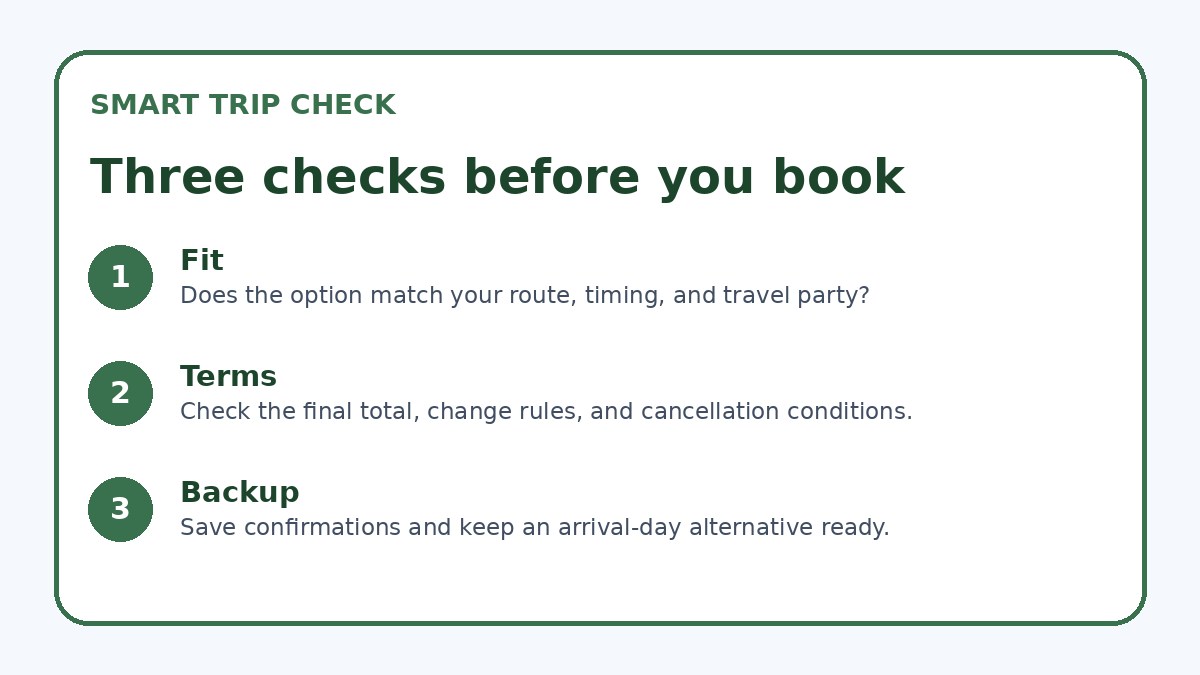
Confirm insurance wording, exclusions, deposit, fuel, mileage, and return terms on the final page.
Pickup and return friction: how wording affects your trip
Pickup and return clauses can create unexpected costs or inconveniences. Wording about mileage limits, fuel policy, and late returns determines whether you face per-kilometer fees, refueling charges, or penalty days. Couples should confirm whether a one-way rental between Toronto and another province or city is permitted and whether extra insurance or authorization is needed for crossing provincial borders. Check the provider’s final page for specific drop-off locations and any associated one-way charges.
Also inspect requirements for driver documentation at pickup: primary driver’s license, passport, proof of address, and the credit card used for the hold. Some companies will refuse rental or apply higher insurance if the second driver’s license is from another country. Read the ‘requirements at pick-up’ section closely and, if anything is conditional, call ahead to avoid being denied a car or having to buy last-minute coverage at a much higher rate.
Car rental terms to verify
- Confirm who is named as an authorized driver on the booking page and add your partner if required.
- Read the deductible, CDW/LDW wording, and any listed exclusions for tires, windshield, and undercarriage damage.
- Verify whether your personal auto insurance or credit card offers primary or secondary coverage and note exact trigger phrases.
- Check pickup requirements: required IDs, credit card hold amount, and whether the second driver must be present.
- Confirm fuel policy, mileage limits, and any one-way or cross-province fees before finalizing the reservation.
- Document the car’s condition with photos at pickup and keep the rental agreement wording and contact numbers accessible.
Non-driving fallback: options if you decide not to rent
If you opt out of a rental, Toronto has robust alternatives that often suit couples. The TTC (subway, streetcar, bus) covers most urban attractions; ride-hail and taxis are plentiful for nights out and short trips. For scenic day trips, consider organized tours that include transportation, or regional buses and trains that take you to many suburbs and nearby towns. These remove the need to parse insurance wording and eliminate parking headaches.
For more flexible day trips without a full rental commitment, look for hourly car-sharing services in Toronto or one-day peer-to-peer rentals that may offer clearer insurance terms for a single driver. When comparing these options, read their terms on the provider’s booking page and verify whether you must add a second driver, how claims are handled, and what documentation triggers coverage. Trip.com can be useful to compare current availability, but always confirm insurance specifics with the rental provider directly.
Car Rental & Road Trip questions travelers ask
If I have personal auto insurance, do I still need the rental company’s damage waiver for a Toronto car rental?
It depends on your policy wording and whether it offers primary or secondary coverage for rentals. Some personal auto policies extend to rental cars with the same limits; others only cover you after the rental company’s insurer pays. Check your insurer’s rental-car section for phrases like “primary coverage,” “secondary coverage,” and any territorial exclusions that might limit coverage in Ontario. Also confirm whether your policy excludes certain vehicle types or age groups. Always verify specifics on both your insurer’s documentation and the rental provider’s final booking page.
Can my partner drive even if only one of us booked the Toronto rental?
Not automatically — many rental agreements require every driver to be declared and sometimes charge an additional driver fee. Look for wording such as “additional driver,” “named driver only,” or “unauthorized driver” to see the consequences. If the partner isn’t declared and drives, the rental company may deny coverage for damage or liability. To avoid disputes, add your partner on the reservation page and bring their license at pickup; if the booking process doesn’t allow this, call the provider to get the requirement clarified in writing.
What does ‘loss of use’ mean and how could it affect our financial liability?
Loss of use refers to charges the rental company may apply while a vehicle is being repaired after an incident, reflecting rental income lost during repairs. Wording often appears under damage charges or administrative fees; some providers pass these costs to renters unless a waiver explicitly covers them. Amounts and assessment methods vary, so check the booking page for terms like “loss of use,” “administrative fees,” and “assessment policy.” If your credit card or insurer covers loss of use, confirm the exact conditions and whether they require itemized invoices from the rental firm.
Final decision note
For couples planning to rent a car in Toronto, the core decision is whether driving materially improves your itinerary: prioritize rentals for flexible day trips beyond transit corridors and skip them when staying downtown. Before booking, spend time decoding the insurance wording—named drivers, CDW/LDW, deductibles, loss of use, and cross-border allowances matter. Always confirm who must be listed at pickup, which damages are excluded, and whether your personal insurance or card provides primary coverage. Carefully review the rental provider’s final booking page and save screenshots of key terms. That diligence prevents surprise costs and lets you focus on enjoying the trip together.
Continue planning
Check current options and final conditions
Use the provider page to confirm live availability, the final total, cancellation terms, and every condition that matters to your trip.
This evergreen planning guide was created with AI-assisted drafting and a structured quality review. It does not display live prices, schedules, availability, visa guidance, or provider rankings. Verify current details before booking. Some links are affiliate links; we may earn a commission at no additional cost to you.