If your trip to Hanoi focuses on meetings in the city and a couple of nearby client visits, driving may not be necessary — but if you must move between dispersed offices, factories, or regional sites, renting gives you schedule control. The practical decision hinges on fuel and mileage rules in your rental contract: whether you receive a full tank, must refuel to the same level on return, face per-kilometre charges, or are limited by daily mileage caps. For business travelers, those clauses translate directly into expense predictability and administrative headache. This guide tells you the quick answer up front, explains the tradeoffs for route value, insurance wording, and pickup/return friction, and gives a usable non-driving fallback so you can book with confidence. Before you sign, verify specific contract language on the final booking page and your company’s travel policy regarding receipts and reimbursable charges.
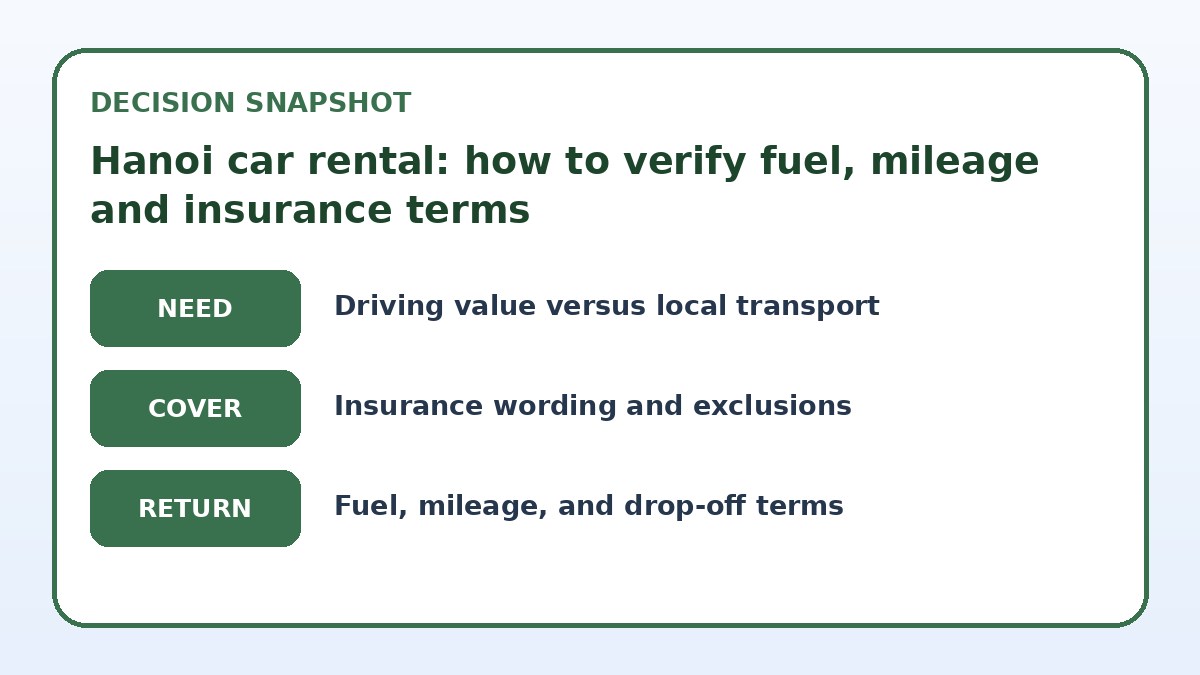
Decide if driving improves this business itinerary
Start by mapping each meeting, site visit and airport transfer. Within central Hanoi the dense traffic, frequent short rides and availability of drivers make hired cars or ride-hailing more efficient. If your schedule is spread across industrial parks, suburban client sites, or the Red River area — locations with limited public transport or unpredictable local taxis — a rental can save transit time and let you carry materials or sensitive documents without hand-offs to a driver.
Also weigh corporate rules about driver liability and reimbursement. Some companies prefer drivers provided by local suppliers because they retain control over insurance and limits. If your travel policy reimburses mileage at a fixed per-kilometre rate, compare that allowance to likely rental costs including fuel, mileage surcharges, parking and tolls. The decision should be calendar-driven: short, central itineraries — no rental; decentralised, time-sensitive days — rental likely beneficial.
Decide whether driving earns its place
| Mobility strategy | Best for | Cost or friction to check |
|---|---|---|
| Self-drive rental with full-to-full fuel | Control over schedule, privacy, and short to medium-distance site visits | Requires careful refueling and receipt records; potential liability and excess on corporate cards |
| Rental with prepaid fuel and unlimited miles | Smoother returns and predictable distance-heavy itineraries | Prepaid fuel may be more expensive than actual use; verify refund rules for unused fuel |
| Local chauffeur or driver-for-hire | Busy executives needing hands-free travel and local expertise | Higher hourly cost and less control over vehicle model; confirm invoicing meets company rules |
| Ride-hailing and taxis on company account | Short, central trips with minimal administrative follow-up | Can be inefficient for many off-site stops; receipts must include full details for expense approval |
Check live rental choices only after the route test
Use the exact driver, dates, pickup point, and return plan to compare current conditions.
What to check in fuel and mileage wording
Fuel clauses usually fall into three types: full-to-full (you pick up with a full tank and return full), prepaid fuel (you pay in advance and return empty or any level), or billed-for-fuel (company refuels and charges you at a rate). For business travellers, full-to-full is easiest to document: you submit the pickup and return fuel receipts with mileage to finance. Prepaid fuel can be convenient if you’ll drop the car late, but it’s costlier when you return with unused litres because you’ve paid for fuel you didn’t use.
Mileage terms are equally important: look for daily caps, cumulative limits, and per-kilometre penalties. Some contracts include a generous daily allowance, others a strict per-day maximum that stacks into steep fees when you exceed it. Verify whether GPS-derived distances or odometer readings determine charges and whether any penalties apply for short-term overages during a busy day. For clarity, request sample math for a day with X kilometres so you can estimate the expected corporate charge.
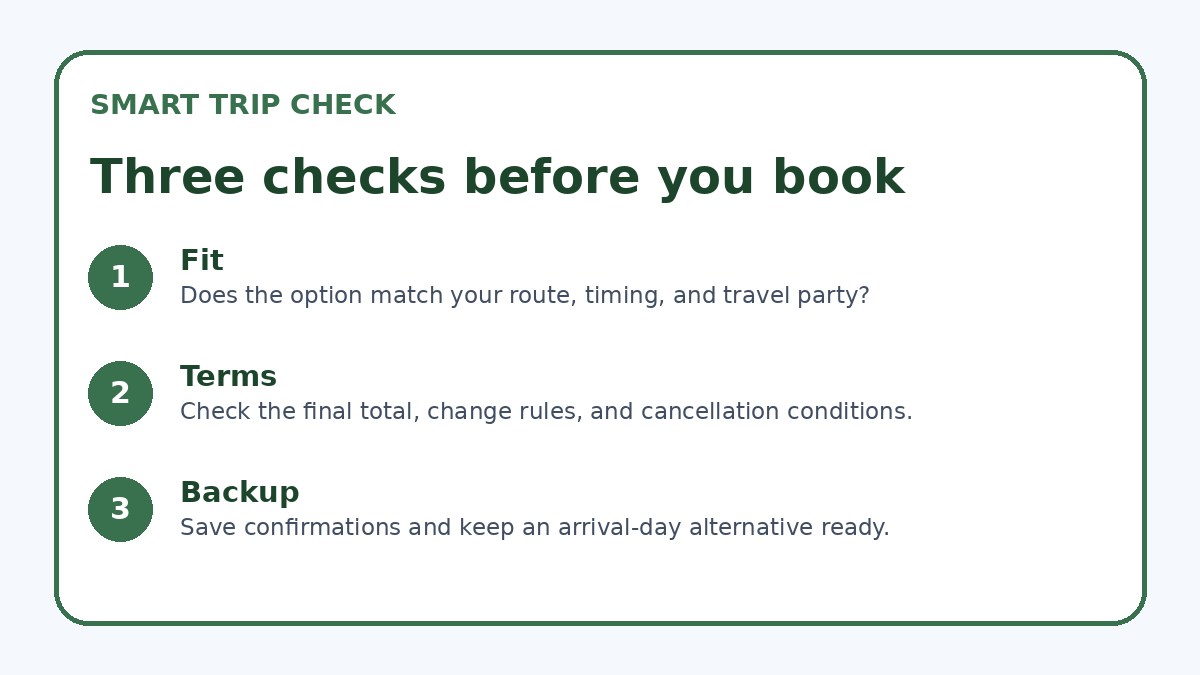
Compare the full rental conditions
Confirm insurance wording, exclusions, deposit, fuel, mileage, and return terms on the final page.
Insurance wording and pickup/return friction to budget time for
Insurance sections often mix collision-damage waiver language, excess amounts, and the insurer’s view of ‘authorized drivers.’ Business travelers should read which drivers are covered, whether the car must only be driven by named employees, and how the excess is held on cards. Note that some contracts reduce excess only if you buy additional cover; others require you to submit claims through international brokers. In all cases, photograph vehicle condition at pickup and return, and keep those files to support corporate disputes.
Pickup and return logistics add time and potential fines. Check where the rental desk is located relative to your hotel or the airport, what paperwork is mandatory (international licence, passport, business card), and whether after-hours drop-off attracts a fee. Also confirm fuel measurement on return: some providers measure by gauge, others by litre and receipt. Allocate buffer time in itineraries for both collections and unexpected return inspections so meetings do not suffer.
Car rental terms to verify
- Ask the rental company for the exact fuel policy wording and confirm whether they use full-to-full, prepaid, or billed-for-fuel arrangements.
- Verify daily and total-kilometre caps, the per-kilometre excess fee, and whether GPS or odometer readings determine charges.
- Confirm which drivers are covered by insurance, the excess amount held on card, and what additional waivers reduce your liability.
- Photograph vehicle damage and fuel gauge at pickup and again at return; save timestamps and filenames for finance claims.
- Clarify pickup and after-hours return procedures, required documents (licence, passport), and any late drop-off fees.
- Request an example invoice or sample charge calculation for a typical day’s kilometres so finance can pre-approve the estimated cost.
Non-driving fallback and how to implement it quickly
If you decide not to drive, prepare a reliable fallback: a local chauffeur service or pre-booked ride-hailing account tied to your company card. Chauffeur services give consistent pickup times, language-capable drivers and an auditable invoice that many finance teams accept more readily than self-rental receipts. For ad hoc trips, set up a corporate ride-hailing profile with payment and receipts tied to your email — that simplifies expense claims and reduces the need for fuel or mileage paperwork.
When using local drivers, brief them on meeting locations and expected waiting times. Keep a list of nearby alternatives for every meeting (another driver, a mall or hotel) so you can pivot without losing time. If a last-minute rental still looks necessary, prefer an agency with clear full-to-full fuel wording and no daily kilometre caps, or arrange a driver through the rental firm to combine benefits of control and lower administrative work.
Car Rental & Road Trip questions travelers ask
Will renting a car in Hanoi save time compared with drivers or taxis for business visits?
It depends on your agenda. If meetings are clustered in central districts, taxis or ride‑hailing usually save time because you avoid parking and the administrative burden of fuel and mileage. Renting helps when you have several dispersed visits in a day, need to carry equipment or documents, or require privacy. Also consider local traffic patterns: starting and ending times of peak congestion change how much driving buys you. Before booking, sketch a day’s route and compare door-to-door travel times using both chauffeur and self-drive estimates.
What specifically should I check on the provider’s booking page about fuel and mileage?
On the booking page, locate the fuel policy phrase (full-to-full, prepaid or billed-for-fuel), the method used to verify return level, and any refund rules for unused prepaid fuel. For mileage, find the stated daily and total kilometre allowance, the per-kilometre overage fee, and whether GPS or odometer readings are authoritative. Also check for clauses about tolls, parking fines, and how they appear on the final invoice. If anything is unclear, save a screenshot and ask the agent to confirm in writing before accepting the vehicle.
How should I handle insurance and excess holds on a corporate card?
Read the insurance and excess section on the rental contract carefully: note the excess amount that will be authorised on your card and whether your corporate insurance or credit-card coverage applies. If the excess is high, consider buying the rental company’s additional coverage or arranging a chauffeur service that shifts liability away from the employee. Always request written confirmation of covered drivers and keep all receipts and claim numbers. After any incident, report immediately to both the rental firm and your company’s travel manager to streamline reimbursement and insurance claims.
Final decision note
For most short-stay business trips focused inside Hanoi’s central districts, renting a car creates more paperwork than benefit. But if your schedule requires multiple off-site visits, control over timing and secure transport for documents or equipment often make a rental worthwhile. The deciding factors are the fuel policy (full-to-full vs prepaid), mileage allowances and how insurance excess is handled on your card. Use the checklist to get exact wording and sample calculations from the provider’s booking page before you commit. If uncertainty remains, a local chauffeur or arranged ride-hailing on a company account offers a reliable fallback with minimal fuel and mileage administration.
Continue planning
Check current options and final conditions
Use the provider page to confirm live availability, the final total, cancellation terms, and every condition that matters to your trip.
This evergreen planning guide was created with AI-assisted drafting and a structured quality review. It does not display live prices, schedules, availability, visa guidance, or provider rankings. Verify current details before booking. Some links are affiliate links; we may earn a commission at no additional cost to you.