If you’re arriving in Hong Kong with more or heavier bags than usual, the practical choice often comes down to balancing convenience against cost and local mobility. A private car or meet-and-greet transfer gives door-to-door handling and less hassle hauling suitcases through trains and footbridges. Public options — the Airport Express, airport buses, taxis, and public MTR — usually require more physical effort and moving luggage between elevated walkways, paid luggage storage, or platform access, but they can be faster through dedicated lanes and better integrated with city transit. This guide gives the short answer up front, then walks you through the tradeoffs and clear decision criteria: how much luggage, where you’re staying, mobility needs, group size, budget flexibility, and how to verify real-time availability and luggage allowances on providers’ booking pages.
See current options before you compare the details
Availability and final conditions change. Open Trip.com now or keep reading for the practical comparison.
Practical short answer: pick by luggage, door-to-door need, and mobility
Decide primarily on three factors: how many pieces you carry, how heavy or bulky they are, and whether door-to-door service matters. Private transfers win for large, fragile, or many suitcases because they remove stairs, moving between platforms, and the need for repeated lifting. If any traveller has reduced mobility, private vehicles or prearranged meet-and-assist services reduce walking and standing, and they can often include porter help at both ends. Public options save money and connect directly into the city rail network if you can manage the physical element.
If you have one or two standard-sized checked bags and prefer speed over minimizing steps, public options like the Airport Express combined with local taxis or an MTR connection typically offer the fastest point-to-point time during normal conditions. For two to four medium bags, shared shuttles or airport buses can fit the balance: they reduce the number of transfers compared with rail, but still require curbside handling and potential short walks. Use this simple rule: more bags and mobility constraints push you toward private transfers; fewer, lighter bags and a tolerance for stairs and bridges point toward public solutions.
How public transport handles extra luggage in Hong Kong
Public transport in Hong Kong is extensive and integrated, but it was built around high-capacity commuter flows rather than oversized baggage. The Airport Express has dedicated luggage racks and spacious cars, and is well signed for international arrivals, but you will likely need to carry bags along pedestrian connections or up escalators at some stations depending on your final stop. Airport buses and coaches usually store suitcases in underfloor bays, reducing hand-carrying, yet you still handle luggage when boarding and disembarking at often crowded stops. Take stock of how many times you must move each bag between vehicle and curb or platform when planning.
Public taxis and street-level pick-ups are plentiful, but not every taxi can take multiple large suitcases comfortably — you’ll likely need larger taxis or two cars for bulky loads. Using public rail plus a short taxi or a hotel shuttle can be efficient for single travellers or light pairs. Also check station accessibility on the route: many central MTR stations have lifts, but some interchanges require walking long corridors or stairs. Verify step-free routes on official transit maps or provider pages before you decide.
| Approach | Best for | Tradeoff to check |
|---|---|---|
| Private transfer (prebooked car or van) | Large groups, heavy or fragile luggage, reduced-mobility travellers, door-to-door convenience | Higher cost and potential waiting time if flight is delayed and the booking has limited free waiting time |
| Airport Express + taxi or MTR | Solo travellers or pairs with one to two standard suitcases who value speed and rail reliability | More physical handling at stations and short walks; might be less convenient with many bags |
| Airport bus or shared shuttle | Mid-size luggage loads and travellers seeking a balance of cost and reduced transfers | Longer stops and potential walking between pick-up/drop-off points; scheduled times may add wait time |
| Street taxi on arrival | Short distances, last-mile convenience, or when you need immediate curbside pickup | Taxi space varies; multiple large bags may require two cars or a larger vehicle, increasing cost and coordination |
Ready to check the option that fits your plan?
Use your exact dates and traveler details so the provider page can show the current total and conditions.
Private transfers: control, door-to-door service, and what to confirm
Private transfers give predictability: a driver meets you at arrivals, loads luggage, and drops you at your accommodation’s door. For groups, families, and travellers carrying sports equipment, instruments, or fragile baggage, this reduces the physical strain and stress of managing connections. Booked hires vary by vehicle size and included services — for example, whether a porter helps with check-in, waiting time allowances, or child seats — so read the provider’s booking page carefully to confirm what’s included and what incurs extra charges.
Because provider details change frequently, always verify the exact meeting point, maximum vehicle luggage capacity, and any waiting-time or flight-delay policies on the company’s final booking page. Look for written confirmation that the vehicle can handle your dimensions and number of bags, and save the driver contact number. If multiple vehicles are needed for a large group, compare the extra handling time versus arriving separately on public transit; sometimes splitting into two taxis or a larger van is the pragmatic choice.
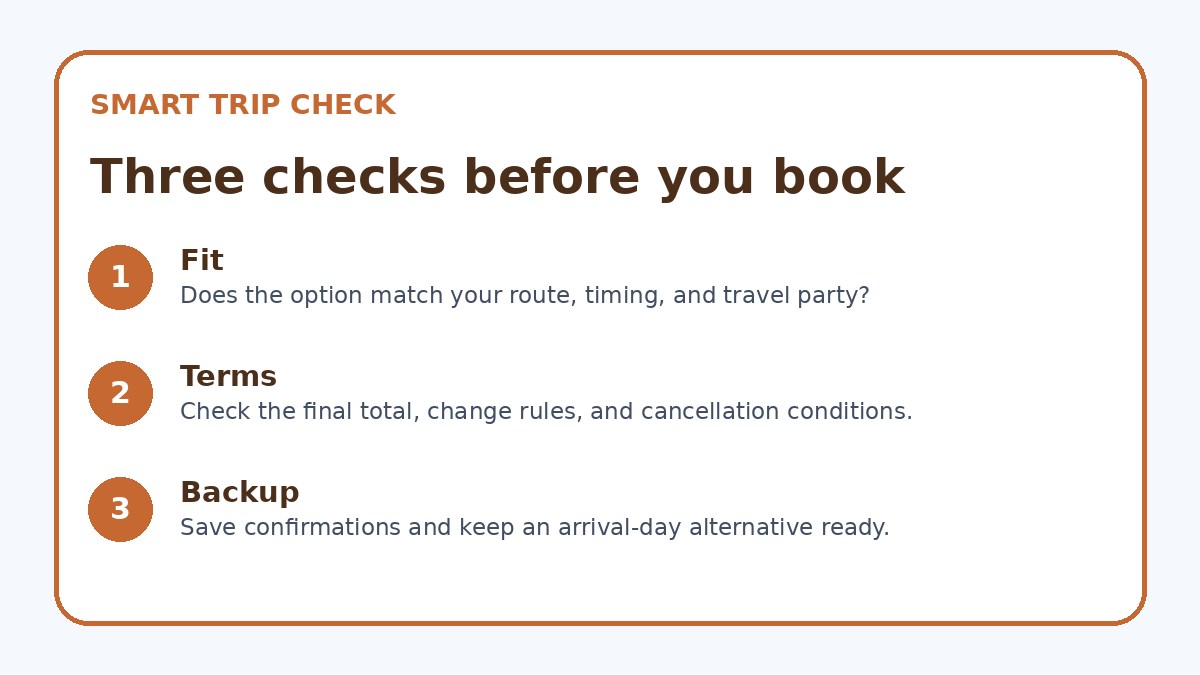
Before you book
- Count your bags and measure the largest piece; record dimensions and number on your phone before booking a vehicle or rail ticket.
- If booking private transfer, confirm vehicle type, maximum luggage capacity, meeting-point instructions, and any waiting-time policy on the provider’s booking page.
- If choosing public rail or bus, plan the full route including station exits and lift locations using official transit maps and note any stairs or long corridors.
- Reserve a hotel transfer or inform your accommodation about arrival time if you need a porter or a specific drop-off point at the property.
- Save the driver or provider contact number and keep a printed copy of booking details and pickup instructions in case your phone battery dies.
- Have a Plan B: locate the nearest taxi rank, luggage storage, or kerbside drop point from the airport arrivals area in case your first option is unavailable.
Decision checklist: matching your itinerary, budget, and comfort level
Match your accommodation location and check-in logistics first. If you stay in a hotel on a steep hillside, a private transfer that drops you at the property entrance is more attractive than a rail-to-shuttle option requiring luggage over several short walks. Conversely, if your destination is beside an MTR station with lift access and short corridors, public rail plus a short cab can be quicker and less expensive. Consider arrival time: late-night or very early flights reduce public transit options and increase the convenience value of private transfers.
Weigh added costs against the value of saved time and effort. Private transfers cost more in exchange for reduced physical handling and often quicker door-to-door time during off-peak road traffic. If cost is a concern but you still want less handling, look for airport shuttle services, prebooked shared vans, or hotels that offer luggage portering. In all cases, confirm luggage policies and pickup points on booking pages and have a Plan B — for example, local taxi ranks, luggage storage, or a brief hotel call to clarify drop-off procedures.
Frequently asked questions
Can I take a lot of big suitcases on Hong Kong’s Airport Express?
The Airport Express accommodates standard checked luggage and has luggage areas, but it is a commuter rail service designed for high passenger throughput. If you have several very large or oddly shaped items, you will still need to carry them across station concourses, and some stations require stairs or footbridges for platform access. Before committing, check station accessibility and the number of transfers on your route. If physical handling is a concern, consider booking a private transfer or an airport coach with underfloor storage, and confirm luggage rules on the operator’s booking page.
Is it better to prebook a private transfer or get a taxi on arrival with extra luggage?
Prebooking guarantees a vehicle sized to your needs and typically includes driver instructions and a set meeting point, which reduces uncertainty after a long flight. This is especially useful for groups, families, and oversized items. Hailing taxis on arrival can be faster if you only have a couple of bags and taxis are queued at the rank, but you may need two cars or a larger vehicle if your luggage load is heavy. If you prebook, verify pickup procedures, waiting-time terms, and cancellation options on the booking confirmation page before you travel.
What if my flight is delayed—will a booked transfer wait for me?
Transfer providers and private drivers have different policies for flight delays: some include a grace period tied to your flight’s actual arrival time, while others charge for extra waiting or require reconfirmation. Airlines and third-party platforms do not standardize these policies, so check the provider’s booking page for their specific terms about delayed flights, missed connections, and how they monitor flight status. Keep the driver’s contact details on hand and notify the provider promptly if a significant delay occurs to arrange revised pickup timing.
Final planning note
For travelers arriving in Hong Kong with extra luggage, the core decision is simple: choose private transfers for minimal handling, door-to-door convenience, and mobility support; choose public options for lower cost and good rail connectivity if you can manage the physical carries. Midway solutions — airport coaches, shared shuttles, or a mix of Airport Express plus a short taxi — let you balance effort and expense. Whatever you select, verify luggage allowances, meeting points, vehicle size, and delay policies on the provider’s final booking page before you travel. Consider Trip.com or official provider pages to compare current availability, then pick the option that fits your luggage, schedule, and comfort needs.
Continue planning
Check current options and final conditions
Use the provider page to confirm live availability, the final total, cancellation terms, and every condition that matters to your trip.
This evergreen planning guide was created with AI-assisted drafting and a structured quality review. It does not display live prices, schedules, availability, visa guidance, or provider rankings. Verify current details before booking. Some links are affiliate links; we may earn a commission at no additional cost to you.