Practical answer first: for a business traveler on Hanoi to Ho Chi Minh City flights, prioritize a direct daytime flight if you need predictable arrival times and minimal baggage risk; aim to arrive at Hanoi’s airport 75–105 minutes before departure with carry-on-only when possible, or 90–120 minutes if checking bags. Confirm minimum connection times, checked-baggage cutoffs, and boarding gate change policies before you book. If fare differences push you toward a connecting itinerary, allow extra buffer for transfers and choose an airline or routing that lets you see the final baggage rules on the carrier’s booking page. Prepare exact travel dates, meeting times, and your equipment footprint before comparing live options so you can match schedules to your workday.

See live routes for your exact travel day
Compare direct and connecting choices with the same baggage and traveler details.
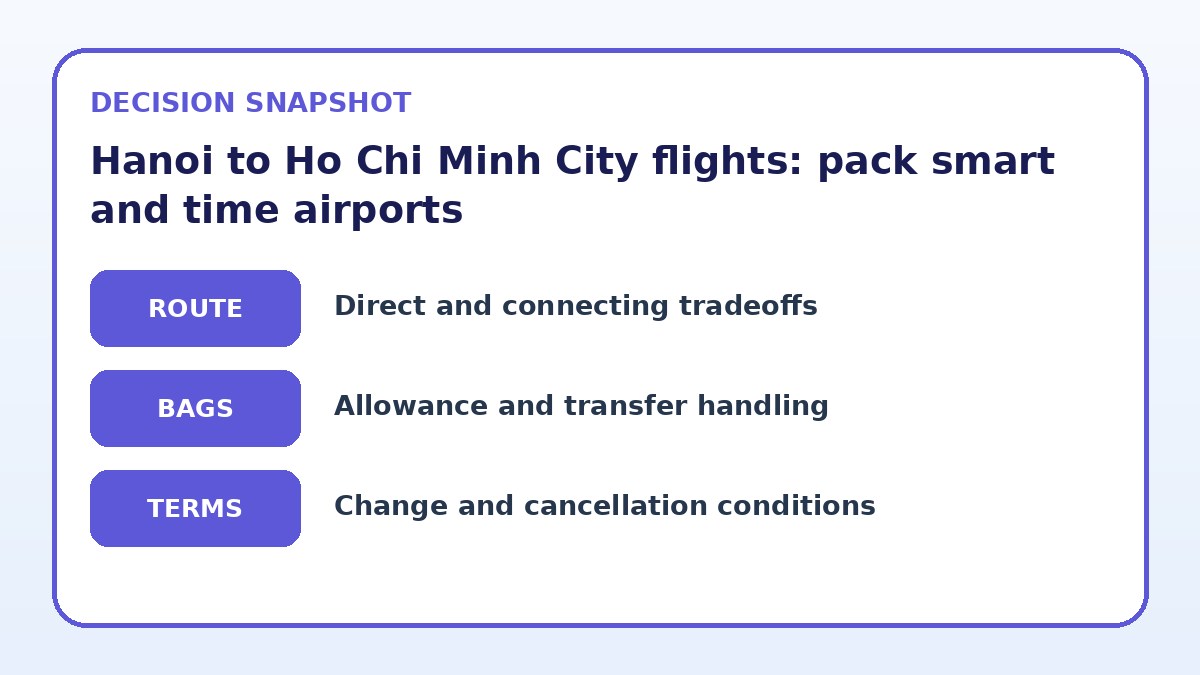
Routing: direct versus connecting for business schedules
The primary decision for business travelers on Hanoi to Ho Chi Minh City flights is whether to accept a connecting itinerary to save money or go direct to protect schedule certainty. Direct flights simplify planning: fewer moving parts, lower chance of a missed connection, and clearer arrival times for meetings or hotel check-in. Connecting flights may fit tighter budgets or specific timing pockets, but every added segment increases the number of things that can go wrong—delays, terminal changes, or baggage transfer issues. Assess how critical your arrival window is and whether you can absorb the risk of a delayed connection before choosing a connecting route.
When comparing routes, treat the connection as a separate risk you must manage: what are the minimum connection times, are different terminals involved, and will your baggage be checked through to the final destination? If the connection is domestic-to-domestic within Vietnam, transfers are usually simpler than international transits, but policies vary by operator and itinerary. Before booking, note the scheduled elapsed time between flights and multiply it against your tolerance for stress: business travelers with tight schedules often prefer a slightly higher fare for the predictability of non-stop service.
Baggage and connection risk: how to organize luggage
Start by inventorying what you must bring: laptop, charger, presentation materials, a suit or smart outfit, and any bulky items. If everything fits in a carry-on and a personal item, carry-on-only is the fastest option—skip check-in queues and head straight to security, reducing the chance of delayed or mishandled bags. For checked items, weigh the tradeoffs: checked luggage protects your outfits and frees your hands but introduces check-in time, potential transfer delays, and the risk of baggage arriving late. Decide which category each item falls into and pack to minimize reliance on checked bags when your schedule is tight.
If you choose to check a bag, verify the airline’s checked-bag size, weight limits, and the latest check-in cutoff on the carrier’s final booking page. For connecting flights, confirm whether the airline will check your bag through to Ho Chi Minh City or if you must reclaim and re-check it during the transfer. Also check whether the carrier offers priority baggage handling or expedited delivery for an extra fee; that can matter if you need suits ironed and ready for an early meeting. Use protective packing (garment bags, packing cubes) and label your bag inside and out with contact info and your meeting address.
Compare flight-selection strategies
| Flight strategy | Best for | Risk to check |
|---|---|---|
| Direct daytime flight, carry-on-only | Travelers with tight meeting schedules who prioritize predictability. | Usually higher fare but minimal connection and baggage risk. |
| Direct flight with checked luggage | Travelers needing multiple outfits or bulky items for longer trips. | Adds check-in time and potential baggage delay at arrival. |
| Cheaper connecting itinerary, carry-on-only | Cost-conscious travelers who can accept transfer timing uncertainty. | Higher chance of missed connections or schedule disruption despite lower fare. |
| Connecting flight with checked baggage | Those prioritizing budget over schedule but needing checked items. | Most risk of delayed baggage or needing to re‑check bags during transfer. |
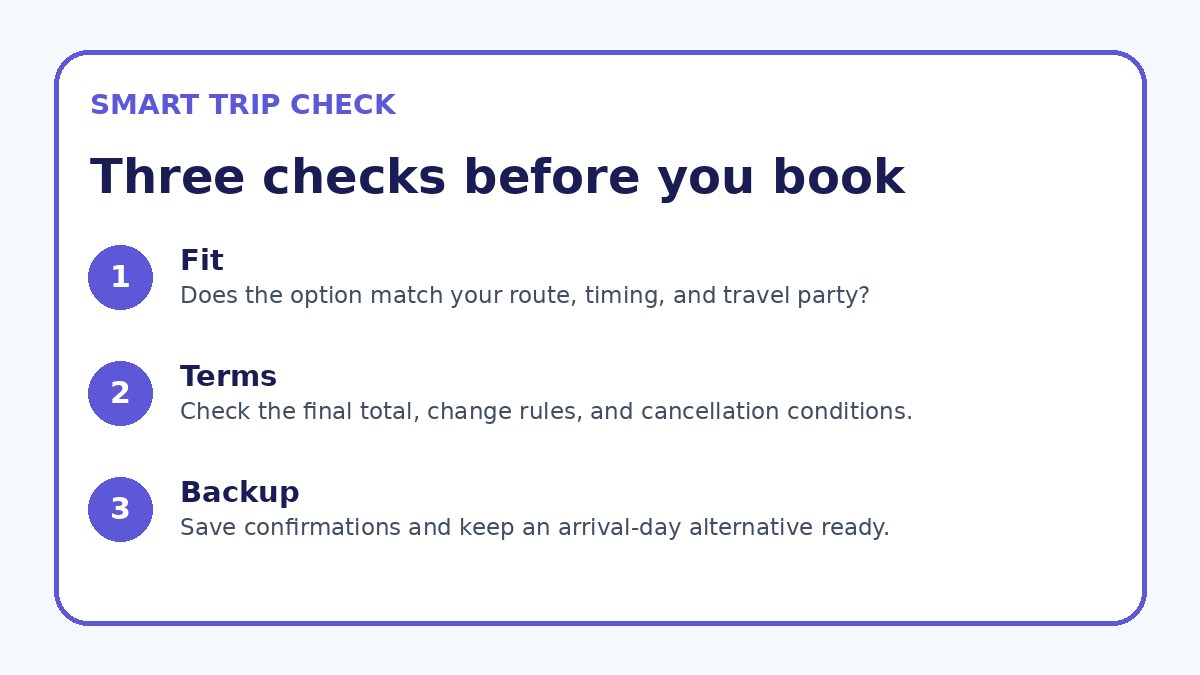
Recheck the complete itinerary
Confirm airports, connection handling, baggage, and change conditions before deciding.
Airport timing: arrival windows and time buffers
Set your airport arrival goal based on baggage plans and personal tolerance for pre-flight tasks. For carry-on-only travelers, arrive at the airport 75–105 minutes before a domestic flight to allow time for security lines, coffee, and a last check of devices. If you need to check luggage, allow 90–120 minutes: this gives room for the check-in counter, unexpected queues, and any security re-checks. Consider local factors—weekday rush hours, public holidays, or city traffic between your office and the airport—that can add time on the road. Book ground transport with a built-in buffer to avoid missing your flight.
For early morning or late-night departures, verify whether your chosen airport’s check-in desks and security lanes are fully staffed at those hours. If your meeting ends close to departure, see if same-day flight change or standby options exist, and check how late the airline accepts checked bags. Also plan for arrival time in Ho Chi Minh City: leaving yourself a 60–120 minute buffer between scheduled touchdown and your first appointment increases the odds you can handle immigration (if applicable), baggage, and a short transfer without stress. If you need fixed arrival times, prioritize flights with historical daytime reliability when comparing options.
Flight details to verify
- Confirm exact travel dates, departure time, and first meeting time before searching fares so you can prioritize schedule fit.
- Weigh each item to decide carry-on versus checked; pack presentations and electronics in carry-on to avoid delays.
- Check the airline’s checked-bag size, weight, and cutoff policy on the carrier’s final booking page before purchase.
- Book ground transport with at least a 30–45 minute buffer for weekday traffic between your office and Hanoi airport.
- If routing involves a connection, verify minimum connection time, terminal transfer requirements, and whether baggage is checked through.
- Save screenshots or PDF of the fare rules, baggage allowances, and change/refund policies immediately after booking for easy reference.
Fare conditions and booking checks before you buy
When evaluating fares for Hanoi to Ho Chi Minh City flights, read the fine print: refundability, change fees, same-day confirmed change policies, and baggage inclusions. Business travelers value flexibility—so even if a basic fare looks cheaper, a slightly higher fare with free changes or a checked-bag allowance may save time and money when plans change. On the airline’s booking page, verify exactly which fare class you are selecting, whether seat assignments incur fees, and whether your ticket includes priority boarding or expedited security that helps when time is tight.
Before clicking purchase, prepare exact travel dates, the number of travelers, frequent-flyer numbers, and any corporate booking codes you must apply. Confirm the carrier’s stated minimum connection times, checked-bag cutoff times, and boarding gate change policies on the final booking page, because those operational details can change. If comparing itineraries across sites, use Trip.com or the airline’s official site to see current availability and conditions, but always finalize the fare details on the airline’s confirmation screen so you can print or save the relevant rules and baggage allowances.
Flight Guide questions travelers ask
How early should I arrive at Hanoi airport for a domestic business flight?
For domestic Hanoi to Ho Chi Minh City flights, aim to reach the airport 75–105 minutes before departure when traveling carry-on-only; this allows for check-in counters that may not open until an hour before but still provides cushion for security and a brief prep before boarding. If you plan to check bags, increase the arrival window to 90–120 minutes to cover counter queues and baggage drop cutoffs. For very early-morning flights or days with known local traffic issues, add another 15–30 minutes to your schedule to avoid stress.
What’s the best way to reduce the risk of delayed baggage affecting my meeting?
Minimize risk by carrying essential items—laptop, chargers, presentation materials, a spare shirt or outfit—in your carry-on. If you must check a bag, use a compact, well-labeled suit/garment bag and verify on the airline booking page whether bags are checked through on connecting itineraries. Select flights with fewer segments and consider priority or express baggage handling if the airline offers it. Finally, allow an hour or more between arrival and your meeting to absorb any unexpected baggage or transfer delays.
If a cheaper connecting flight saves money, how much extra buffer should I plan?
If choosing a connecting itinerary, build at least an additional 45–90 minutes beyond the published connection time into your schedule for contingencies such as late arrival, terminal transfers, and slower baggage handling; the exact buffer depends on your tolerance for risk and whether both segments are on the same carrier. Also check whether the booking is protected under a single ticket—if so, the airline may assist with rebooking on delays; if legs are separate tickets, you shoulder more risk and should add more time or avoid tight connections.
Final decision note
For business travelers on Hanoi to Ho Chi Minh City flights, the core tradeoff is time certainty versus fare. If your schedule demands predictable arrival and minimal logistics, choose a direct daytime flight and travel carry-on-only when feasible. If checked luggage is unavoidable, allow extra arrival time, verify check-in and baggage cutoffs on the airline’s booking page, and pick an itinerary with fewer segments. When comparing fares, prepare exact dates and meeting times so you can judge whether a lower fare is worth the increased connection or baggage risk. Use the checklist to finalize details before booking, and always save the carrier’s written baggage and change rules for reference.
Continue planning
Check current options and final conditions
Use the provider page to confirm live availability, the final total, cancellation terms, and every condition that matters to your trip.
This evergreen planning guide was created with AI-assisted drafting and a structured quality review. It does not display live prices, schedules, availability, visa guidance, or provider rankings. Verify current details before booking. Some links are affiliate links; we may earn a commission at no additional cost to you.