Practical answer first: decide between public transport (regional train or intercity bus) and a road transfer (taxi, shared shuttle, or private car) based on your arrival airport, luggage, budget, and timing. If you prefer the simplest door-to-door option and have heavy bags or arrive late, a taxi or private transfer is the least complex. If you want to save money and are comfortable with transfers, check regional trains and intercity buses that connect nearby airports and cities to Gyeongju. Before booking, confirm schedules, luggage rules, and where the bus or train stops in Gyeongju; for road options, verify the pick-up point and whether the quoted time includes waiting. Read the provider’s final booking page for up-to-date operating details and consider Trip.com to compare current availability.
See current options before you compare the details
Availability and final conditions change. Open Trip.com now or keep reading for the practical comparison.
Which nearby airports serve Gyeongju and how that shapes your options
Gyeongju does not have a large international airport of its own; most visitors arrive via a nearby airport and continue by train, bus, or car. Your transfer choices depend on which airport you use: a larger international or regional hub will offer more direct public-transport links and scheduled intercity buses, while a smaller airport may require a road transfer into the city. When planning, identify the nearest airport by comparing ground distance, available public transport links, and how many transfers the route requires—this determines whether a rail connection or a road transfer will be more convenient.
Also factor in arrival time: daytime visitors can take advantage of scheduled trains and buses, which usually stop at central stations or major bus terminals in Gyeongju, while late-night arrivals may have no scheduled public transport. Luggage and mobility needs should influence your decision too: trains and buses can be economical but might require handling bags on and off platforms, whereas taxis or private cars minimize handling and will drop you at your accommodation. Always check the provider’s booking page for the exact terminal, platform, or meeting point before committing.
Public transport (trains and intercity buses): what to expect
Taking a train or intercity bus is often the most cost-effective method to reach Gyeongju from nearby airports or major Korean cities. Trains typically deliver you to a central station, after which local buses or taxis complete the last mile. Intercity buses may drop you at a city bus terminal that has onward local buses. Before choosing this route, compare total journey time, the number of transfers, and whether your luggage will be carried for you; not all services offer porter help and some require short walks between terminals and stations.
When evaluating public options, focus on reliability and schedule frequency rather than just price: more frequent services reduce the risk of long waits. Also verify whether the service ends at a station within walking distance of your accommodation or if you need an additional short taxi ride. If a direct public link isn’t available from your chosen airport, plan a mixed route: for example, a short taxi to a nearby train station followed by a rail service to Gyeongju. Always recheck times and final stop names on the carrier’s live booking page.
| Approach | Best for | Tradeoff to check |
|---|---|---|
| Regional train or intercity bus | Travelers prioritizing cost savings and predictable daytime schedules | May require transfers and extra walking with luggage; limited service late at night |
| Taxi or metered car | Arrivals wanting direct, door-to-door convenience and on-demand departure | Higher cost and variable travel time when traffic is heavy |
| Private pre-booked car or driver | Groups, families, or travelers needing guaranteed meet-and-greet and fixed pricing | More expensive than public options; check exact pick-up details and included wait time |
| Shared airport shuttle | Budget-conscious travelers who still want minimal navigation at the airport | Lower cost than private transfer but slower due to multiple stops |
Ready to check the option that fits your plan?
Use your exact dates and traveler details so the provider page can show the current total and conditions.
Taxis, shared shuttles and private transfers: convenience versus cost
Taxis and private transfers provide door-to-door transport with minimal hassle—ideal if you have heavy luggage, a tight schedule, or a late arrival. Shared shuttles can reduce the cost while retaining some convenience but may add time as they follow multi-stop routes. When considering a private or hired car, inspect what the service includes on the booking page: whether the price covers tolls, waiting time, and exactly where the driver will meet you at the airport. Confirm the vehicle capacity and luggage allowance for your group to prevent last-minute issues.
Tradeoffs are clear: you pay more for direct service and reliability, but gain predictability and comfort. For families or travelers with limited mobility, the extra cost often makes sense. Beware that estimates for travel time can vary with traffic, so check whether your provider monitors live traffic and offers alternative routing. If you prefer the reassurance of a booked meet-and-greet, take a photo of the driver or booking confirmation and save local contact numbers in case of changes at the airport.
Before you book
- Confirm which airport you will land at and the closest arrival railway or bus stations serving Gyeongju.
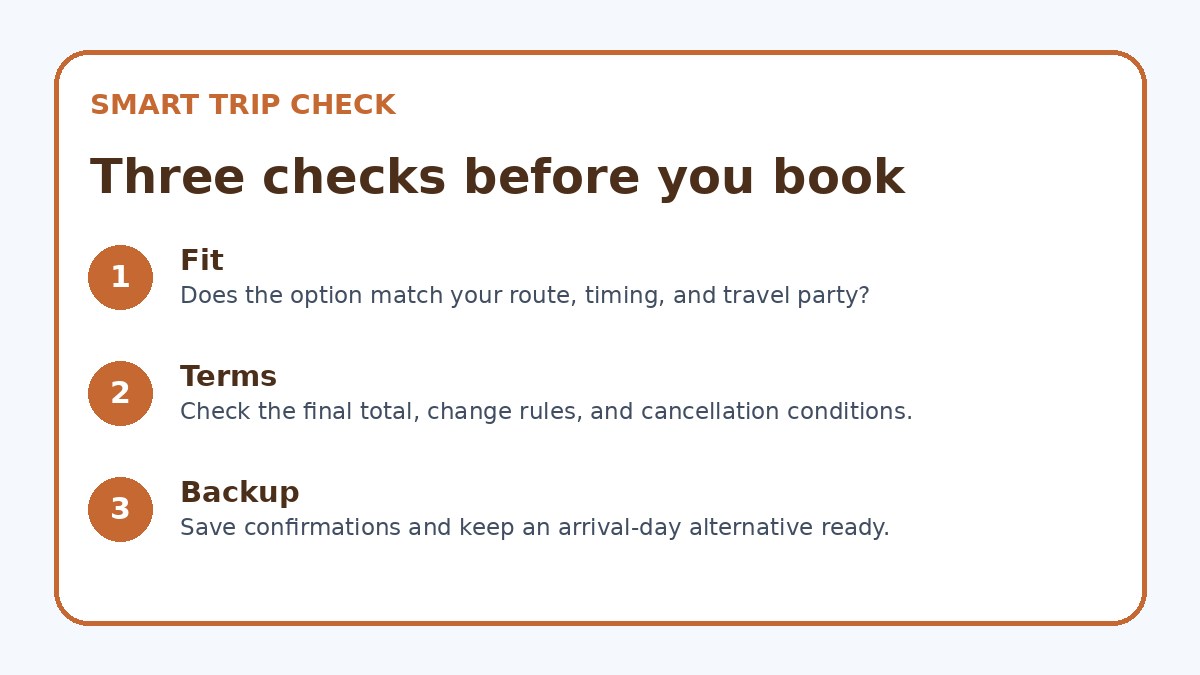
- Check live schedules and terminal pick-up points on the provider’s official booking page before finalizing any booking.
- Estimate door-to-door time including waits, luggage handling, and transfers rather than relying only on in-transit time.
- Verify luggage allowances and vehicle capacity for taxis, shuttles, or private cars when you book.
- Save the driver’s contact number and a screenshot of the booking confirmation for easy re-contact at the airport.
- Plan a backup route (alternate train, bus, or taxi) in case your preferred service is delayed or unavailable.
How to choose the right transfer for your itinerary
Start by mapping your arrival time, luggage, group size, budget, and tolerance for transfers. If your schedule is tight and you value time savings over cost, prioritize a direct road transfer. If you are on a budget or want a more local experience, select public transport but build extra time into your itinerary for possible waits and transfers. Compare total door-to-door time for each option rather than only the advertised travel time; include walking, waiting, and any required transfers in your calculation.
Next, check the provider’s final booking page for up-to-date schedules, pick-up points, luggage rules, and cancellation terms before booking. If there are multiple train or bus routes, compare how many transfers each route requires and whether they align with your arrival. For higher certainty, book a service that allows flexible changes or shows live availability. Use Trip.com or similar platforms to compare current options, but rely on each carrier’s booking page for definitive details.
Frequently asked questions
Is there a direct airport transfer to downtown Gyeongju from the nearest airports?
Direct road transfers such as taxis and private cars typically provide the most straightforward door-to-door route to downtown Gyeongju; however, whether a direct public service exists depends on which airport you use. Some larger regional airports and nearby city hubs offer direct intercity buses or rail connections to a Gyeongju terminal, while smaller airports may not. Always check the operator’s timetable and the final stop name on the booking page to confirm whether the route is direct or requires a connecting service.
How should I decide between a taxi and a train when I arrive late at night?
If public trains and buses have limited late-night schedules from your arrival airport, a taxi or pre-arranged private transfer can be the safer choice because it avoids long waits and complicated transfers. Consider luggage, safety, and whether your accommodation is far from the train or bus stop. If you prefer to save money and are comfortable waiting, check the last available public services and whether they align with your arrival time; otherwise choose a road transfer and confirm the driver’s exact meeting point on the booking page.
What should I check on a transfer provider’s booking page before I pay?
Look for precise pick-up and drop-off locations, whether the price includes waiting time and tolls, luggage limits, vehicle capacity, cancellation and change policies, and any required traveler details. For public services, check the final stop name, platform or terminal information, and whether transfers are required. Confirm contact details so you can reach the provider if plans change. If using an intermediary like Trip.com, still verify the individual carrier’s page for the most accurate and current operational details.
Final planning note
For first-time visitors to Gyeongju the right airport transfer balances convenience, cost, and arrival timing. If you value speed and minimal handling, choose a taxi or private transfer and confirm meeting details on the booking page. If you prefer lower costs and daytime travel, compare trains and intercity buses but include transfer time and luggage handling in your plan. Always verify final stop names, pick-up points, and any luggage or waiting policies before you book. Having a fallback option and the provider’s contact number saved will smooth any unexpected changes and get you into Gyeongju with less stress.
Continue planning
Check current options and final conditions
Use the provider page to confirm live availability, the final total, cancellation terms, and every condition that matters to your trip.
This evergreen planning guide was created with AI-assisted drafting and a structured quality review. It does not display live prices, schedules, availability, visa guidance, or provider rankings. Verify current details before booking. Some links are affiliate links; we may earn a commission at no additional cost to you.