If your Dubai business trip includes meetings across the city or on nearby highways, renting a car can feel efficient — but the decision often hinges on insurance detail, not convenience alone. The practical answer: drive only if your schedule needs flexible point-to-point travel, you can secure clear third-party liability and collision cover with reasonable excess, and your itinerary avoids heavy central-city parking. If insurance wording leaves ambiguity about damage responsibility, cross-border travel, or named drivers, you should plan a non-driving fallback. This article gives a quick decision rule, explains the insurance clauses that change your risk, flags pickup and return friction that eats time, and lays out alternatives so you can arrive prepared and avoid surprises at the rental desk.
Decide whether driving improves your Dubai business itinerary
Start by mapping your appointments and hotels. Driving helps when you have multiple off-network meetings, need early departures, or expect equipment transport. It’s less useful if most meetings cluster inside a single business district or in free zones with shuttle links, where traffic, parking constraints, and valet rules can slow you down. Consider travel time variability: Dubai roads are fast outside peak hours, but congestion around malls, trade centres, and metro junctions can erode the advantage of door-to-door driving.
Assess the non-monetary costs: navigating unfamiliar signage, finding legal parking, and potential language friction at ticketing or car-park booths. If your company prioritises predictable arrival windows, a chauffeur service or prebooked ride-hail can reduce stress compared with splitting attention between driving and preparing for meetings. Use a simple threshold: if driving would save you more than 30–45 minutes per day of travel time or remove a late-night logistics problem, it’s probably worth pursuing — but only after you confirm the insurance and rental terms.
Decide whether driving earns its place
| Mobility strategy | Best for | Cost or friction to check |
|---|---|---|
| Self-drive rental with full CDW/LDW and low excess | Travelers who need total schedule control and will make multiple point-to-point trips. | Higher base cost and more responsibility for inspection, misuse exclusions, and potential administrative charges. |
| Corporate rental via company account with named drivers | Companies that want central billing and specified authorised drivers for longer multi-stop itineraries. | Requires paperwork and verification; insurance wording may still limit certain damage claims or cross-border use. |
| Prebooked chauffeur or car-and-driver service | Executives who prioritise productivity, punctuality, and avoiding parking or inspection hassle. | Less flexibility for ad-hoc stops and potentially higher hourly or daily costs compared with self-drive rentals. |
| Ride-hailing plus point transfers (no rental) | Short-city schedules or single-district meetings where parking and driving risks outweigh benefits. | Costs can balloon for many long inter-emirate trips; less control over vehicle type and luggage handling. |
Check live rental choices only after the route test
Use the exact driver, dates, pickup point, and return plan to compare current conditions.
How rental insurance wording changes your true risk
Insurance sections that matter most are third-party liability, collision damage waiver (CDW) or loss damage waiver (LDW), theft protection, and the stated excess (your out-of-pocket amount). Don’t rely on headline words like “fully covered”; instead, look for exclusions, conditions for waiver applicability, and whether cover is conditional on using approved fuel or authorised drivers. Special clauses often limit cover for off-road use, sand damage, windscreen or tyre incidents, and driving outside the UAE or into neighbouring emirates or territories — these exceptions can change your financial exposure significantly.
Also check definitions: who is a named driver versus an authorised occasional driver, the procedure for reporting incidents (required police report or rental company form), and whether administrative fees, recovery, or towing are reimbursable. If a corporate credit card offers secondary insurance, clarify how it coordinates with the rental’s primary policy — some corporate covers kick in only after the rental cover pays, while others exclude certain vehicles or rental classes. Before you accept keys, confirm in writing which clauses reduce or remove your financial liability and exactly how the excess is applied.

Compare the full rental conditions
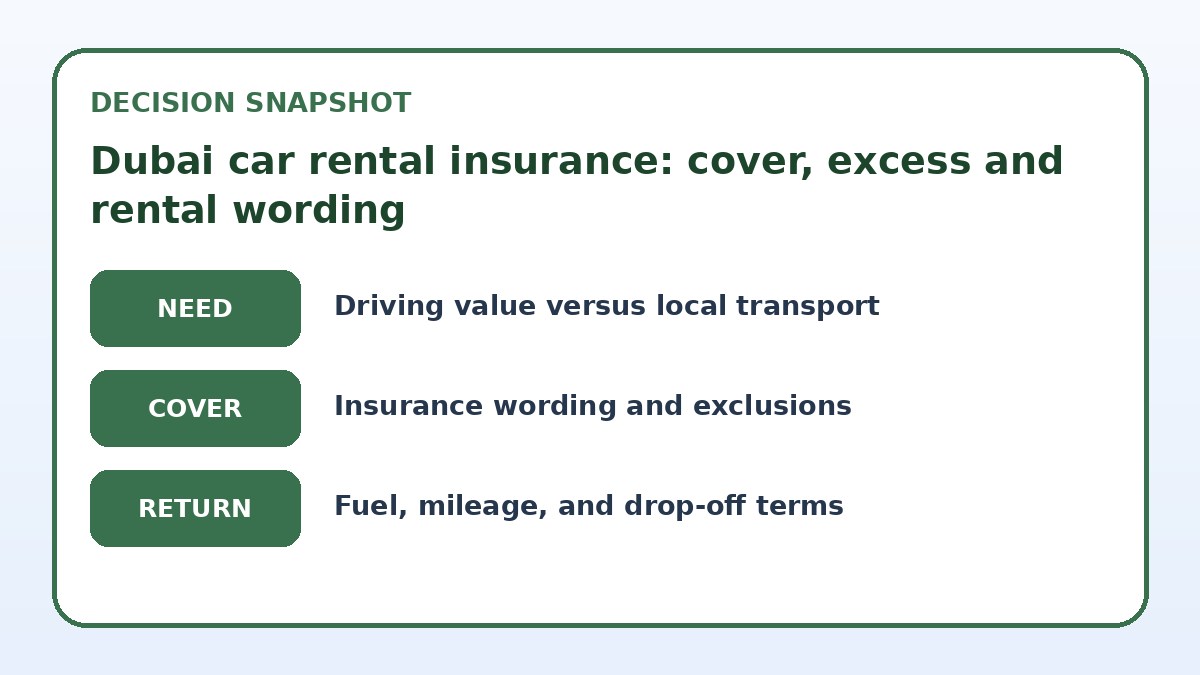
Confirm insurance wording, exclusions, deposit, fuel, mileage, and return terms on the final page.
Pickup and return friction: what adds time and risk at the desk
Airport counters, off-airport shuttles, and downtown pick-up points each bring different friction. At airports, long queues and identity checks can delay departure; off-airport providers may require shuttle transfers that chew into your schedule. On return, fuel policies (full-to-full versus pre-purchase), late drop-off rules, and vehicle inspection procedures determine whether you leave with headaches. Ask the rental provider what their standard inspection process is, whether they record damage with photos, and how quickly they close out final charges. If inspection is informal, you risk post-return claims.
Confirm documentation requirements for both pickup and return: acceptable driver licences (international driving permit when required), corporate authorisation letters, and the format for receipts or damage reports that you must keep. For business travelers, a faster option can be pre-arranged corporate pickup, an express lane, or documented email confirmation of fuel and damage notes. If the rental company’s inspection is delayed, request timestamped photos at handover and on return — these are the clearest defense against disputed damage or administrative fees later.
Car rental terms to verify
- Before booking, request the rental agreement’s insurance sections and read the definitions for CDW/LDW, third-party liability, theft protection, and excess amounts.
- Confirm which drivers are authorised, whether additional drivers incur fees, and whether company-assigned drivers require pre-registration or documentation.
- Ask the provider to list exclusions (off-road, sand, windscreen, tyre, cross-border) and whether any administrative or loss-of-use fees apply after incidents.
- At pickup, photograph the vehicle from multiple angles with timestamps, and request a written or emailed inspection record signed by the agent.
- Before returning, refuel according to the policy, get a signed return inspection form, and keep all receipts and photos until final billing clears.
- If using corporate credit card insurance, obtain the card issuer’s certificate of insurance that details primary/secondary status and covered rental classes.
A dependable non-driving fallback for business trips
If you decide not to drive, build a fallback that keeps you mobile and punctual. Combine ride-hailing apps for short inner-city hops, prebooked point-to-point transfers for airport runs or inter-emirate travel, and a local chauffeur service for tightly scheduled days. This mix eliminates parking worries and transfers inspection risk to providers, while letting you work in transit. It can also be more cost-effective if your itinerary doesn’t require multiple long-distance drives, since time saved from not parking or navigating may offset rental costs and insurance excesses.
When arranging non-driving options, confirm cancellation and wait-time policies so your day won’t be surprised by sudden fees. For cross-emirate meetings, verify that your selected transport provider is licensed for those routes. Keep contact details for a reliable backup provider in your calendar, and build small time cushions into your schedule for hotel-to-meeting transfers. If you eventually need a rental for occasional legs, plan to hire it only for those days, reducing insurance exposure and administrative friction.
Car Rental & Road Trip questions travelers ask
Does buying the rental company’s extra insurance always remove my financial exposure?
Not always. Purchasing additional waivers (CDW/LDW, theft protection) usually reduces or eliminates the stated excess, but exclusions often remain — items like windscreen, tyres, undercarriage, and damage resulting from policy violations (driving on sand, unlicensed drivers, alcohol involvement) may still be excluded. Administrative fees and loss-of-use charges can also be assessed separately. Always read the waiver wording for listed exclusions and ask the desk to confirm in writing what residual liability, if any, you would have after buying the extra cover.
How does my corporate credit card’s insurance coordinate with rental cover?
Corporate card insurance policies vary widely: some provide primary coverage for collision and theft, while others act as secondary, paying only after the rental company’s insurer. Coverage limits, vehicle class exclusions, and authorised driver rules differ too. Before relying on card insurance, request from your card issuer a certificate describing applicable cover, whether it applies internationally (specific to UAE), and any required claim procedures. If card cover is secondary, you may still need to file with the rental provider first and risk temporary holds on your corporate card.
What should I verify at pickup to avoid later disputes over damage claims?
At pickup, do a thorough walkaround with the agent, point out and have them note existing dents, scratches, and interior marks, and obtain a signed or emailed inspection report. Take high-resolution, timestamped photos of all sides, tires, interior, and the fuel gauge. Ask how the company documents returns and how long after return they may raise additional charges. Keep copies of the rental agreement page that lists insurance, excess, and contact details for claims; these items are the clearest evidence if a later dispute arises.
Final decision note
For business travelers in Dubai, the right choice hinges less on whether driving is technically possible and more on how insurance wording shapes your financial and operational risk. If your schedule needs flexible, multi-stop mobility and the rental’s insurance clauses are clear with manageable excesses, a self-drive rental can be efficient. If the policy contains exclusions, high excess, or awkward named-driver rules, a chauffeur or ride-hail strategy avoids inspection and recovery hassles. Always extract the relevant insurance clauses, photograph the vehicle at handover and return, secure written inspection records, and confirm corporate card coordination before accepting keys so your trip stays on schedule without unexpected liabilities.
Continue planning
Check current options and final conditions
Use the provider page to confirm live availability, the final total, cancellation terms, and every condition that matters to your trip.
This evergreen planning guide was created with AI-assisted drafting and a structured quality review. It does not display live prices, schedules, availability, visa guidance, or provider rankings. Verify current details before booking. Some links are affiliate links; we may earn a commission at no additional cost to you.