Practical answer: driving in Barcelona can help if you need flexible door-to-door transport for bulky or heavy luggage, but only after you verify fuel policies, mileage caps, and trunk-size allowances with the rental contract. If your luggage is oversized or numerous, the key tradeoffs are extra fees, a higher vehicle group, and possible mileage restrictions that could turn a cheap daily rate into an expensive one. Before you click reserve, compare the total cost of a larger car plus fuel and excess-mileage risk versus alternatives like a private airport transfer or local delivery service. Read the provider’s fuel-fill rules, mileage terms, and excess-luggage wording on the final booking page; Trip.com can be a place to compare live availability, but always confirm the carrier’s rental contract and pickup-location notes.

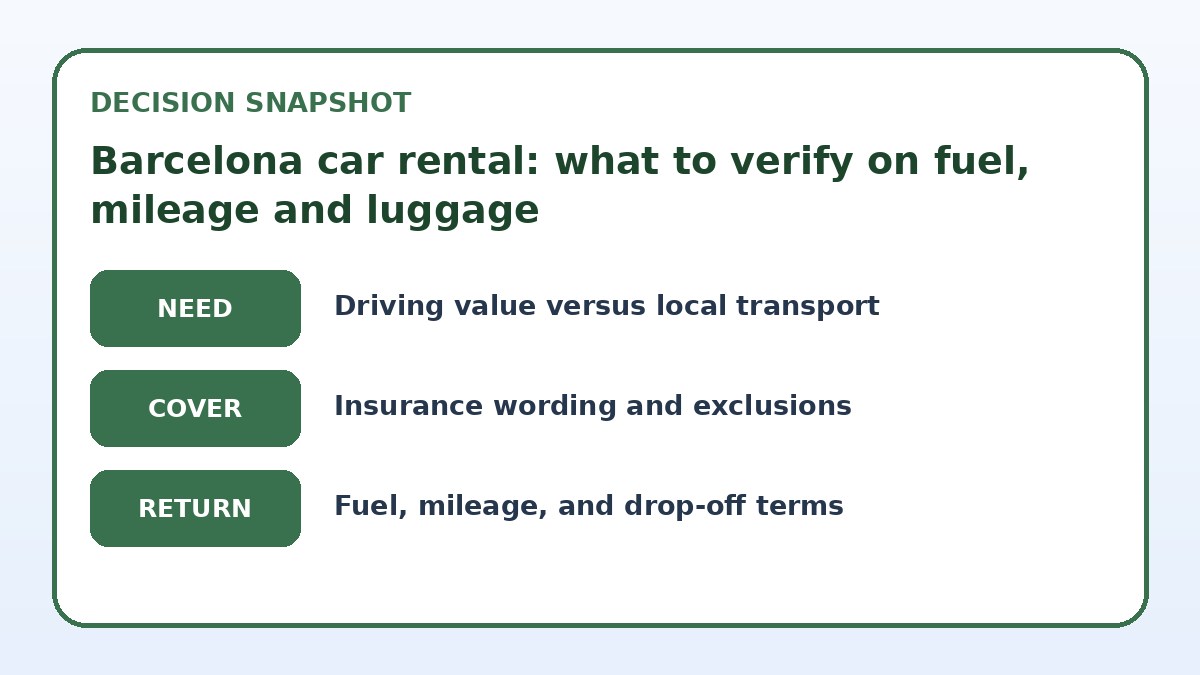
Does driving improve this Barcelona trip for travelers with extra luggage?
Decide by matching travel goals to luggage reality. If your itinerary requires frequent journeys from Barcelona’s airport to city areas, or you’re moving between several accommodation points with bulky suitcases or sports equipment, a rental gives control and minimizes repeated handling. However, you carry responsibility for parking, low-emission zones, and finding a car large enough for both passengers and luggage. For short city stays where most time is inside central Barcelona, driving often adds friction: narrow streets, restricted parking and the possibility that a taxi or transfer is simpler when luggage handling is the main concern.
Estimate the number and size of suitcases, any special items (bikes, surfboards, instruments) and the length of drives. If you need to travel coast-to-coast in Catalonia or explore the Costa Brava with gear, driving is worthwhile but only with the right vehicle group and clearly understood mileage terms. If the car is primarily to move luggage between two points, compare private transfers and porters — these remove parking and fuel questions and may be cheaper once vehicle size and excess-mileage fees are factored in.
Decide whether driving earns its place
| Mobility strategy | Best for | Cost or friction to check |
|---|---|---|
| Rent a larger car with unlimited mileage | Travelers planning long drives or carrying bulky gear who want fewer mileage worries | Higher daily rate and possibly larger parking/urban driving challenges in Barcelona |
| Book a standard car and pay excess-mileage as needed | Short city stays where driving is occasional and luggage fits compactly | Risk of large variable costs if your itinerary expands or detours occur |
| Reserve a private transfer or airport shuttle for luggage-only moves | Door-to-door convenience for heavy or awkward items without worrying about fuel or mileage | Less flexibility for multi-stop regional exploration and generally higher per-trip cost |
| Use taxis, local delivery services or luggage shipping | Minimal driving stress and professional handling for oversized items | Can be costly for repeated trips and requires coordination for schedule and pickup |
Check live rental choices only after the route test
Use the exact driver, dates, pickup point, and return plan to compare current conditions.
Fuel policy and how it interacts with extra luggage
Fuel rules are a common source of unexpected charges. The main fuel policies are full-to-full, pre-purchase, and same-to-same. Full-to-full means you pick up with a full tank and return full; it avoids fuel administration fees if you refill before drop-off. Pre-purchase sells you a tank upfront and lets you return empty, but you won’t be refunded for unused fuel; this can be convenient with heavy luggage when you don’t want to locate a petrol station near return points.
For travelers with large or awkward baggage, factor in the extra time and effort to refill a near-empty tank before returning — this can be harder if you’re dropping off at an airport terminal with long lines. On the booking page, verify the required fuel level at return, cost-per-liter if the company refuels for you, and whether fuel-related admin fees apply. Always check whether refueling stations are available near your chosen drop-off location and include refill time into your schedule when carrying heavy items.

Compare the full rental conditions
Confirm insurance wording, exclusions, deposit, fuel, mileage, and return terms on the final page.
Mileage rules, excess charges, and route planning
Check whether the rental includes unlimited mileage or a fixed daily/total allowance. Unlimited mileage is straightforward and often worth the premium if you plan long drives with heavy luggage; a daily cap can be inexpensive for short trips but costly if your route extends to Girona, Tarragona or coastal drives. Calculate expected kilometers by mapping your planned stops and adding contingency for detours, parking searches, and the airport-city transfer, then compare that to the allowance on the booking page to project potential excess charges.
If excess-mileage fees are charged per kilometer, multiply that rate by your projected overage to see the real cost of a compact car versus upgrading to a more expensive group but with higher included mileage. Many contracts specify how mileage is counted — per calendar day or per 24-hour period — so confirm the exact wording where it lists allowed miles, overage rate, and whether there are any free promotional miles. These specifics are critical when bulky luggage makes short inner-city drives less likely but longer regional legs more likely.
Car rental terms to verify
- Measure all luggage and photograph items; compare dimensions to trunk volume listed for the car group before selecting a vehicle.
- Confirm the rental’s fuel policy on the final booking page and note the exact refill level required at return (e.g., full-to-full).
- Check included mileage wording, daily caps, and the per-kilometer excess fee to calculate realistic trip costs.
- Review insurance exclusions, deductibles and any add-ons for roof racks, ski boxes or cargo damage on the provider’s contract.
- Ask the pickup location whether oversized luggage handling or staging fees apply and how long handover will typically take.
- Compare the total package—rental rate plus estimated fuel and excess charges—to a private transfer quote for the same route.
Pickup, return friction and insurance wording to verify
Extra luggage changes pickup and return dynamics: longer paperwork time, oversized-item checks, and possible staging fees. On the final booking page and in the rental contract, confirm whether the pickup location charges handling or luggage storage fees, whether there’s an airport-concession surcharge, and the expected time for handover when you have bulky items. Also check whether some locations require pre-booked larger vehicles or special equipment like roof racks — if so, verify how the provider records these requests and whether they appear on the contract.
Insurance wording is especially important with heavy gear. Standard liability and collision terms often exclude damage to third-party equipment or unsecured items, and policies may limit or expressly exclude roof-box or rack coverage. On the provider’s final page, read the insurance inclusions and optional add-ons for possessions, roof-rack damage, and undercarriage claims; note deductibles and how deposit holds are applied. If using a credit-card insurance benefit, verify the card issuer’s conditions regarding vehicle group, excess, and whether they cover damage to carried equipment.
Car Rental & Road Trip questions travelers ask
If I have oversized sports equipment, should I reserve a larger car or add roof racks?
Reserve a larger car group whenever possible: trunk space is more secure and less likely to affect liability than aftermarket roof racks. If you must use a roof rack or box, confirm on the final booking page that the rental company permits roof equipment and that it is listed on your contract. Also check insurance terms for roof-mounted gear, and whether the company charges extra cleaning or damage fees for roof-box use. If the provider offers pre-fitted racks at pickup, ask how those are documented and whether any additional deposit is needed.
How do I estimate fuel costs and refueling time when returning a car in Barcelona?
Estimate fuel by mapping distance driven and checking your vehicle’s average fuel consumption on the booking page or manufacturer specs; then plan time for a refill stop near your return location. If the policy is full-to-full, locate petrol stations close to the drop-off point beforehand; if the company pre-sells fuel, compare the cost-per-liter they charge on the final page against local station prices. Always allow extra time for refueling while handling heavy luggage, and verify whether an unattended return is permissible if you need to drop keys outside office hours.
What should I ask about mileage when my route includes Girona or Tarragona day trips?
Ask whether the rental offers unlimited mileage or states a daily or total kilometer limit; then calculate round-trip distances for Girona and Tarragona from your base in Barcelona and add buffer kilometers for detours. On the booking page, check if mileage is measured per calendar day or per 24-hour rental period and whether there are any promotional caps. If your projected distance approaches the allowance, consider upgrading to unlimited mileage or a higher allowance to avoid per-kilometer overage charges that can quickly exceed an upgrade cost.
Final decision note
If you’re traveling to Barcelona with extra luggage, the smart move is to verify fuel and mileage rules before committing. Choose a vehicle size that genuinely fits your gear, then read the rental contract’s fuel wording, mileage allowances, and insurance exclusions on the provider’s final booking page. Compare the fully calculated rental cost—including potential excess-mileage fees and fuel administration charges—against private transfers or delivery services for heavy items. Small investments in the right checks up front can prevent surprise charges and ensure your trip runs smoothly without sacrificing the convenience of having your belongings with you.
Continue planning
Check current options and final conditions
Use the provider page to confirm live availability, the final total, cancellation terms, and every condition that matters to your trip.
This evergreen planning guide was created with AI-assisted drafting and a structured quality review. It does not display live prices, schedules, availability, visa guidance, or provider rankings. Verify current details before booking. Some links are affiliate links; we may earn a commission at no additional cost to you.