
Practical answer first: for most couples who want fewer coordination headaches and clearer cancellation rules, a well-reviewed package can be the easier choice; for couples who value schedule control, neighborhood choice, or mixing carriers, booking flights, hotels and transfers separately usually offers more customization. Which route is right depends on what you prioritize: convenience and one-stop support, or control and the ability to cherry-pick services. This guide compares the two approaches specifically for Busan travel deals, points out the decision criteria couples should weigh, and tells you exactly what to verify on booking pages before you commit. Use this to decide quickly, then dive into the tradeoffs and practical checks that follow.
See current options before you compare the details
Availability and final conditions change. Open Trip.com now or keep reading for the practical comparison.
How packages simplify planning — and where they don’t
Packages bundle flights, hotels, and often airport transfers or select activities into a single booking. For couples who prefer one invoice, one policy and a customer service desk to call if plans change, this can be reassuring. Packages can include curated hotel choices and suggest itineraries that reduce decision fatigue. They also tend to present cancellation and change terms at a package level, which is convenient—until the fine print shows mixed supplier rules. Always read whether the package issuer acts as principal or simply consolidates independent supplier reservations, because that affects who handles refunds or rebooking.
Packages are not a magic fix for unpredictability. If you want to change only one leg—a later flight, a different hotel neighborhood, or an extra night—packages can be rigid or expensive to alter. Couples who value a spontaneous extra beach day, a last-minute festival detour or swapping hotels mid-trip may find package rules inconvenient. Finally, packages sometimes restrict which room types, flight times, or airlines are included, limiting flexibility for couples with specific needs like late arrivals, early departures, or seat preferences.
Why separate bookings give couples more control
Booking flights, hotels and transfers separately gives couples granular control over schedules, neighborhoods and amenities. You can choose morning flights for one partner’s comfort, a guesthouse in Gamcheon Culture Village for atmosphere, and a private transfer for late arrivals. This approach also makes it easier to mix and match carriers, loyalty programs and extra services, such as adding checked bags only to the traveler who needs them. For couples who enjoy crafting an itinerary together or who have distinct priorities—quiet nights versus central location—separate bookings let you prioritize what matters to each person.
That control comes with responsibility: you must coordinate separate policies and contact points. If a flight delay causes a missed check-in, the hotel’s policy and the airline’s policy apply independently, and you’ll manage claims separately. You’ll also need to compare cancellation windows, deposit rules and any change fees for each supplier. For couples comfortable with a little extra planning time, separate reservations can be financially advantageous and more adaptable, but they require diligence to avoid gaps in coverage or overlapping penalties.
| Approach | Best for | Tradeoff to check |
|---|---|---|
| Package deal | Couples wanting one point of contact and less planning time | Less flexibility to change single trip elements and possibly higher change fees |
| Separate bookings | Couples seeking tailored schedules, neighborhoods, and supplier choices | More coordination required and multiple policies to juggle during disruptions |
| Hybrid (package + add-ons) | Couples who want a core itinerary but still need extras like extra nights or transfers | You must manage which parts are changeable and verify mixed cancellation rules |
| Self-managed with travel protection | Couples prioritizing refundability and maximum control | Higher upfront costs for refundable rates or comprehensive insurance |
Ready to check the option that fits your plan?
Use your exact dates and traveler details so the provider page can show the current total and conditions.
Cost comparison and what to calculate before deciding
Compare total out-the-door costs rather than advertised fares. For both packages and separate bookings, add taxes, baggage fees, seat assignments, airport transfers, local transport cards, and any mandatory resort or local fees. Couples should split or apportion extras early in the planning stage to see the realistic cost per person. Don’t forget indirect costs like the time you spend researching and making changes—packages save time, which has value for some couples; for others, that time is part of the fun.
Also consider risk-adjusted cost: check refundability, change fees and travel protection options. A package may include limited travel protection or require a separate insurance purchase; independently booked flights and hotels may offer refundable rates at a higher price. For couples, think about whose plans are most likely to change—if one partner has a less predictable schedule, it may be worth paying more for refundable components or adding a protection policy to avoid large rebooking costs.
Before you book
- Compare total door-to-door costs including baggage, transfers, taxes and local fees for both package and separate options.
- Read full cancellation and change policies on the supplier’s final booking page and save policy text for both travelers.
- Confirm who handles refunds or rebooking for each component if the package uses third-party suppliers.
- Verify hotel check-in rules and late-arrival options before choosing a package with fixed transfer times.
- Decide whether refundable rates or travel protection are worth the extra cost given your cancellation risk.
- Store all confirmation numbers, contact emails, and emergency phone numbers in a shared document accessible to both partners.
Practical checks and verification steps before you confirm
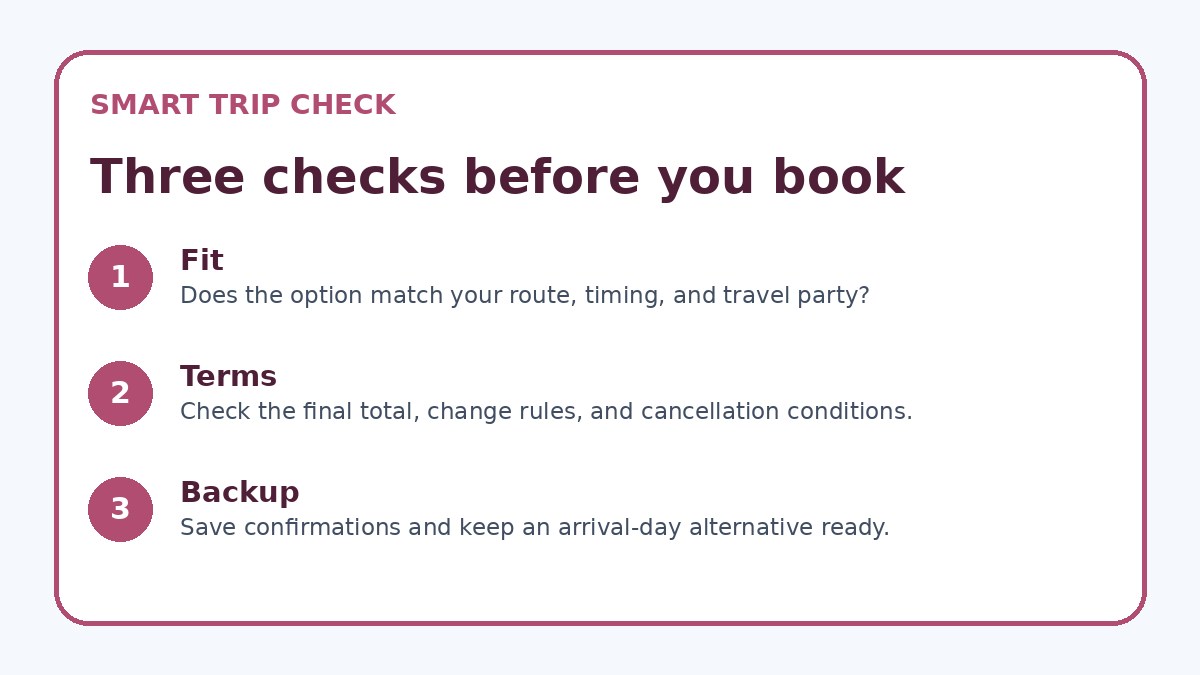
Always verify three things on the provider’s final booking page: the cancellation/change policy in the exact scenario you’re concerned about, what is and isn’t covered by any included transfers or activities, and who to contact for support in-country. If a package includes third-party services, confirm whether refunds are handled by the package seller or the supplier. When booking separately, copy relevant policy text from each supplier and save confirmation numbers in one document so both partners can access them if needed.
For Busan-specific logistics check transfer options from Gimhae International Airport or bus/train stations, and confirm hotel check-in windows if you expect a late arrival. If you want to compare current availability and combined pricing quickly, you can check aggregators like Trip.com as one data point, but verify all final terms on the supplier’s own booking page. Finally, ensure passports, any required documentation and payment card authorizations are valid for both travelers before you finalize bookings.
Frequently asked questions
If one partner has unpredictable dates, is a package still sensible?
If one partner may need to change dates, carefully examine the package change and cancellation terms. Packages often bundle rules and may charge fees to alter a component. Compare the cost of refundable individual flights or hotels against the package change fees. Sometimes a hybrid approach — a package for hotel and local activities and separately booked refundable flights — reduces risk. Whatever you choose, confirm whether the package operator or the supplier processes refunds and who you contact for urgent changes.
How should couples compare neighborhoods and hotels when a package offers limited hotel choices?
Look up the included hotel options and compare their neighborhoods to the experiences you want—beach access, nightlife, or quieter residential areas. If the package limits choices, check whether the operator allows upgrades or substitutions and at what cost. Alternatively, book accommodation separately to pick a specific neighborhood and use a package only for flights or curated activities. Always verify the exact room type, bed configuration and any resort fees before committing so the choice suits both partners’ preferences.
What evidence should we keep to make claims easier if something goes wrong?
Save all booking confirmations, payment receipts and the exact cancellation/change policy text from the final booking pages. Take screenshots that include booking reference numbers and timestamps. Keep vendor contact details and the package operator’s support channels in one shared place. If you buy travel insurance, store the policy number and emergency claim instructions. This documentation speeds up refunds or rebookings and helps both partners act quickly if a schedule change or service failure occurs.
Final planning note
There’s no single right answer for every couple. Choose a package if you value time savings, centralized support and a predictable, hands-off booking process. Opt for separate bookings if you prioritize neighborhood choice, scheduling flexibility, and the ability to pick specific carriers or hotels. A hybrid approach can balance convenience with customization, but it requires careful attention to which parts are changeable and who handles refunds. Before you book, run the checklist: compare total costs, verify policies on the supplier’s final page, and store confirmations so both partners can manage issues easily while enjoying Busan together.
Continue planning
Check current options and final conditions
Use the provider page to confirm live availability, the final total, cancellation terms, and every condition that matters to your trip.
This evergreen planning guide was created with AI-assisted drafting and a structured quality review. It does not display live prices, schedules, availability, visa guidance, or provider rankings. Verify current details before booking. Some links are affiliate links; we may earn a commission at no additional cost to you.