
If you and your partner are planning travel from Busan to Jeju, the fastest planning decision is whether to take a direct flight (when available) or accept a connecting routing. Practically, a direct flight usually means less transfer hassle and more time on Jeju — good for short breaks or when one of you dislikes airport changes. A connecting option can expand schedule choices, sometimes lower fares, or let you add a stopover city if you want to mix destinations. Before you book, consider your priorities: travel time, baggage rules, connection minimums, departure airport convenience in Busan, and how much unpredictability you’re willing to accept. Use flight search tools — including Trip.com as one comparison source — then verify baggage, change fees, and exact connection time on the airline’s final booking page.
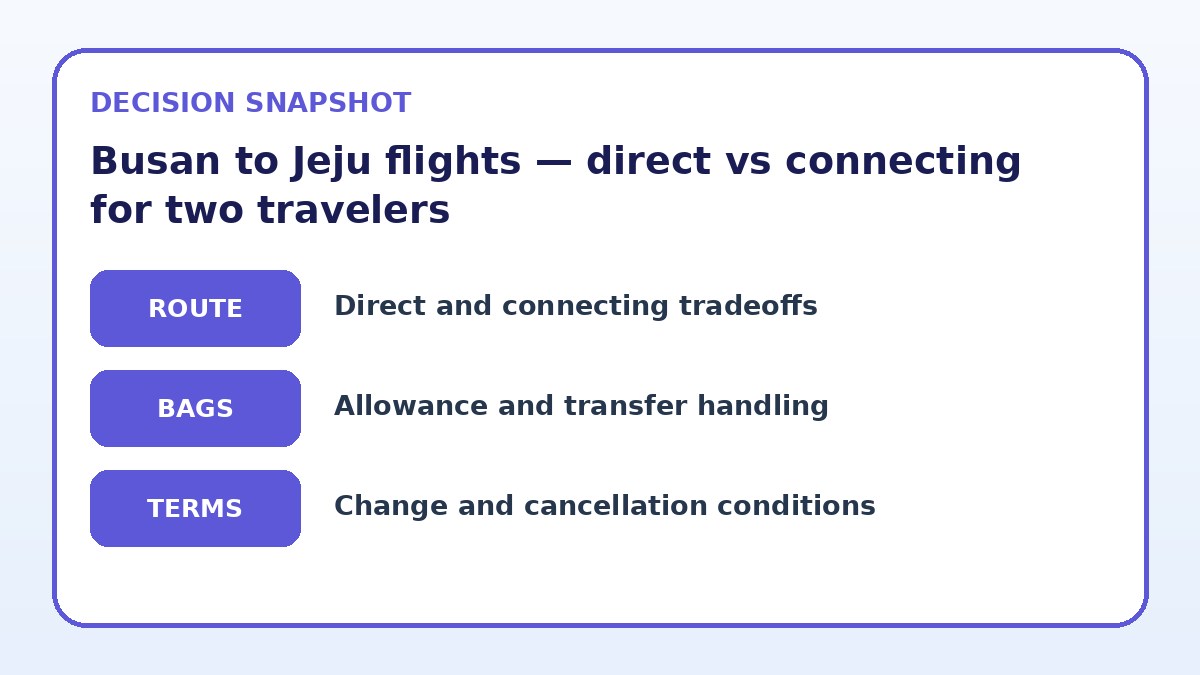
See current options before you compare the details
Availability and final conditions change. Open Trip.com now or keep reading for the practical comparison.
How direct flights work and why couples like them
Direct flights between Busan and Jeju operate as single-plane journeys from departure to arrival with no scheduled change of aircraft. For couples this matters because direct service reduces the number of moving parts in the trip: fewer boarding processes, no gate changes, and a simpler timeline for getting from airport to accommodation. When your goal is maximizing beach time or keeping a short itinerary relaxed, the fewer transitions you face the better. A direct flight also reduces the emotional load when one partner dislikes rushing through terminals or dealing with last-minute gate switches.
Even on short domestic hops, a direct option influences planning beyond the flight itself. You can book transfers to and from the airport with greater confidence about arrival times, and there's less need to build large buffers into your schedule. If one of you has mobility considerations, simpler itineraries with fewer stairs and less walking inside airports improve the overall experience. When comparing direct flights, verify the carrier’s baggage policy and boarding times on the airline’s official page before finalizing seats.
When a connecting route makes sense for couples
A connecting itinerary can be the smart choice when direct seats are limited, schedules don’t match your timing, or you want to add an extra stop en route. For couples seeking a more varied trip — for example, a short visit in another city before reaching Jeju — a careful connection lets you build that into one ticket or a coordinated set of tickets. Sometimes the widest schedule selection comes from connections, which is useful if your travel dates are fixed and direct options don’t align with your plans. Connecting routes also give flexibility for late-night or early-morning departures when direct flights are not offered.
Drawbacks come from the added complexity: transfers mean more time in airports and the need to manage layovers, possibly switching terminals. Couples should assess whether they enjoy exploring an airport together (shopping, lounging, dining) or prefer being on the ground at their destination sooner. If you choose a connecting option, double-check minimum connection times, whether the carrier protects through-checked baggage, and how missed connections are handled in case of delays. Confirming these details on the airline’s site will reduce unpleasant surprises.
| Approach | Best for | Tradeoff to check |
|---|---|---|
| Direct flight | Couples who value simplicity, time savings, and predictable arrival times | Fewer schedule choices and sometimes higher fares or limited seat availability |
| Connecting flight (single ticket) | Travelers seeking more schedule options or an intentional stopover without rebooking | Longer total travel time and greater dependency on on-time performance |
| Connecting flights on separate tickets | Couples prioritizing lower fares and willing to manage risk and logistics | Higher risk of missed connections and extra effort to recheck luggage and clear security |
| Mixed approach (direct one way, connecting return) | Couples balancing predictability on arrival with flexibility or savings on the return | More complex planning and the need to track different fare rules and luggage arrangements |
Ready to check the option that fits your plan?
Use your exact dates and traveler details so the provider page can show the current total and conditions.
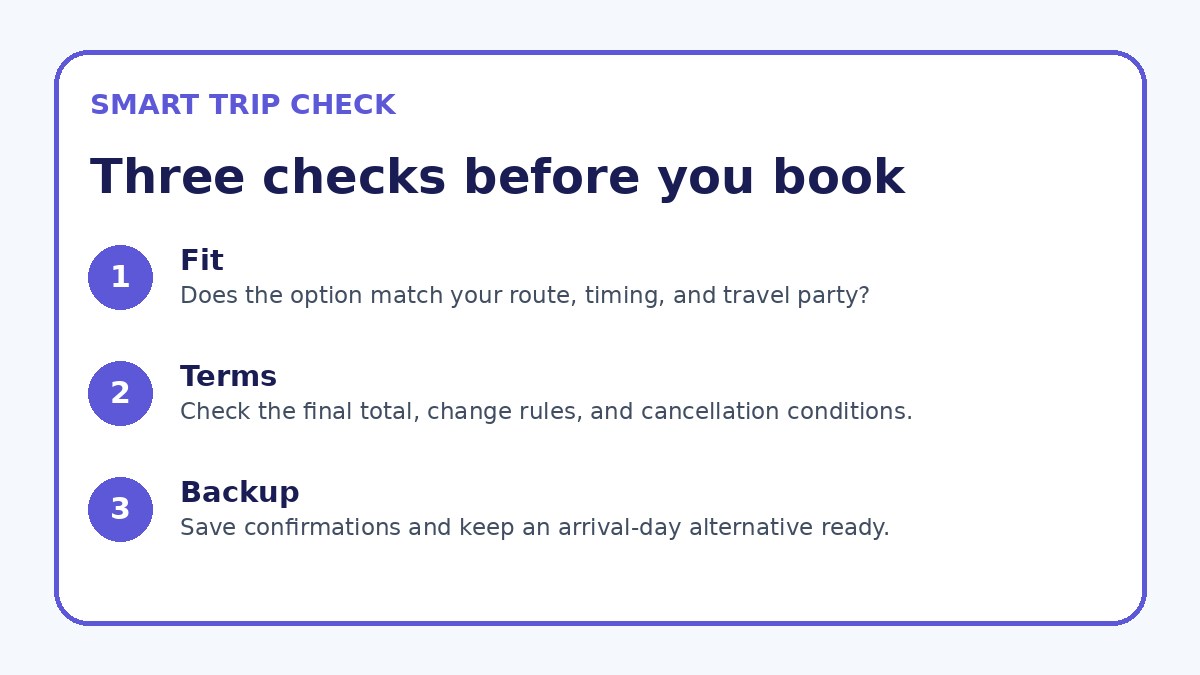
Key factors for couples when comparing options
Time on road or in terminals: calculate total door-to-door travel time, not just block times on the ticket. A direct flight with an inconveniently placed airport in Busan could still be faster overall if it reduces ground transfer time. Think about how much buffer you want between check-in and departure — couples who cherish slow mornings may prefer a later direct flight even if a connecting routing is cheaper. Add in hotel check-in times and any scheduled activities on Jeju to see which option fits your rhythm.
Cost and convenience trade-offs: when comparing fares, total cost should include potential extra expenses: checked-bag fees, transfer taxis, or spending during a long layover. Consider intangible costs too—stress from tight connections or the convenience of guaranteed seats on the same flight. If one partner values predictability and the other values savings or adventure, aim for a compromise: perhaps a direct outbound to minimize arrival stress and a connecting return if timing or price make sense. Always read the carrier’s final booking terms for baggage rules and change/cancellation policies.
Before you book
- Compare total door-to-door travel time for each itinerary, not just flight duration, including ground transfers and expected waiting times.
- Verify baggage allowances, carry-on rules, and fees on the airline’s official booking page before finalizing the purchase.
- If booking connecting flights on different tickets, allow extra buffer time and plan how you will recheck luggage and clear security.
- Select adjacent seats or confirm you can sit together at booking to avoid seating separation at check-in.
- Check minimum connection times and the airline’s missed-connection policy when you choose a single-ticket connection.
- Confirm both travelers have contact details in the booking and enable flight status notifications on your phones.
Practical booking and day-of-travel tips
Book as a pair: select seats together and confirm contact details so both travelers receive updates. If you pick connecting flights, consider buying a single itinerary that covers both legs under one reservation so the airline has responsibility for missed connections. When separate tickets are cheaper, build generous time between flights to safely recheck baggage and pass security. Before payment, verify whether the lowest fare carries restrictions that affect changes or refunds, and check the airline’s final page for baggage allowances and carry-on limits.
On travel day, pack with the connection scenario in mind: a shared small carry-on with essentials (medication, chargers, a change of clothes) reduces stress if luggage is delayed. Arrive earlier than usual when you must check bags or deal with unfamiliar terminals. For couples, coordinating a simple plan for navigating a transfer—who watches luggage, who buys coffee, how you meet if separated—keeps things calm. Finally, confirm flight status the morning of departure and have contingency time if you plan activities right after arrival on Jeju.
Frequently asked questions
Are direct Busan to Jeju flights always faster than connecting options?
Direct flights are usually faster in air time and simplify logistics, but not always faster door-to-door. If a direct flight departs from a less convenient terminal or at an awkward hour, a connecting route with shorter ground transfers could equal or beat the total travel time. Calculate total travel time including travel to and from airports, expected wait times, and time to clear baggage claim. For couples, consider which timeline reduces stress—arriving sooner at your hotel or having a more relaxed departure schedule.
How should couples handle luggage when taking connecting flights?
If your connection is on a single ticket with the same carrier or a codeshare partner, checked bags are often transferred automatically, but always confirm this on the airline’s booking page. For separate tickets, assume you must collect and recheck bags, and build extra time for that process. To reduce risk, travel with a carry-on containing essentials for at least one night. Agree in advance who manages luggage during transfers and keep important documents and medication in an easily accessible bag.
What practical checks should we make before booking to avoid surprises?
Before booking, confirm three key items on the airline’s official site: exact baggage allowances and fees, minimum connection times or required layovers, and the carrier’s policy for missed connections and rebookings. Verify seat availability for both travelers and whether seats are guaranteed together. If you find a deal on a third-party site like Trip.com, use it to compare options, but always complete the final verification on the airline’s page so you understand cancellation terms, change penalties, and any boarding or check-in deadlines.
Final planning note
Choosing between direct and connecting Busan to Jeju flights comes down to what matters most to you as a couple: simplicity and time on Jeju, or flexibility and potentially wider scheduling. Direct flights reduce stress, fewer steps mean fewer things that can go wrong, and they make short trips simpler. Connecting options broaden choices and may offer route creativity or cost advantages, but add transfers and contingency planning. Walk through the decision checklist together, verify baggage and connection rules on the carrier’s final booking page, and pick the option that aligns with your shared travel priorities so you start your Jeju time relaxed and ready to enjoy it.
Continue planning
Check current options and final conditions
Use the provider page to confirm live availability, the final total, cancellation terms, and every condition that matters to your trip.
This evergreen planning guide was created with AI-assisted drafting and a structured quality review. It does not display live prices, schedules, availability, visa guidance, or provider rankings. Verify current details before booking. Some links are affiliate links; we may earn a commission at no additional cost to you.