Practical answer first: for most first-time visitors to Busan, a rental car is unnecessary unless your itinerary prioritizes remote coastal or mountain spots, you’re traveling in a group with heavy luggage, or you plan day trips beyond the city’s effective public transit and intercity bus/train links. Busan’s dense neighborhoods, extensive metro and bus network, and compact tourist areas make walking and public transport faster, cheaper, and simpler for single travelers and short stays. That said, a car gives flexibility for early-morning fishing villages, scenic seaside drives, and stops outside regular transit schedules. This article helps you decide by listing tradeoffs, concrete decision criteria, and practical steps to compare options and verify provider details before booking.
How Busan’s layout and transport affect the decision
Busan is a long, hilly port city with several concentrated activity nodes: beaches in the east (Haeundae), busy shopping and nightlife around Seomyeon, and the old port and markets near Nampo-dong. These districts are connected by an extensive metro system and a dense city bus network that reach most tourist sights. For many typical sightseeing days—temple visits, beachfront time, market wandering, and museum stops—public transit minimizes parking stress and frequently beats cars for door-to-door travel time during busy periods.
However, the city’s geography also creates longer east–west travel times by public transit for some cross-city trips and limited direct routes to rural coasts or mountains. If your ideal trip includes early-morning or late-night departures, multi-stop day trips along the coast, or destinations where local buses are infrequent, a rental car can save time and enable flexibility. The key is matching the map of your planned stops to transit coverage and frequency.
Practical tradeoffs: cost, convenience, and comfort
Cost comparisons have many moving parts: base rental fees, fuel, highway tolls, parking charges, and potential drop-off fees. Public transit and taxis keep costs predictable for short city stays, while car rental becomes more economical with several passengers splitting fees or when transit service to your chosen destinations is scarce. Also factor in the time you'll spend finding and paying for parking, which is often scarce near popular beaches and market areas.
Comfort and convenience matter beyond money. A car gives privacy, climate control, and space for luggage or equipment, useful for families or active travelers with bikes or surfboards. But city driving requires comfort with unfamiliar signage, variable driving styles, and negotiating narrow streets and crowded intersections. If you prioritize relaxing travel and minimal navigation, combining trains, buses, and occasional taxis may be the less stressful choice.
| Approach | Best for | Tradeoff to check |
|---|---|---|
| Rent a car for full trip | Groups, remote itineraries, flexible multi-stop schedules | Higher cost, parking hassles, need to navigate unfamiliar roads |
| Use public transit and taxis | Solo travelers, short stays, city-focused itineraries | Less flexibility for remote stops and early/late travel |
| Mix: transit in city, rent car for select days | Balanced itineraries with one or two remote day trips | Extra time for pickup/drop-off and separate booking logistics |
| Guided day tours or private transfers | Travellers who prefer no driving and curated local knowledge | Fixed schedules and less privacy compared with a private rental |

When a Busan car rental clearly makes sense
Choose a rental if your trip centers on destinations poorly served by public transit, such as rural coastlines, mountain trails outside trailhead transit, or dispersed island accesses that require flexible timing. A car is also sensible for multi-stop family trips, photographers chasing sunrise/sunset at multiple spots, or travelers bringing bulky sports gear. If your schedule includes early departures to remote ferry ports or late returns when buses stop, driving avoids long waits and tight connections.
Also consider group size: three to four adults splitting a rental and parking costs often balances out compared with multiple taxi fares. Finally, if you’re comfortable with long-distance driving in Korea and can comfortably use GPS (and verify necessary documents like an International Driving Permit if required), the car’s autonomy can convert travel time into productive or restful moments without coordinating with transit timetables.
Before you book
- List every place you want to visit and mark which are outside the metro or served infrequently by bus.
- Estimate group size, luggage, and gear to determine whether splitting a rental makes financial sense.
- Check driver document requirements (license, International Driving Permit) and confirm them on the rental company’s final booking page.
- Compare total estimated costs: rental base, fuel, tolls, parking, insurance, and potential drop-off fees.
- Review pickup/drop-off locations and hours to avoid arriving when counters are closed or requiring extra transfers.
- Confirm what insurance covers and whether you need extra liability or damage waivers to match your comfort level.
How to verify and book responsibly
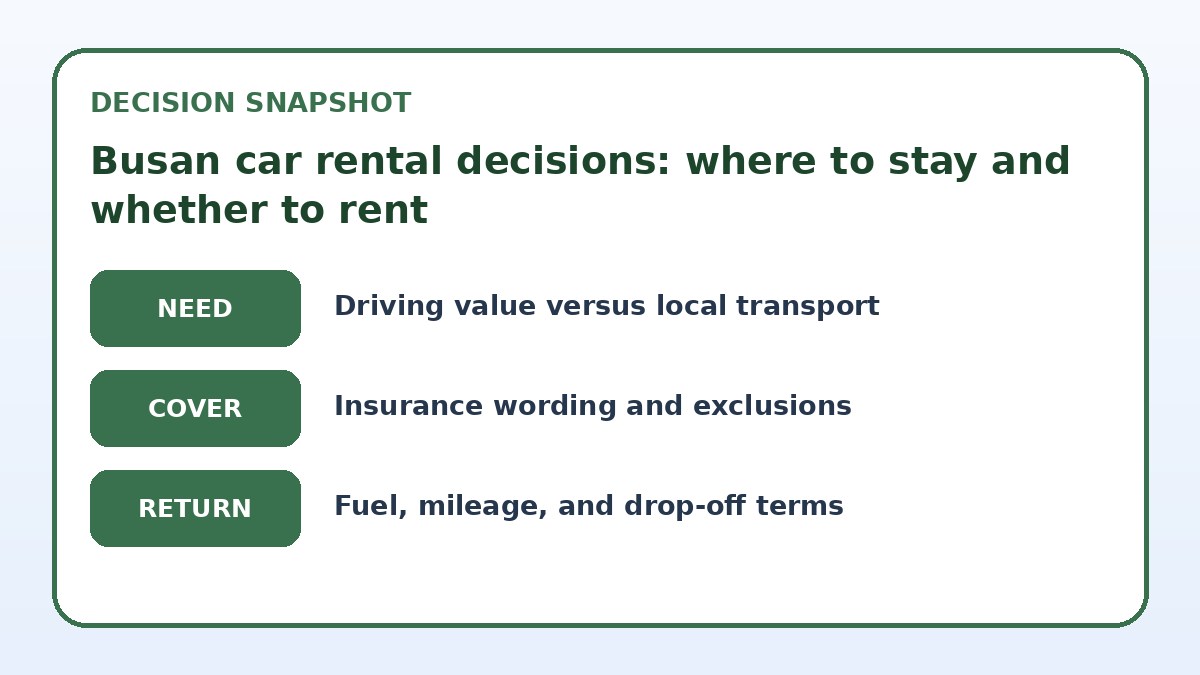
Before you book, confirm the provider’s fuel policy, mileage limits, cross-border restrictions (if you plan to drive outside Busan), and requirements for driver documentation. These elements can change and are often detailed only on the rental company’s final booking page. Check cancellation and insurance options—specifically what standard coverage includes and what optional collision damage waivers or liability upgrades cost—and verify deposit and credit card holds so you’re not surprised at pickup.
Compare practical pickup/drop-off logistics too: airport counters, off-airport shuttles, and hotel delivery services differ and can add time. If you prefer to skip the car altogether, look into local day tours, private transfers, and intercity buses or trains that connect Busan to nearby destinations; Trip.com can be a place to compare availability but always verify schedules and final terms on the operator’s pages before committing.
Frequently asked questions
Can I drive a rental car in Busan with a foreign license?
Whether you can drive with a foreign license depends on your home country and the type of license. Many visitors use an International Driving Permit (IDP) alongside their national license, while others may need a certified Korean translation or local permit. Verify exact requirements for your nationality and license type before booking by checking the rental company’s final booking page and the Korean transport authority’s guidance. Don’t assume universal acceptance—carry the original documents and photocopies to present at pickup.
Is parking in Busan easy to find and affordable near tourist areas?
Parking availability and cost vary widely by neighborhood and time of day. Popular beach areas, market districts, and viewpoints often have paid lots or street parking with limited spaces; rates and payment methods differ by location. Expect to pay more and search longer during peak tourism periods and weekends. If parking convenience is a priority, confirm hotel parking options and fees before booking and plan for extra time when visiting crowded spots. The rental provider’s staff can often advise about typical parking in your planned areas.
How should I decide between renting a car and booking an organized day tour?
Start by listing must-see stops and checking their transit access and operating times. If sites are remote, require early starts, or need multiple stops in one day, renting a car or private transfer offers flexibility. If you prefer local commentary, hassle-free logistics, and guided itineraries, a reputable day tour provides transport, timing, and insights without driving. Compare total cost, convenience, and experience tradeoffs; for availability comparison, you can look on platforms such as Trip.com but always confirm the operator’s final terms and cancellation policy before booking.
Final planning note
Deciding whether a Busan car rental fits your first visit comes down to three practical questions: where you’ll base yourself, the exact locations you want to reach, and how comfortable you are driving in a foreign city. For most visitors staying in central neighborhoods and focusing on beaches, markets, and museums, public transit combined with occasional taxis is simpler and often faster. Rent a car if your plan includes remote coastal routes, early or late departures, or bulky equipment and a group sharing costs. Whatever you choose, run the checklist items, verify legal and insurance details on the rental provider’s final booking page, and compare transit and guided-tour alternatives to make the most relaxed, efficient plan for your trip.
Continue planning
Check current options and final conditions
Use the provider page to confirm live availability, the final total, cancellation terms, and every condition that matters to your trip.
This evergreen planning guide was created with AI-assisted drafting and a structured quality review. It does not display live prices, schedules, availability, visa guidance, or provider rankings. Verify current details before booking. Some links are affiliate links; we may earn a commission at no additional cost to you.