Practical answer first: for most first-time visitors to central London, a rental car is more a liability than an asset — expensive to park, tricky to navigate, and often unnecessary because the city’s public transport and rail links are efficient. However, if your plan focuses on rural escapes, multiple countryside stops, or traveling with bulky gear, a car can be the easier choice. This article helps you judge which approach fits your itinerary, budget, and comfort level. Read the tradeoffs, where driving adds value, what to compare before booking, and a quick checklist of actions to take if you decide to rent a car for any part of your trip.
When a London car rental makes sense
A car becomes attractive when your itinerary pushes beyond the capital. Day trips to the Cotswolds, South Downs, or coastal towns, multi-stop countryside routes, or itineraries that include early-morning departures and unpredictable schedules are examples where driving saves time and reduces reliance on infrequent trains or buses. A vehicle gives freedom to explore small villages, reach viewpoints or remote pubs, and carry bulky items like sports equipment, strollers, or musical instruments without juggling multiple transfers.
Travel parties that benefit most include families with young children, groups sharing the vehicle cost, and travelers with mobility needs who require door-to-door access. Also consider mixed plans: rent for the days you leave London and park the car near a train station for city time. Before booking, map your day-trip routes roughly, check typical rural parking availability, and confirm whether a smaller car or automatic transmission better suits the roads you’ll drive.
Why public transport often wins in central London
London’s public transport — Underground, buses, trams, and Thames services — simplifies moving between attractions and neighbourhoods without the stress of traffic and parking. Stations are usually closer to major museums, theatres, and shopping districts than car parks, and many central hotels are chosen for their transport links. Walking between stops is often faster than driving short distances because congestion, traffic lights, and one-way systems slow cars down, while bus lanes and Underground routes keep public transit moving.
Beyond convenience, driving in central London introduces extra tasks: understanding congestion and low-emission zones, finding and paying for parking, and possible lane restrictions. If you value uninterrupted sightseeing and an easy arrival at your hotel, leave the driving to local transit. That said, public transport requires thinking about luggage and mobility; if those are concerns, plan how you’ll transfer between stations and your accommodation, or consider a short taxi ride for door-to-door comfort.
| Approach | Best for | Tradeoff to check |
|---|---|---|
| No rental: rely on public transport and taxis | Visitors staying central, short trips, and those who dislike driving in cities | Less flexibility for rural day trips and managing bulky luggage; possible higher local taxi costs for door-to-door transfers |
| Short-term rental just for day trips outside London | Those who want transit in the city but a car for specific excursions | Extra time to pick up/return vehicle; added booking complexity and potential one-way fees |
| Full-trip rental based in and outside London | Travelers planning extensive countryside touring or moving between many remote locations | Higher parking and congestion costs in the city, and more driving stress navigating urban areas |
| Hybrid: train + short-term hire at regional station | Visitors combining easy access to central London with flexible rural exploration | Requires careful coordination of train schedules and car pick-up windows; luggage handling still needed |
Key decision criteria to weigh before booking
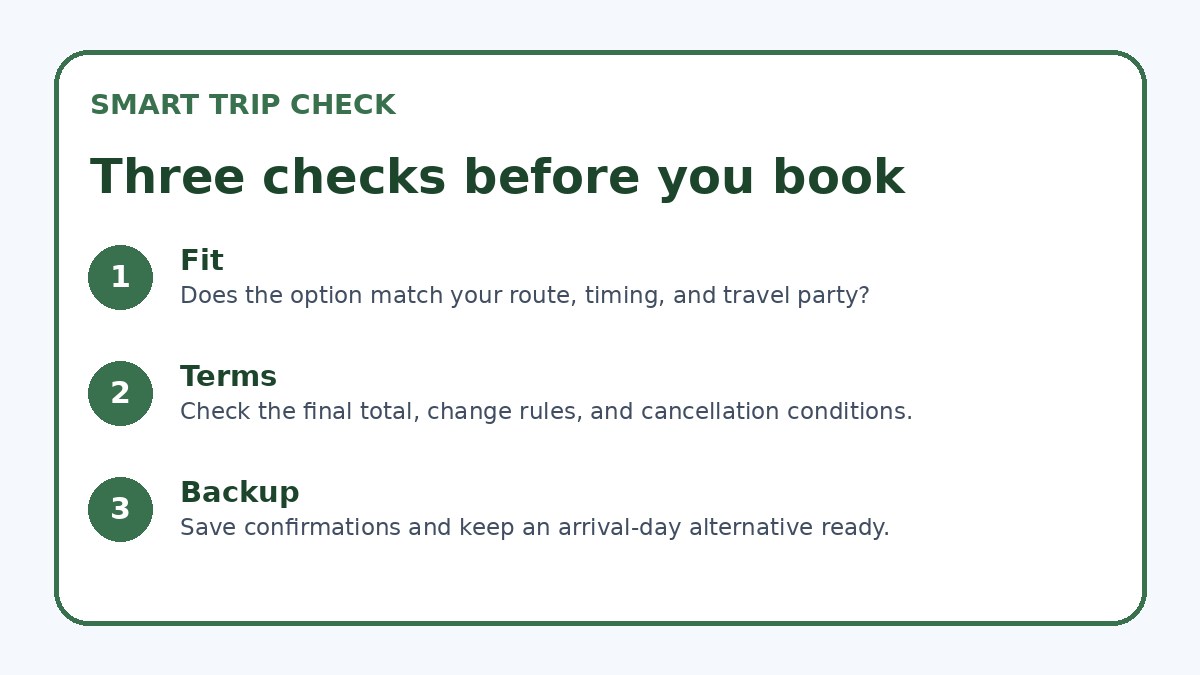
Start by listing your core activities and locations. If most days are inside zones 1–2, a car is probably unnecessary. For each day outside central London, estimate whether public transit or a car saves time door-to-door. Consider companions — children, elderly travellers, or people with mobility constraints change the balance in favour of a car. Factor in how much you plan to move between places in a single day: multiple rural stops typically point to hiring a vehicle, whereas single-destination visits often don’t.
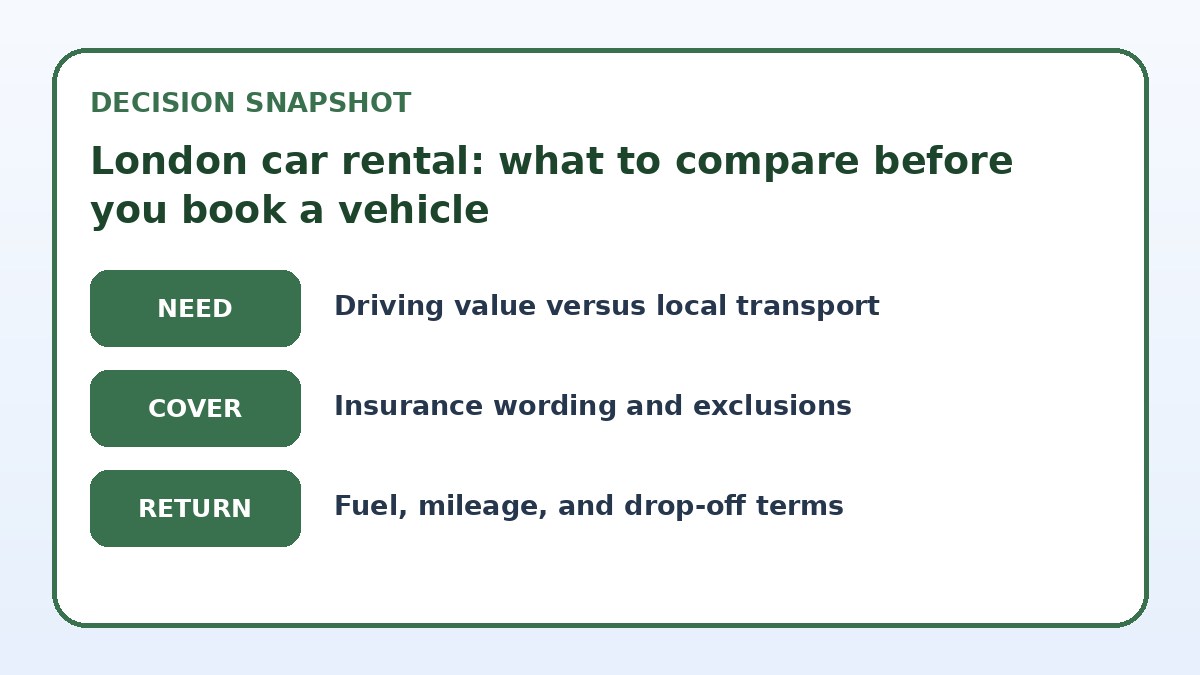
Next, add practical checks: does your accommodation include affordable on-site parking? Are you comfortable driving on the left and using UK road signage? Check whether the car size fits narrow side roads and short parking spaces. Finally, account for extra costs you must verify at booking — fuel policy, insurance excess, additional driver fees, and pick-up/drop-off times — because these commonly make a rental more expensive than the headline rate suggests.
Before you book
- List each day’s main destinations and mark which are inside central London zones to see how many days actually need a car.
- Check whether your accommodation offers on-site or nearby parking and the exact costs and reservation policies before booking a vehicle.
- Compare insurer CDW/excess levels on the final rental booking page and verify what your credit card or travel insurance covers.
- Decide car size and transmission (automatic vs manual) based on narrow roads, parking space, and driver comfort, and confirm availability.
- Estimate door-to-door travel time for key days by comparing car routes with train/bus options to spot where driving saves time.
- Photograph the vehicle at pick-up and drop-off, keep a copy of the rental agreement, and note fuel policy to avoid disputes.
How to compare rental options and protect yourself
When you decide to rent, compare more than price. Verify what the quoted rate includes on the provider’s final booking page: the insurance coverage type, excess amount, fuel policy, mileage limits, and penalties for late return or tolls. If you need car seats, roof racks, or an automatic, confirm availability and extra charges. Look for flexible pick-up/drop-off locations that minimize time spent in traffic; sometimes an off-airport branch near a train link makes mixed-mode travel simpler.
For insurance, check whether your personal credit card or travel insurance covers collision damage and theft; if not, evaluate the rental company’s supplemental options and the exact excess amount. Photograph the car at pick-up and drop-off, keep all receipts, and record mileage. If using a GPS or mobile navigation, preload offline maps in case of poor signal. Finally, Trip.com can be a convenient place to compare current availability and pick-up locations, but always confirm the final terms and coverage on the rental supplier’s booking page before you commit.
Frequently asked questions
Will I need a special permit or licence to drive in London?
Most visitors can drive in London with a valid driver’s licence from their home country; if your licence is not in English, check whether an international driving permit is recommended. You should also confirm age restrictions and any additional requirements directly on the rental supplier’s booking page before completing the reservation. Remember that payment methods, deposit holds, and optional insurance offerings vary by company, so verify what the provider requires at pick-up to avoid surprises.
How should I handle congestion and low-emission zones when driving in London?
London uses traffic control areas and emissions charging in parts of the city; if you plan to drive into central zones, identify whether your route crosses charge boundaries and confirm responsibility for any fines or charge payments with the rental company. Rental suppliers differ in how they bill these charges, so check the final booking terms for toll and congestion handling. Planning routes that avoid restricted zones or parking outside central areas and using public transit for the final leg can reduce these complications.
What’s the easiest way to combine public transport and a rental car?
A practical approach is to use public transport while in central London and rent a car only for the days you plan to leave the city. To do this efficiently, pick up or drop off the vehicle at a location with good rail links or at an off-airport branch near a mainline station to minimize urban driving. Confirm the rental company’s opening hours and whether they allow late returns, and plan train tickets and luggage logistics in advance to ensure smooth transfers between modes.
Final planning note
Deciding whether a London car rental fits your first visit comes down to where you’ll spend most days and how you travel between places. For central London stays focused on museums, theatre, and neighbourhood exploration, public transport is usually faster, simpler, and less stressful. Choose a car when your plans involve multiple rural stops, early starts, mobility needs, or lots of bulky gear. If you do rent, compare insurance excess, fuel policies, pick-up locations, and parking availability carefully on the rental provider’s final booking page. With a few checks and the right mix of train and car days, you can enjoy both London’s excellent transit and the freedom of the British countryside.
Continue planning
Check current options and final conditions
Use the provider page to confirm live availability, the final total, cancellation terms, and every condition that matters to your trip.
This evergreen planning guide was created with AI-assisted drafting and a structured quality review. It does not display live prices, schedules, availability, visa guidance, or provider rankings. Verify current details before booking. Some links are affiliate links; we may earn a commission at no additional cost to you.