If you are traveling alone in Berlin and considering a Berlin car rental, start by deciding whether driving genuinely improves your trip. For many solo travelers, a car is helpful for day trips outside the city — think Potsdam, the Spreewald, or Brandenburg lakes — but in-city driving adds parking, environmental zones, and navigation stress that can erode the benefits. This guide gives the short practical answer up front: rent a car only if your itinerary includes multiple destinations outside central Berlin or if you need flexibility for remote stays; otherwise rely on public transport, bikes, or targeted rides. Below I explain how to assess pickup and return terms, what to read in insurance wording, how pickup/return friction affects your schedule, and a clear non-driving fallback so you can make a confident choice before booking.
Route value: when a Berlin car rental actually helps
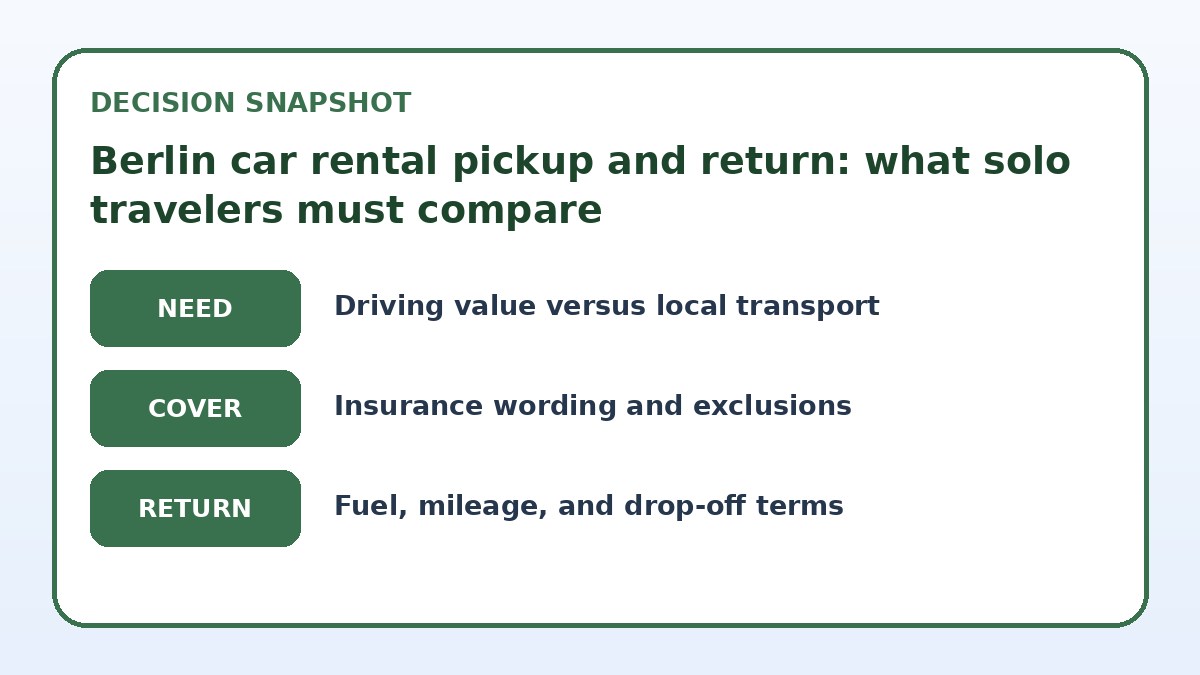
Decide first whether driving adds real value for your solo trip. Inside central Berlin the public transport network (U-Bahn, S-Bahn, trams and buses) covers nearly every neighborhood, often faster and cheaper than a car once you factor parking and low-emission zones. A rental tends to pay off when your plan includes several day trips to places with limited public transport, lodging outside town, or carrying bulky gear—photography, camping, or cycling equipment. For single-day trips to nearby attractions with good rail or bus links, the car’s time savings can vanish after walking to and from parking, paying fees, and searching for a spot.
To make the decision, list each day’s major stops and compare door-to-door travel time by car versus public transit. Estimate parking search time and cost at each stop; in Berlin central districts that can easily add 20–40 minutes and extra expense. Also consider comfort: if you value privacy for early departures or late returns, a car gives autonomy. If most of your time is in Mitte, Prenzlauer Berg, Kreuzberg, or near major museums, keep public transit as the default and consider a single-day rental or hire for excursions.
Decide whether driving earns its place
| Mobility strategy | Best for | Cost or friction to check |
|---|---|---|
| Rent a car for the whole trip | Solo travelers with multiple rural day trips or remote accommodations | Higher parking, fuel, and admin friction in city; requires careful insurance and return-window checks |
| Single-day car hire for excursions | Urban-based solo travelers who need a car only for a specific day | Saves parking and long-term costs but adds a pickup/return step that must fit your schedule |
| Public transport and regional trains | Travelers staying in central Berlin wanting reliable, frequent connections | Limited flexibility for remote sites and carrying large gear; may require early planning of connections |
| Taxis, ride-hailing and bike share mix | Short hops, late-night travel, and flexible in-city movement without parking concerns | Can be costly for long day trips and dependent on availability during peak demand or at night |
Check live rental choices only after the route test
Use the exact driver, dates, pickup point, and return plan to compare current conditions.
Insurance wording: what solo travelers must verify
Insurance descriptions are often short on booking pages but can hide crucial limitations. On the provider’s final booking page check three specifics: the amount of the damage excess (and whether it’s refundable on dispute), what incidents are excluded (roof, underbody, tires, glass, key loss), and whether cover applies to solo drivers or requires an added named driver. Note whether collision damage waiver (CDW) reduces the excess or simply shifts responsibility; some CDW products still leave large deductibles unless you buy a separate zero-excess product or use a credit card that provides primary coverage.
Also confirm roadside assistance response times and what it covers—towing distance caps, battery jumps, and lockout fees are common gaps. If you plan longer day trips, clarify whether coverage extends to other German states or bordering countries, and whether all drivers must be registered on the rental agreement to have any cover. When provider specifics could change, the single reliable source is the rental company’s final booking page and the written rental contract; print or save the policy pages before you drive off.
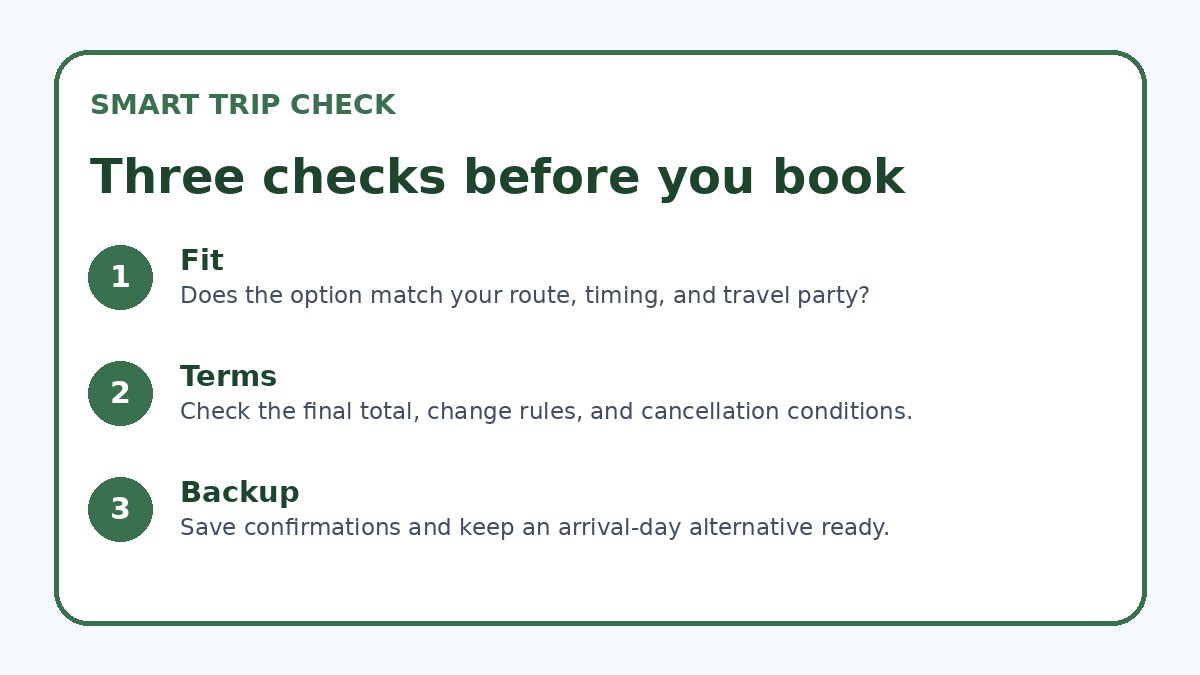
Compare the full rental conditions
Confirm insurance wording, exclusions, deposit, fuel, mileage, and return terms on the final page.
Pickup and return friction: schedule and location tradeoffs
Pickup and return terms create most of the practical friction that solo travelers feel. Airport counters have long hours but often long lines; city-center locations may close earlier or require appointment pickups. Verify exact opening hours, after-hours return procedures, and any late return penalties written on the booking confirmation. Some companies require you to park in a specified lot and complete a return checklist with staff or risk additional charges for unrecorded damage—this matters when you arrive late or when public transit or trains delay you.
Other friction points include key handover procedures, where some smaller depots close at lunchtime or operate by appointment only, and relocation fees for one-way rentals if you plan to drop the car at a different city. Also note that supplemental equipment (GPS, child seats, roof boxes) may only be available at certain branches; if you need them, confirm availability in writing. Before you book, decide if you can realistically meet the pickup and return window without rushed transfers; if not, choose an alternative mobility option.
Car rental terms to verify
- Confirm the exact pickup address, opening hours, and after-hours return process on the rental company’s final booking page.
- Read the rental contract’s insurance section and note the damage excess amount, excluded items, and whether roadside assistance is included.
- Verify the fuel policy (full-to-full or pre-purchase) and how final fuel charges are calculated on return.
- Check whether cross-border travel is permitted, any toll device rules, and whether additional fees apply for driving in other states or countries.
- Compare parking availability and typical costs for each overnight location on your itinerary to estimate daily parking time and expense.
- If renting for a single excursion, confirm equipment availability (child seat, roof box) and that the pickup branch stocks it on your rental date.
A non-driving fallback: how to plan without a car
If you opt not to drive, build a reliable fallback that matches the parts of your itinerary where a car would have been useful. For regional day trips, look for timed regional trains (RB, RE) and regional buses that connect Berlin with Potsdam, Oranienburg, or the Spreewald—compare schedules and travel times rather than assuming direct options. For locations not well served by public transport, combine a shorter train journey with local bike rental or a scheduled transfer service. Rideshares and taxi apps will fill short gaps, but confirm typical journey times and expected costs for late-night returns.
Also consider booking a single-day car hire from a central depot for the precise day you need flexibility rather than renting for the whole trip—this minimizes pickup/return friction and insurance exposure. Use Trip.com as one place to compare current availability and terms, but always verify pickup location, hours, insurance limits, and fuel policy directly on the rental company’s final booking page before confirming. That final-step verification prevents surprises at the counter and keeps your solo travel plan robust.
Car Rental & Road Trip questions travelers ask
Do I need special insurance for driving around Berlin as a solo traveler?
You don’t necessarily need special insurance beyond the standard rental cover, but you must verify what the included policy actually covers. Check whether the collision damage waiver (CDW) reduces your excess or if you need an additional zero-excess product to eliminate the deductible. Confirm whether glass, tires, undercarriage, and key-loss incidents are excluded by default. If you rely on a credit card for coverage, read the card issuer’s terms to ensure it provides primary rental insurance in Germany and that you satisfy any enrollment or documentation requirements before pickup.
What are the pickup and return pitfalls that most solo travelers overlook?
Common pitfalls include after-hours returns without staff inspection, which can lead to disputed damage charges; remote or appointment-only pickup locations that add transfer time; and failing to document pre-existing damage. Also watch for fuel policy mismatches—pre-paid fuel with a no-refund remainder can be costly. Before driving away, walk the car with staff or take time-stamped photos of all sides and the interior, keep the staff-signed condition report, and store the rental agreement and final booking page screenshots in case of later disputes.
How do I decide between renting a car for the whole trip or using public transit and day hires?
List the days that require a car and assess travel times door-to-door with and without driving. If most days are inside central Berlin, public transit plus occasional single-day hire is often more convenient and cheaper once parking and insurance are counted. If you have consecutive days with remote stops or heavy gear, a continuous rental may reduce repeated pickup friction and be simpler for carrying equipment. Whatever you choose, verify branch hours, cross-border permissions, insurance limits, and fuel policy on the final booking page before committing.
Final decision note
For most solo travelers, a full Berlin car rental only makes sense when the itinerary includes several remote destinations, bulky equipment, or early/late transfers that public transit cannot easily cover. The key booking-stage checks are straightforward: verify pickup/return hours and procedures, read the insurance wording and excess amounts carefully, confirm fuel rules, and plan for parking. If any of those items don’t align with your schedule or comfort level, choose a public-transit base with targeted single-day hires or a mix of trains, taxis, and bike rentals. Always confirm critical terms on the rental company’s final booking page before you finish your reservation.
Continue planning
Check current options and final conditions
Use the provider page to confirm live availability, the final total, cancellation terms, and every condition that matters to your trip.
This evergreen planning guide was created with AI-assisted drafting and a structured quality review. It does not display live prices, schedules, availability, visa guidance, or provider rankings. Verify current details before booking. Some links are affiliate links; we may earn a commission at no additional cost to you.