If you’re traveling Bangkok to Chiang Mai and want to build a multi-city ground-transport plan, start with a simple decision matrix: how much time you have, how many stops you want, and how comfortable you need to be while moving. The practical answer: identify your fixed travel windows (arrival/departure in Bangkok and Chiang Mai), list intermediate stops you want to include, then compare train, overnight bus, and private/drivered segments for each leg. Mix slower daylight legs for scenery with one overnight link if you want sleep-on-board. Book core long-distance legs after you’ve chosen the stops and time budget; reserve shorter transfers later. Below I’ll explain how to weigh tradeoffs—time, flexibility, cost, comfort, and scenery—and give a checklist to finalize bookings and on-the-ground checks.
See current options before you compare the details
Availability and final conditions change. Open Trip.com now or keep reading for the practical comparison.
Choose your travel framework: fastest, scenic, or staged
Start by picking the framework that fits your trip: fastest travel, scenic exploration, or a staged multi-city route with specific stopovers. Fastest travel minimizes stops and prioritizes direct long-distance options. Scenic travel balances longer daytime legs to enjoy countryside views—this often means choosing trains or slower daytime buses. A staged multi-city plan purposely slices the route into short segments so you can stay overnight at intermediate destinations. That last approach is the most flexible but requires more bookings and ground coordination.
Practical planning means mapping time, interests, and logistics. List must-see stops between Bangkok and Chiang Mai and estimate how many hours you want to spend traveling each day versus exploring. From there you can decide whether to use a single overnight service for the longest transfer and shorter daytime buses/trains or split almost every segment into daytime travel plus an overnight in a town you want to explore. Your choice drives what to book first: long-distance sleepers or the short inter-city legs.
Compare transport modes for long and short legs
Long-distance options between Bangkok and the north are typically trains, overnight buses, and private car or van transfers. Trains often run along a scenic northbound corridor; consider reserved seats or berths for overnight comfort. Overnight buses can be more frequent and sometimes quicker, but quality and legroom vary widely. Private transfers or hiring a driver give door-to-door flexibility and allow timed stops for attractions, but they require more coordination and can be the most expensive choice per kilometer.
For shorter inter-city legs that connect your staged stops—such as Bangkok to Ayutthaya or Phitsanulok to Sukhothai—regional trains, local buses, and shared minivans are common. Trains and minivans are usually easy to book locally; vans are practical for flexible schedules but often leave only when full. Check exact pickup and drop-off locations, as some operators use peripheral terminals or guesthouse pickups. When comparing modes, weigh seat comfort, luggage handling, and how each option fits into your daily sightseeing windows.
| Approach | Best for | Tradeoff to check |
|---|---|---|
| Direct overnight train or sleeper bus | Travelers prioritizing continuous travel with minimal planning | Less flexibility to stop and explore; you trade local visits for saved travel days |
| Staged multi-city plan with daytime legs | Sightseeing-focused travelers who want to spend time in intermediate towns | Requires more bookings and on-the-ground coordination; longer total travel time |
| Private car/driver for select legs | Groups or travelers needing door-to-door service and timed stops | Higher cost, but greater convenience and bespoke routing |
| Mix-and-match (one overnight + short daytime legs) | Balanced travelers who want rest plus daytime sightseeing | Needs careful timing and buffer plans to avoid missed connections |
Ready to check the option that fits your plan?
Use your exact dates and traveler details so the provider page can show the current total and conditions.
Timing and booking strategy for a multi-stop itinerary
Book the longest overnight leg first once your route and dates are fixed—this secures the part that most affects your schedule. After that, reserve key daytime inter-city transfers that are on tight timelines or have limited capacity. Leave flexible legs (walk-up local buses, ferries, or frequent trains) for later so you can adjust if a primary night service changes. If you plan to travel during local holidays or busy periods, verify availability earlier and consider refundable or changeable fares where possible.
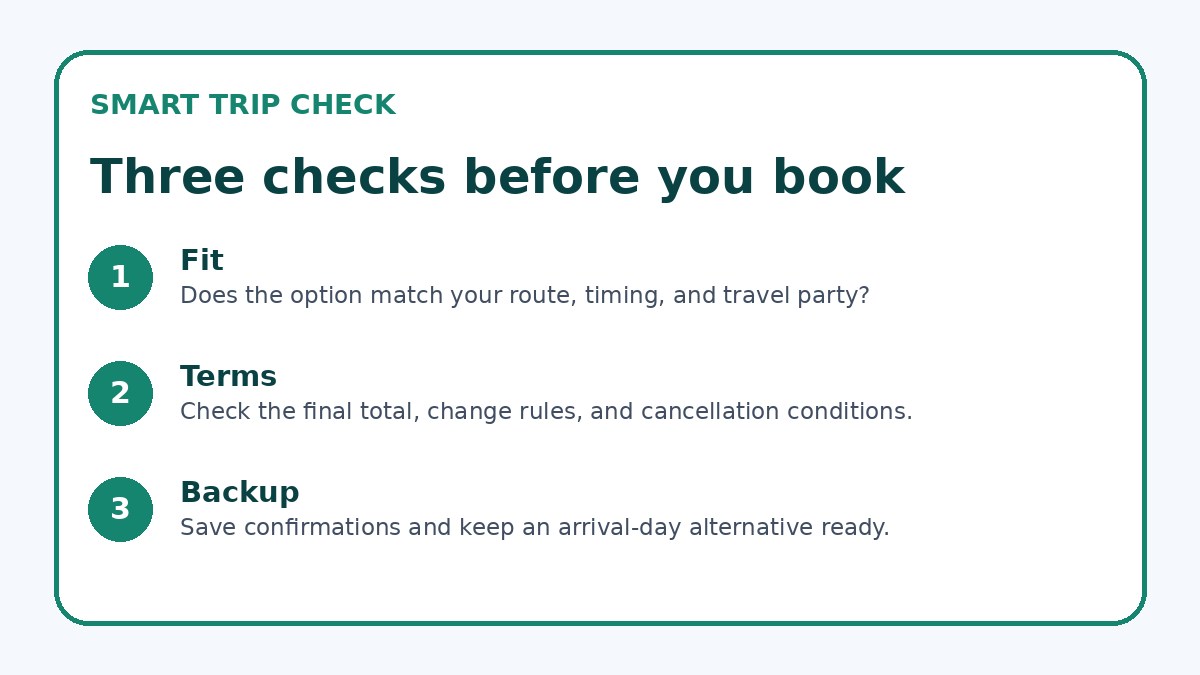
Use a two-tier verification process: initial comparisons on aggregator sites and then confirmation on the operator’s final booking page before paying. Aggregators (including Trip.com if you want an extra comparison) help find options and show typical durations, but always confirm seat class, baggage allowances, pickup points, and cancellation terms on the provider’s site. Keep final confirmation emails or tickets accessible and note exact station names—many cities have multiple train and bus stations with similar names.
Before you book
- List fixed travel constraints: arrival and departure days and preferred sightseeing stops along the route.
- Decide which leg will be your overnight long-distance transfer and prioritize booking that first.
- Check pickup/drop station names and exact addresses for every booked leg and save screenshots.
- Confirm seat/berth type, baggage allowances, and cancellation/change rules on the operator’s final booking page.
- Reserve accommodation near stations for early departures or late arrivals to reduce transfer stress.
- Identify one alternate service per long leg and note local taxi or ride-hail options for last-mile transfers.
On-the-ground logistics and contingency planning
Plan for transfers between stations and accommodations: factor in city traffic in Bangkok, potential taxi waits, and transit time to more remote low-cost bus terminals. Allow buffer time for immigration formalities if you’re arriving from another country before starting your ground journey. Carry printed or offline copies of your tickets and clear directions to pickup points; local taxis or ride-hail apps can save time but verify the correct station or terminal name before departing. Consider travel insurance that covers missed connections if your schedule is tight.
Prepare a simple contingency plan: identify an alternate afternoon service or a nearby guesthouse where you could stay if a planned leg is delayed. Keep a short list of phone numbers for your accommodations and transport providers, and learn a few basic phrases in Thai or have them written down to show drivers. Finally, if you’re using mixed modes (train plus private car), confirm baggage limits and whether transfers will include assistance loading larger suitcases.
Frequently asked questions
How do I decide between an overnight train and an overnight bus for the Bangkok to Chiang Mai route?
Choose based on your priorities: trains generally provide more space and a steady ride, which some travelers find easier for sleep and scenic daytime options. Buses often run more frequently and may shave hours on certain timetables, but comfort varies by operator and vehicle type. Consider whether you prefer a reserved berth, how much luggage you have, and the exact station locations, because some bus terminals are farther from city centers. Always check the operator’s detailed descriptions of berth types and luggage rules before booking.
Can I break the journey into multiple stops without complicating bookings too much?
Yes—many first-time visitors build staged itineraries by combining one longer overnight connection with shorter daytime legs between stops. The trick is sequencing: book the critical long-night transfer first, then fill in daytime hops. Use flexible or refundable options for legs that might need changing, and confirm pickup/drop locations. Local minivans and regional trains are easy to book on short notice, but if you have a tight timetable for sightseeing, reserve those inter-city seats in advance when possible.
What should I verify on a provider’s booking page before final payment?
On the operator’s final page, confirm the exact departure and arrival station names and addresses, the class or seat/berth type, luggage allowance and any extra baggage fees, the provider’s cancellation or change policy, and whether the ticket is transferable. Also check arrival times that match your onward plans and any required identification or printing instructions. If an aggregator suggested the option (including Trip.com), use the provider page to validate these details before committing.
Final planning note
Building a Bangkok to Chiang Mai multi-city ground-transport plan reduces to three practical steps: pick your travel framework (fast, scenic, or staged), secure the longest overnight transfer early, and fill in shorter legs around sightseeing windows with practical buffers. Balance comfort against time and the number of bookings you’re willing to manage. Use operator pages to verify the station names, seat types, baggage rules, and cancellation terms before paying. With a clear sequence and a simple contingency plan, you can enjoy both the journey and the stops along the route without scrambling at the last minute.
Continue planning
Check current options and final conditions
Use the provider page to confirm live availability, the final total, cancellation terms, and every condition that matters to your trip.
This evergreen planning guide was created with AI-assisted drafting and a structured quality review. It does not display live prices, schedules, availability, visa guidance, or provider rankings. Verify current details before booking. Some links are affiliate links; we may earn a commission at no additional cost to you.