
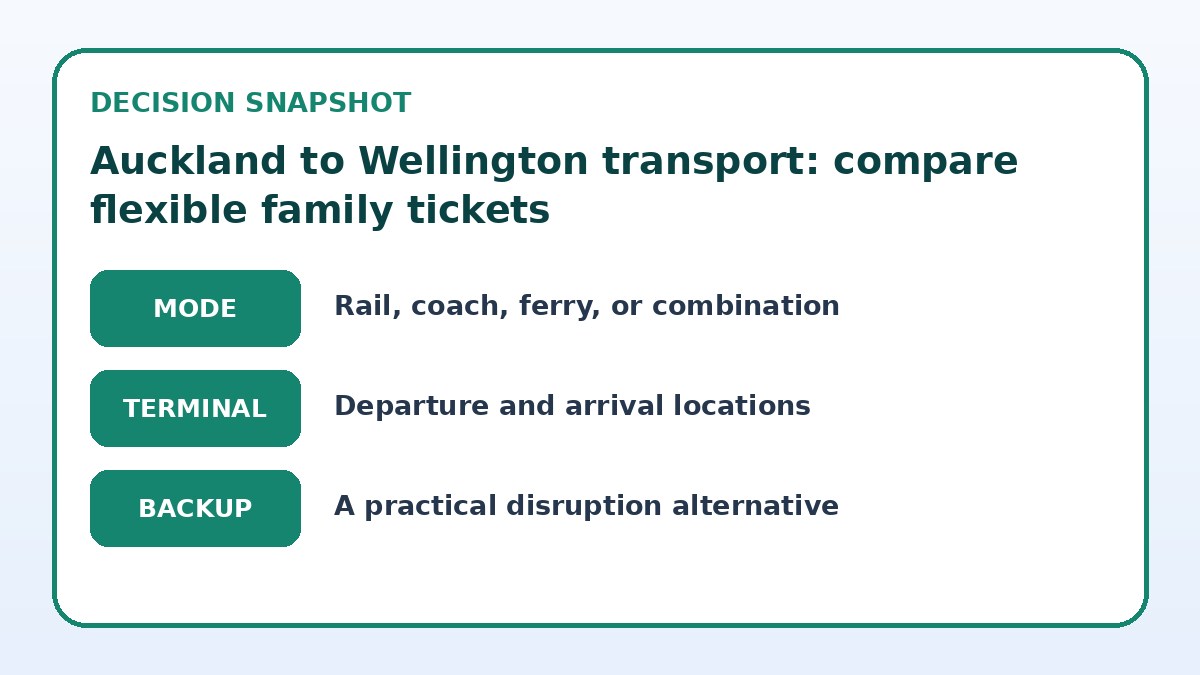
If you're planning Auckland to Wellington transport with kids, the practical answer is: prioritize tickets that allow easy changes, free or cheap child fares, and simple refunds—then weigh convenience versus cost. Families most often need the ability to rearrange travel around illness, childcare logistics, or last-minute plans; that makes flexible-change or refundable tickets more valuable than the absolute cheapest non-changeable deals. When comparing options, look for clear family policies on child discounts, seat reservations, luggage allowances, and whether a partial refund or travel credit is issued if you need to cancel. Before you complete any booking, verify the provider’s full cancellation and change rules on the final booking page and check whether families can reserve adjacent seats or carriages in advance.
What ‘flexibility’ actually means for family travel
Ticket flexibility can cover several things: the right to change the travel date or time, the ability to cancel for a full or partial refund, the option to reissue tickets as travel credits, and whether seat reservations can be altered without penalty. For families, flexibility also includes child-friendly provisions such as discounted child fares, infant policies, and family seat allocation. Read the fine print for each element rather than assuming a single ‘flexible’ label covers everything you need. A fare may permit free date changes but still charge to change reserved seats or to add luggage.
Operational details can affect flexibility too: some schedules involve transfers or different operators, and each segment may have its own rules. When a trip contains multiple legs, verify change and cancellation rules for all operators involved. If you plan a mixed-mode journey—train plus bus or ferry—check whether tickets are sold as a single through-ticket or as separate bookings; separate bookings often mean separate penalties for changes, which is critical for families juggling multiple reservations.
Comparing refundable vs changeable vs non-changeable fares
Refundable fares let you get money back, typically after some administrative steps, while changeable fares let you move your booking to another date or time for a fee or for free depending on the tier. For families who anticipate a high chance of cancellation (illness, unexpected commitments), refundable fares reduce financial risk. Changeable-but-non-refundable tickets are useful for households that are fairly confident in travel dates but might need a swap; these usually cost less than refundable fares but more than strict advance-purchase deals.
Non-changeable or restricted tickets are the cheapest option in many markets, but they carry the biggest planning risk for families because fees or inability to change can make unexpected events costly. Evaluate how likely you are to alter plans: if changes are probable, the difference between a cheap non-changeable ticket and a pricier flexible one might be less than the cost of rebooking later. Also think about whether the provider issues travel credits or vouchers rather than cash refunds—those may be easier to use for future family travel but less useful if you need immediate reimbursement.
| Approach | Best for | Tradeoff to check |
|---|---|---|
| Refundable full-fare ticket | Families who may cancel and need a cash refund | Higher upfront cost compared with changeable or non-refundable fares |
| Changeable ticket with modest fee | Households likely to shift dates but confident they’ll still travel | Cheaper than refundable fares but can incur fees and seat changes may cost extra |
| Non-changeable advance-purchase ticket | Families with fixed, certain plans and a low tolerance for higher fares | Lowest price but little to no leeway if plans change |
| Semi-flexible family bundle or pass | Frequent regional travelers or multi-leg family itineraries | May require commitment or minimum trips to be cost-effective; rules vary by issuer |
Practical decision criteria for families on the route
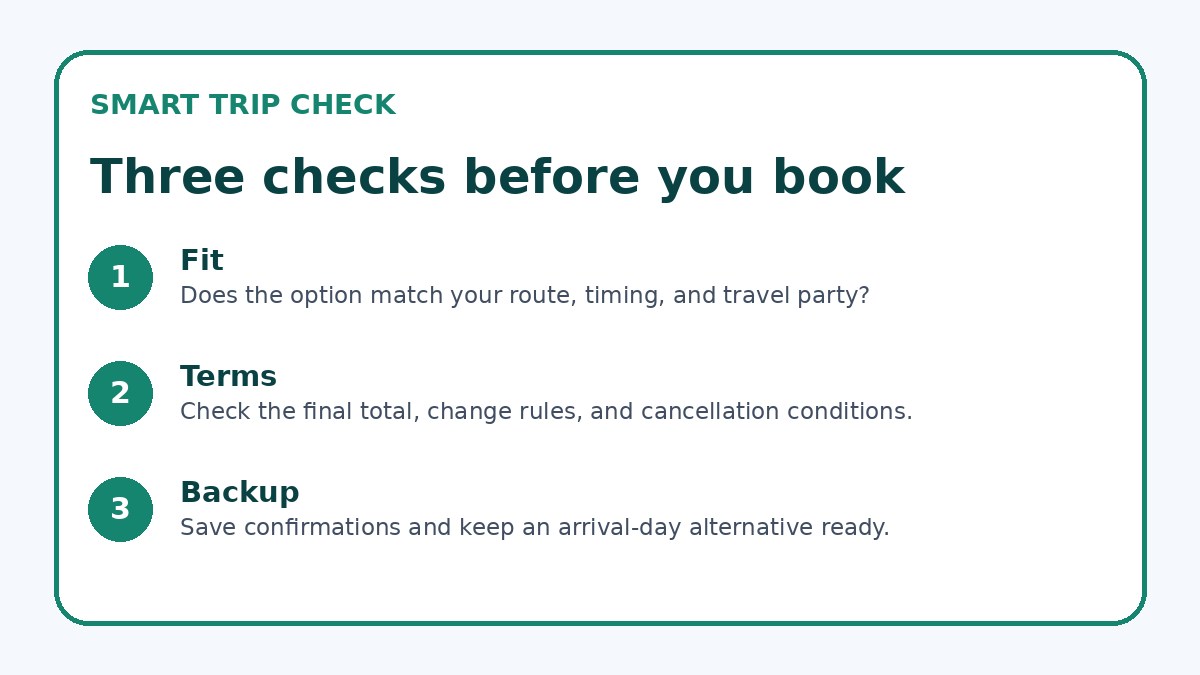
Start by listing what you cannot compromise: adjacent seats, guaranteed luggage allowance for prams, or the ability to move dates without a fee. Next, estimate the likelihood of needing to change plans; if a young child or multiple caregivers are involved, err on the side of more flexibility. Consider travel timing too: weekday services and off-peak times sometimes have more flexible small-group fare options. If you need to combine train with bus or ferry, confirm whether the booking is protected as a single itinerary or sold as distinct legs—this changes how flexibility applies.
Also factor in how you value convenience on the day of travel: refundable or flexible fares may include perks such as priority boarding or free seat assignments, which matter when securing adjacent seats for children. Don’t ignore customer-service access—providers with easy phone or web support can smooth last-minute changes. Finally, check family-specific rules—some carriers allow free travel for very young infants, while others require a reduced child ticket; verify these on the provider’s booking page before you finalize anything.
Before you book
- Confirm child and infant fare definitions and whether adjacent seats can be reserved together on the booking page.
- Check the exact change and cancellation fees, plus whether refunds are cash or travel credit before completing purchase.
- Verify luggage and pram policies for families, including any free allowances or required advance notifications.
- If your journey includes a connection, confirm whether the ticket protects missed connections or if you need separate bookings.
- Compare seat-reservation rules across fare classes—ensure the ticket type allows reserved seats if you need them.
- Record customer-service contact options and hours so you can reach the provider quickly if plans change.
How to compare options effectively before you book
Create a side-by-side checklist: change fees for different time windows, refund conditions, whether credits are transferable, seat reservation rules, luggage/pram policies, and child fare definitions. Use the provider’s final booking page to confirm exact terms; preliminary pages or third-party summaries may omit crucial exclusions. If you’re comparing multiple providers or combined itineraries, make sure each leg’s rules are visible—Trip.com is an option to view current availability, but always verify final fare rules on the operator’s own booking confirmation page.
When price differences are small, prioritize the option that reduces logistical friction—easier seat changes, clearer child fares, and simpler refund processes. If the itinerary requires a connection, compare the protection each vendor gives for missed connections (some offer protected connections within a single ticket). Finally, if you plan to travel frequently between these cities, look into family passes or multi-trip products and check how flexibility differs from single-trip fares.
Frequently asked questions
Should families always choose refundable tickets for Auckland to Wellington transport?
Not always. Refundable tickets offer the easiest path to recover money if you cancel, which is attractive for families with higher uncertainty. But they cost more. If your plans are stable and you can tolerate switching to a different date or receiving travel credit, a changeable or semi-flexible fare may be a better value. Weigh the probability of cancellation against the fare premium, and always check whether the operator issues full refunds or travel credits on the final booking page before purchasing.
How can I ensure my children can sit next to me if I book a flexible fare?
Seat-adjacency is often handled separately from ticket flexibility. When choosing a fare, confirm whether seat reservations are included or available for an additional fee; then reserve adjacent seats immediately after booking. Some operators let you select seats at the time of purchase, while others require a separate step. If seat choice isn’t guaranteed, contact the provider’s customer service or review the booking page for family seating policies to secure seats together well before travel day.
What should I do if I need to change a mixed itinerary with different operators?
Mixed itineraries can be tricky because each operator may enforce its own rules. First, identify whether your booking is issued as a single through-ticket; if so, changes might be centralized. If it’s multiple separate tickets, you’ll need to change each leg individually and pay separate fees. Before booking, compare the combined change/cancel conditions for all legs and consider booking with a single provider that offers protected connections if available. Always verify the complete terms on each operator’s final booking page.
Final planning note
For families traveling between Auckland and Wellington, prioritize the type of flexibility that matches your household’s risk tolerance: refundable fares for maximum security, changeable fares for likely date shifts, or low-cost non-changeable tickets for fixed plans. Make decisions using concrete criteria—seat adjacency, child fare rules, luggage and pram allowances, and whether cancellations return cash or travel credits. Compare full terms for each leg of the journey on the operator’s booking page before you finish booking, and keep customer-service contacts handy. With those checks in place you’ll reduce stress and make a choice that balances cost, convenience, and family needs.
Continue planning
Check current options and final conditions
Use the provider page to confirm live availability, the final total, cancellation terms, and every condition that matters to your trip.
This evergreen planning guide was created with AI-assisted drafting and a structured quality review. It does not display live prices, schedules, availability, visa guidance, or provider rankings. Verify current details before booking. Some links are affiliate links; we may earn a commission at no additional cost to you.