If you’re traveling from Amsterdam to Berlin with extra luggage, plan transfers around where your train, bus, or flight actually begins and ends rather than assuming a single central hub. Practical choices: pick services with through-check or easy luggage policies; choose arrival and departure stations with step-free access, platforms near exits, or long-term luggage storage; and allow extra time for moving between terminals, ticket gates, and public transport. Start by identifying which stations or airports each carrier uses and whether your booking includes checked-through baggage or requires separate handling at transfer points. This approach reduces stress and avoids last-minute porters, heavy lifting, or missed connections when you have bulky bags or multiple suitcases.
Identify arrival and departure points first
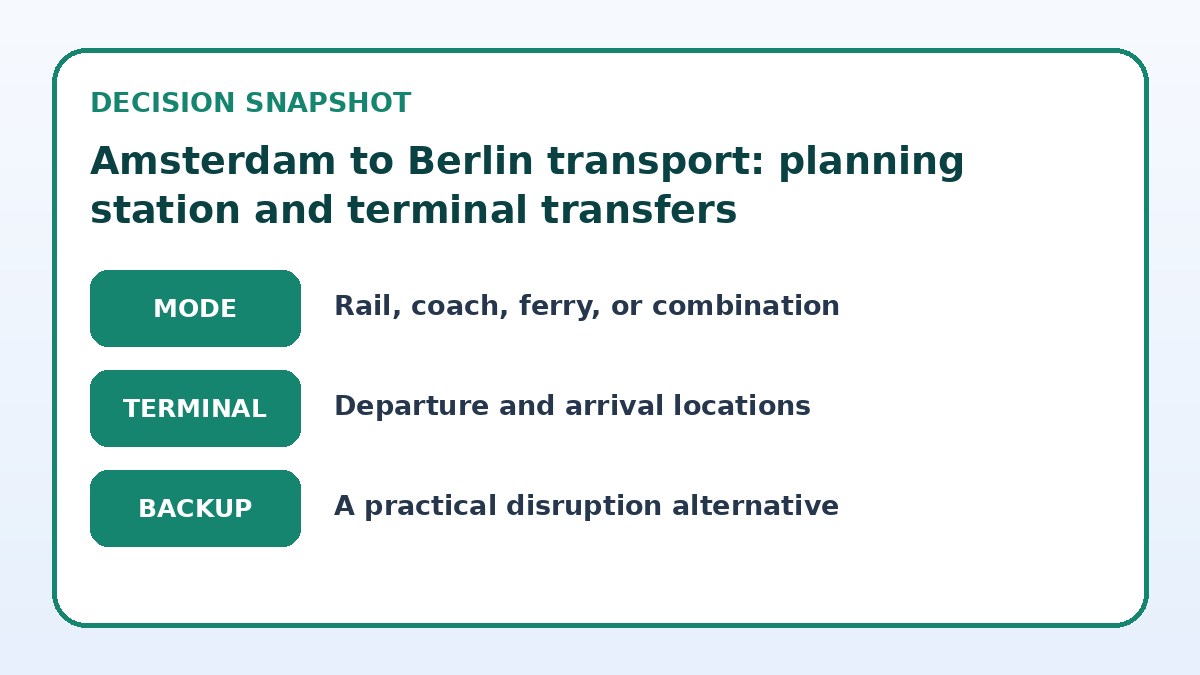
Start by confirming the exact stations or terminals for every leg of your trip: trains can use different central stations, international buses may stop at coach hubs outside the city center, and flights use specific terminals. For Amsterdam–Berlin, bookings might involve Amsterdam Centraal, Schiphol Airport, or long-distance coach terminals in Amsterdam depending on the provider, while Berlin options include multiple long-distance rail stations and airports. Knowing the physical locations matters because some are well connected by public transit with step-free access and elevators, while others require additional transfers or long walks between platforms — important when you’re managing heavy or bulky luggage.
After you know each arrival and departure point, map the on-the-ground transfer: platform location, distance from exit to taxi rank, nearby tram or metro lines, and any shuttle services. If your booking shows a connection that requires moving from a railway station to an airport terminal, check whether there is a direct shuttle or a public transfer with luggage-friendly access. For tightly timed itineraries, identify alternatives such as taxis or private transfers so you can trade money for guaranteed door-to-door assistance; if you prefer cheaper public transfers, factor in extra minutes and the effort of navigating steps and ticket machines with bags.
Luggage-handling options and what to choose
Compare the luggage rules and practicalities for each transport mode rather than relying on headline baggage allowances. Trains in Europe typically have generous onboard space but vary by carrier — some high-speed or night trains reserve specific luggage racks or require a place reservation for large items. Coaches often permit several large suitcases stored in underfloor holds but require staff handling at boarding and alighting. Flights may offer checked baggage but might not allow through-checked transfers across separate bookings. Decide whether you want to check large items, carry them yourself, or use station luggage storage based on how many times you’ll change vehicles and how straightforward transfers look.
If you have oversized items — bikes, surfboards, or bulky photographic equipment — confirm carriage rules, required packaging, and whether you must pre-book space. For multi-leg itineraries, verify whether bags can be checked through to the final destination; if not possible, plan to collect and re-check them during transfers. For travelers who prefer to avoid lugging baggage through transfers, paid porter services or pre-arranged meet-and-greet transfers can be worthwhile despite extra cost. Always verify luggage details on the provider’s final booking page, including dimensions, weight allowances, and any need to book special handling in advance.
| Approach | Best for | Tradeoff to check |
|---|---|---|
| Through-checked baggage with same-booking carrier | Travellers who want minimal handling and fewer transfer steps | Requires matching carrier policies and may limit carrier choices or increase cost |
| Collect-and-recheck between legs | Those combining different carriers or seeking cheaper fares | Adds time and physical effort during transfers, risk of missed connections |
| Use station/airport luggage storage | Short city visits or long layovers without wanting to carry bags | Charges and opening hours vary; requires drop-off and pick-up time |
| Pre-booked taxi/private transfer | Travelers with very heavy or bulky luggage needing door-to-door service | Higher cost but reduces physical strain and transfer complexity |
Practical transfer choices in each city
In Amsterdam, transfers between Schiphol and city terminals are usually straightforward but consider where your provider stops: a train from Amsterdam Centraal versus an international coach from a separate coach terminal creates different first/last-mile needs. If your arrival is at an airport, prioritize transport with step-free routes and lifts. For station arrivals, check platform exits and whether taxis congregate at a nearby forecourt. Choose a transfer mode that minimizes time spent moving suitcases up and down stairs and carrying bags across long concourses — local trams, airport trains, or taxis are often the most luggage-friendly options.
In Berlin, there are multiple major stations and at least one international airport complex with distinct terminals; confirm which one you’ll use because transfers between stations or to terminals can add significant door-to-door time. If you arrive at a central rail station, look for tram or S-Bahn connections that offer level boarding. If your journey ends at an airport terminal, verify the easiest public transport or taxi route into the city or to connecting services. For heavy luggage, pre-booked taxis or private transfers prevent repeated lifting and reduce the risk of missed connections when public transport requires changes or stairs.
Before you book
- Confirm the exact departure and arrival station or terminal names listed on every booking.
- Check luggage rules (dimensions, weight, special items) on each provider’s final booking page.
- Allow at least 60–90 minutes for each transfer when carrying extra suitcases, and add more time for multi-leg itineraries.
- Identify luggage storage options at arrival points and check opening hours and drop-off procedures.
- Decide whether to pre-book a taxi or meet-and-greet transfer for door-to-door assistance.
- If combining different carriers, confirm whether baggage can be checked through or must be collected and rechecked.
Timing, backups, and what to verify before booking
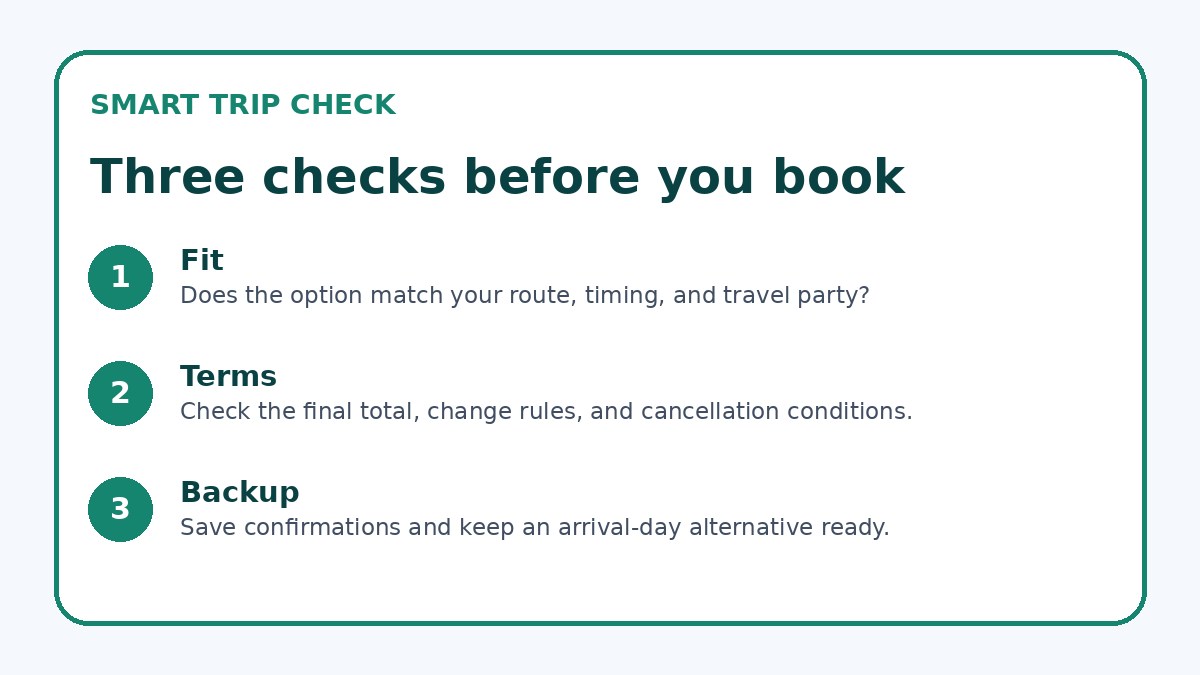
Build schedules with generous buffers: allow extra time for baggage retrieval, queueing for taxis, or transferring between platforms and terminals. If you have separate reservations for legs of the journey, plan a longer connection window than you would with a through-ticket. Before finalizing any booking, verify the carrier’s final booking page for up-to-date station/terminal names, luggage policies, permitted dimensions, and whether your fare includes assistance or seat reservations. When in doubt, contact the provider to confirm whether baggage can be checked through and whether staff assistance is available at specific stations or terminals.
Prepare a backup plan for delays or missed connections: identify the nearest luggage storage options at arrival points, local taxi numbers or apps, and alternative public transport lines. If your itinerary crosses from a railway station to an airport, check the frequency of shuttles and whether late-night or early-morning services are available. Consider buying flexible tickets or travel insurance that covers missed connections due to delays. For quick comparisons of current availability and conditions, you can check Trip.com but always validate transfer-specific details on the chosen carrier’s official booking page.
Frequently asked questions
Should I choose train, bus, or flight for Amsterdam to Berlin if I have extra luggage?
Choose based on where you want fewer handlings. Trains often offer spacious racks and fewer security procedures, which can be easier for bulky luggage, but seat and luggage spaces vary by operator. Coaches usually handle large suitcases in underfloor holds handled by staff at stops, while flights may require checked baggage and separate security procedures that add time. Compare door-to-door time: if a flight appears faster but requires long transfers between terminals or airports, the apparent savings can disappear when you factor in baggage handling. Verify luggage policies and transfer distances on each provider’s booking page.
How much transfer time should I plan between station and terminal when I have heavy bags?
Plan longer than typical connection guidelines: allow at least 60–90 minutes for simple station-to-station moves with extra luggage and two hours or more when changing between airport terminals or mixing transport modes. Add time for retrieving checked baggage, buying local transit tickets, or waiting for elevator access. If you need to change from a railway station to an airport, check shuttle or rail frequency and boarding procedures; also consider peak-hour crowding. When in a tight schedule, opt for a taxi or private transfer to cut uncertainty, but verify pick-up points on the provider’s final booking page.
Is using luggage storage a good idea during a long layover in Amsterdam or Berlin?
Luggage storage can simplify long layovers by removing the need to carry bags across the city, and it’s especially useful for sightseeing between train and flight legs. However, check location, opening hours, size limits, and security procedures before relying on it — some storage options have item-size restrictions or close early. Factor in the time to drop off and collect items and any fees. If you have valuables or fragile items, consider keeping them with you or using a secure service that offers insurance. Always confirm storage details on the facility’s published page or via your carrier’s guidance.
Final planning note
Traveling from Amsterdam to Berlin with extra luggage is mainly a planning problem: identify the exact arrival and departure points, choose how you will handle your bags at each transfer, and build comfortable time buffers. Focus on minimizing the number of times you must pick up and move suitcases — through-checked baggage, station lockers, or a pre-booked taxi can each solve that problem in different ways. Before you book, verify station/terminal names, luggage policies, and transfer logistics on the carrier’s final booking page, and have a backup plan in case of delays. With those checks done, you’ll reduce hassle and make the journey manageable even with bulky gear.
Continue planning
Check current options and final conditions
Use the provider page to confirm live availability, the final total, cancellation terms, and every condition that matters to your trip.
This evergreen planning guide was created with AI-assisted drafting and a structured quality review. It does not display live prices, schedules, availability, visa guidance, or provider rankings. Verify current details before booking. Some links are affiliate links; we may earn a commission at no additional cost to you.