
Practical answer first: set targeted price alerts for flights and hotels, cap how many alerts you act on, and treat any alert as an information signal, not an immediate obligation. For travelers carrying extra luggage, add filters that expose baggage allowances and fees, refundable or changeable fares, and transfer times before you even click through. Keep a short decision checklist—maximum acceptable baggage fee, preferred transfer cushion, and a non-refundable sightline you’ll accept—so you don’t impulse-book because a fare dipped. After you see an alert, verify baggage rules, seat or cabin class, and cancellation/change terms on the provider’s final booking page before you commit. If you use an OTA like Trip.com to compare availability, double-check the provider’s own terms on the airline or hotel page as those can differ.
See current options before you compare the details
Availability and final conditions change. Open Trip.com now or keep reading for the practical comparison.
How to set useful price alerts for Seoul without snapping decisions
Start by creating alerts that are specific, not broad. Choose the exact departure airport, travel dates or date windows, and the cabin class or fare type that meets your baggage needs. For example, filter for fares that explicitly include one or two checked bags if you expect to travel with heavy luggage. Use alert descriptions or tags to remind yourself why you created each alert—‘2 bags included’ or ‘flexible change’—so when the notification arrives you instantly know whether it meets your non-negotiables.
Pair alerts with a simple decision rule that limits impulse action. That could be a rule like ‘only consider bookings when price falls below X and baggage included,’ or ‘evaluate no more than three alerts per route.’ Include a mandatory 24-hour cool-off for any alert you plan to book: read the fine print, check baggage dimensions and fees, and confirm layover times. This structure preserves the benefit of real-time price signals without turning each alert into a spur-of-the-moment purchase.
What to verify on provider pages and why luggage details matter
An alert shows a headline fare; the provider’s booking page shows the rules. Always open the airline or hotel confirmation screen and read the baggage allowance, extra-baggage fees, and permitted carry-on items before booking. Verify whether the fare includes checked bags, whether weight or piece limits apply, and how excess or oversized charges are calculated. If the alert came from an online travel agency, check the airline’s own site too—baggage policies and change rules may differ, and the OTA’s price might not include ancillary fees that the airline applies later.
Also check the booking’s change and cancellation terms: a low fare that disallows changes can cost far more if your luggage forces you to change flights or dates. Look at connection times and the minimum connecting time at the airports involved; short layovers increase the risk of missed connections and extra rebooking fees when large bags slow you down. On multi-leg itineraries, confirm whether checked luggage is through-checked to the final destination or must be reclaimed and rechecked during connections, which affects how much time you need between flights.
| Approach | Best for | Tradeoff to check |
|---|---|---|
| Act on every price alert immediately | travelers prioritizing lowest headline fares and ready to be flexible | high risk of missing baggage fees, poor transfer times, and costly changes |
| Filter alerts by baggage-included fares | travelers who want predictable total costs with fewer surprises | you may see fewer alerts and miss some low headline fares that require add-ons |
| Set few high-confidence alerts with a hold rule | those who prefer deliberate booking decisions with a short evaluation window | requires discipline and possibly small hold fees or quick verification steps |
| Use alerts for price awareness only, book on provider site | travelers wanting full visibility of baggage and change rules before purchase | more time to compare and possibly miss fast-limited OTA-only offers |
Ready to check the option that fits your plan?
Use your exact dates and traveler details so the provider page can show the current total and conditions.
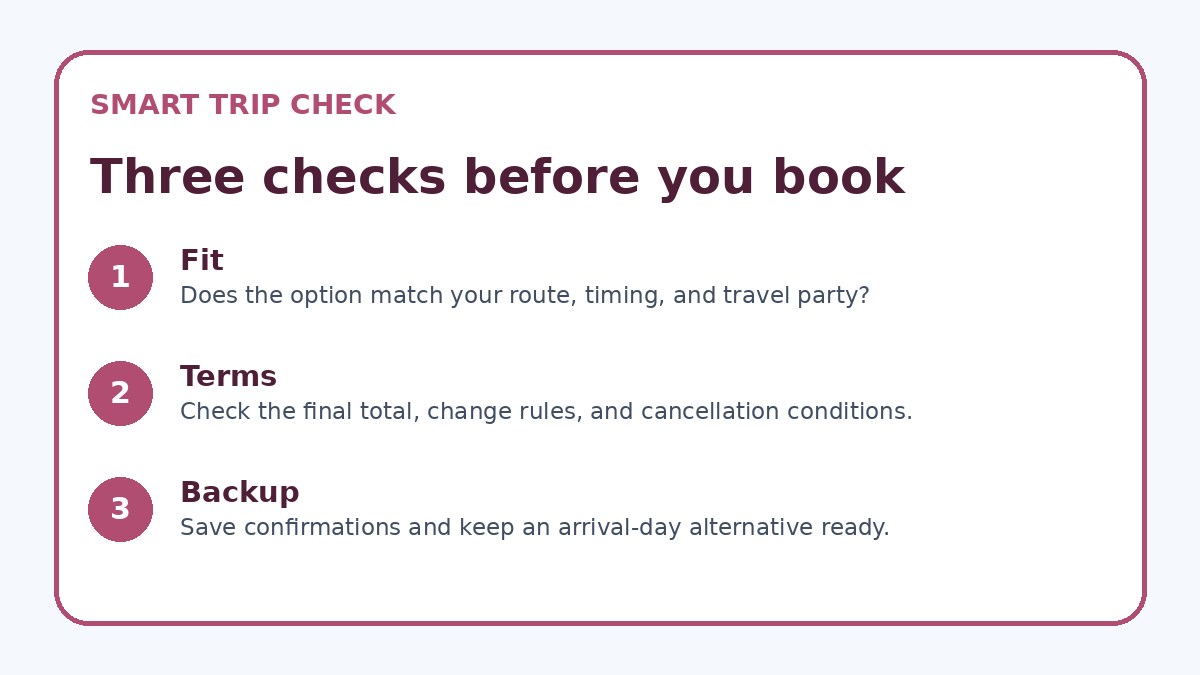
Tradeoffs: cheaper fares vs. baggage flexibility and peace of mind
Lower headline fares often come with tradeoffs that matter most to travelers with extra luggage. Basic economy and similar restricted fares may appear attractive until you factor in per-bag charges, carry-on limits, or fees for seat selection that you need when travelling with heavy bags. A slightly higher fare that includes one or two checked bags, or offers free changes within a window, can save money and stress when weighed against unpredictable baggage fees and rebooking costs.
Time and convenience are other tradeoffs. A cheap connecting itinerary with tight transfers might save money but increase the chance of missed connections and the need to rebook with baggage in tow. Conversely, a direct or single-connection option with a modestly higher fare but better baggage allowance can be a smarter buy. Use a simple spreadsheet or notes to compare total landed cost—fare plus estimated baggage fees and potential rebooking risk—rather than focusing only on the headline price shown in alerts.
Before you book
- Create alerts that specify cabin or fare type matching your checked-bag needs (e.g., fares that include at least one checked bag).
- When an alert arrives, open the airline’s or hotel’s final booking page and read baggage allowances, change fees, and refund terms before booking.
- Estimate total landed cost by adding likely baggage fees and any seat or transfer fees to the quoted fare before you decide.
- Require a minimum transfer cushion on multi-leg itineraries; confirm whether luggage is through-checked or must be reclaimed during connections.
- Limit yourself to a preset number of alerts to act on per route and use a 12–24 hour cool-off before finalizing any purchase.
- If using an OTA like Trip.com to compare options, verify the airline or hotel’s own terms on its official booking page before completing payment.
Decision criteria for booking: a quick rule set for travelers with extra luggage
Make a short set of criteria you'll apply to every alert: acceptable total cost including baggage, required transfer cushion, refundable/changeable terms, and preferred departure/arrival windows. Assign a weight to each item—expenses 40 percent, schedule convenience 30 percent, and refund/change flexibility 30 percent, for example. When an alert fires, score the option against these pre-set weights to remove emotion from the decision. If the option meets your threshold score, proceed to verify the provider page; if not, dismiss the alert.
Include a contingency for unavoidable impulse pressure: a 12–24 hour hold or a call to a travel companion before booking. Some OTAs and airlines offer paid holds or temporary reservations—if you use that, confirm the hold’s exact terms on the provider’s booking page before relying on it. Remember to factor in luggage pickup and drop-off logistics at arrival in Seoul: if you’ll need porters, lockers, or extra transfer time, include those practicalities in your decision score so comfort and timetable aren’t sacrificed for a marginal fare saving.
Frequently asked questions
How do I set price alerts that actually reflect baggage costs?
Use alert settings that let you choose fare classes or cabin types rather than only price thresholds. If the alert tool doesn't show baggage explicitly, create alerts only for fare codes or cabin names that typically include checked baggage, or keep a manual note of which fare classes you accept. When an alert triggers, immediately click through to the airline’s booking page to confirm the exact baggage allowance and any additional fees—OTAs sometimes list a lower fare but add ancillary charges later. Treat the alert as a prompt to verify, not a final price.
What’s a sensible decision rule to avoid impulse booking from alerts?
Adopt a concise rule that balances responsiveness with caution, for example: ‘Consider booking only if total estimated cost including baggage is below my budget threshold and the itinerary scores at least 70/100 on my convenience checklist.’ Your checklist should include maximum baggage fee, minimum connection time, and acceptable change/cancellation terms. Also limit how many alerts you act on—say three per route—and impose a 12–24 hour cooling-off period to review details and confirm availability on the provider page.
If I find a low fare without baggage included, should I add the bag or keep searching?
First, compute the true cost by adding the likely checked-bag fee to the fare. If the combined price still beats alternatives that include baggage plus better flexibility, it can be a good deal—provided connection times and change rules suit you. If fees or tight transfers negate the savings, continue searching or switch to a fare that includes baggage. Always confirm on the airline’s booking page whether bag fees are per segment or per direction and whether discounts for prepaying baggage apply.
Final planning note
Travelers with extra luggage can use price alerts as a powerful planning tool if they treat alerts as signals, not mandates. Focus alerts on fares and classes that align with your baggage needs, adopt a short checklist and decision rule to limit impulse buys, and always verify baggage, change, and transfer details on the provider’s booking page before paying. Balancing headline savings against predictable baggage costs and convenient connections will usually produce the best practical outcome. If you compare options in one place, consider reconfirming terms on the airline or hotel site—Trip.com can be useful for comparisons, but verify final rules where you’ll actually book.
Continue planning
Check current options and final conditions
Use the provider page to confirm live availability, the final total, cancellation terms, and every condition that matters to your trip.
This evergreen planning guide was created with AI-assisted drafting and a structured quality review. It does not display live prices, schedules, availability, visa guidance, or provider rankings. Verify current details before booking. Some links are affiliate links; we may earn a commission at no additional cost to you.