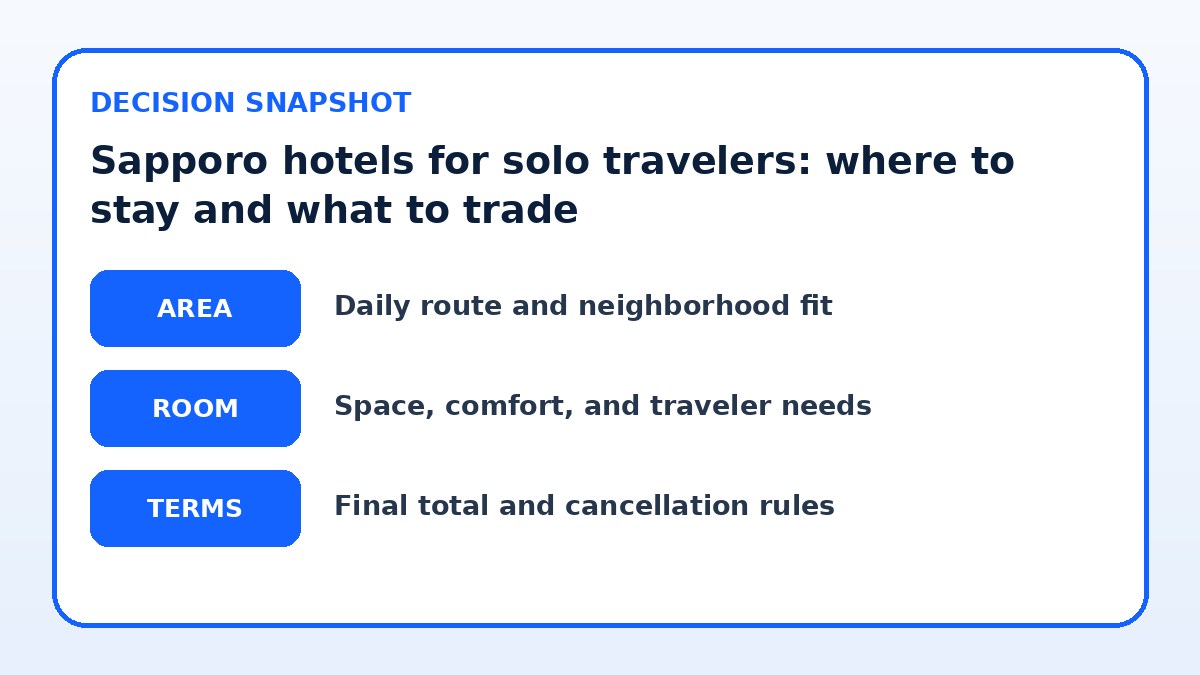
If you’re traveling alone in Sapporo, the central choice is rarely luxury versus budget — it’s location versus room comfort. The practical answer: pick the smallest area that still puts your top activities within easy reach, then prioritize room features that matter to you (quiet, bed size, storage, private bath, workspace). For many solo visitors, Susukino or Odori offers the best tradeoff between being within walking distance of nightlife, restaurants, and subway lines and having a compact, efficient hotel room. If you plan long walks, day trips, or a quieter sleep base, consider neighborhoods slightly farther out such as Sapporo Station or near Maruyama, where rooms may be roomier or calmer. Before you book, compare walking distances, subway access, and the room layout photos. Verify cancellation rules, exact bed type, and check-in times on the hotel’s booking page before confirming.
See current options before you compare the details
Availability and final conditions change. Open Trip.com now or keep reading for the practical comparison.
How to decide which Sapporo neighborhood fits your solo trip
Start from your planned activities: if you’ll be dining late, going out in the evening, or hopping between bars and ramen shops, Susukino puts you in the middle of the action. Odori sits between Susukino and Sapporo Station, close to the large park, TV Tower, and museums, and offers quick subway connections for day trips. Sapporo Station is the transport hub — ideal if you want fast access to regional trains or airport buses, or if you plan day trips to Otaru or ski areas. Maruyama and Hokkaido University neighborhoods are quieter, better for single travelers who value restful nights and morning walks.
When weighing neighborhoods, map your top three destinations and calculate typical transit times at the hour you’ll be traveling. Walking from Odori to Susukino is quick; from Sapporo Station to Susukino it’s longer but still doable on foot for fit travelers. Consider proximity to a subway line: Sapporo’s loop and north-south lines handle most travel efficiently. Also think beyond distance: availability of late-night convenience stores, 24-hour eateries, and the safety and lighting of walking routes should influence your choice as a solo traveler.
Room comfort: what single travelers should prioritize in Sapporo hotels
Room size in Japanese city hotels tends to be compact, so prioritize the elements that affect your sleep and daily routine. Choose a room with a firm, full-size bed rather than twin-compact if you value spread-out sleep; if you work on the road, look for a visible desk or a flat surface with good lighting. Check photos for closet space and luggage storage since limited square footage can make a big difference in comfort on a multi-day trip. Private bathroom versus shared? For solo travelers wanting privacy and speed, a private bath is usually worth the small premium.
Noise control is a frequent tradeoff: a central location can mean street or nightlife noise. Ask for a higher floor away from the street or a room facing an inner courtyard. Read room descriptions for soundproofing terms or explicit statements about double-glazed windows. If you’re sensitive to temperature, check whether the hotel lists individual room climate controls; if not, confirm how heating and cooling are handled. For long stays, consider a hotel with laundry facilities or a nearby coin laundry to avoid packing heavy.
| Approach | Best for | Tradeoff to check |
|---|---|---|
| Central compact room (Susukino/Odori) | Short stays, nightlife-focused itineraries, late dining | Smaller room size and potential street noise. |
| Transport-hub room (Sapporo Station area) | Day trips, early departures, convenience to trains and buses | Stronger transit bustle and fewer peaceful walking routes nearby. |
| Quieter residential room (Maruyama/Hokkaido Univ.) | Longer stays, restful nights, walking and parks | Longer commute to central nightlife and some attractions. |
| Higher-floor/soundproofed room anywhere | Light sleepers who want central access without noise | May cost more and availability is limited—confirm exact room type. |
Ready to check the option that fits your plan?
Use your exact dates and traveler details so the provider page can show the current total and conditions.

Balancing cost, convenience, and solo-traveler needs
Budget and convenience often pull in opposite directions in Sapporo: central locations save time but typically offer smaller rooms; quieter or larger rooms are more likely farther from the city center. Set a clear priority list: is saving travel time more valuable than extra square meters? If you only have two to three full days, shaving transit time by staying central often increases enjoyment even if the room is smaller. For a week-plus stay, the comfort dividend from a slightly larger room or quieter location can outweigh the extra commute.
Consider which amenities bring real value to you rather than choosing by checklist alone. A breakfast buffet may be useful if you plan early departures; a 24-hour front desk is helpful if you arrive late. Free luggage storage can be more valuable than a marginally lower nightly rate if your arrival and departure times don’t align with check-in. When searching, filter for specific features, then inspect pictures and recent guest comments on the booking page to confirm what matters to you — and always verify final terms on the hotel’s official booking page or via Trip.com if you want to compare current options.
Before you book
- Map your daily itinerary and mark the hotel locations that keep average transit under 20–30 minutes for your must-see sites.
- Confirm bed type and room layout from photos or the property before booking to ensure the bed and workspace meet your needs.
- Request a higher-floor, inner-facing room if you’re sensitive to street noise and verify any soundproofing claims with the hotel.
- Check the hotel’s cancellation and check-in policies on the final booking page and note any ID or registration requirements.
- Verify access to luggage storage, laundry options, and whether breakfast is included if those amenities affect your schedule.
- Compare hotel listings on an aggregator and cross-check the property’s official site or call the hotel for final confirmation of details.
Practical booking tips and what to verify before you confirm
Photos and floor plans matter: view multiple room photos and look for the same layout repeated across the hotel’s gallery so you aren’t surprised on arrival. Confirm bed type (e.g., double, semi-double, twin) and whether the room includes a private bathroom. If the listing mentions ‘quiet rooms’ or ‘soundproofing,’ contact the hotel to ask what that means in practice. For arrival logistics, verify check-in hours, late-arrival procedures, and whether the property holds luggage if you arrive before check-in time.
Always confirm cancellation and change policies on the final booking page because these can differ across channels and change over time. If you’re reliant on a late train or bus, confirm whether the hotel provides airport or station transfer information and whether there are additional charges. Check for any required ID or registration procedures at check-in that might be unique to Japan. If you use an aggregator to compare availability, cross-check the hotel’s official site or call the property directly for the most accurate, up-to-date information.
Frequently asked questions
Is Susukino the best place to stay in Sapporo for a solo traveler?
Susukino is ideal for solo travelers who prioritize nightlife, late dining, and being in a lively district within walking distance of many restaurants and bars. It places you close to subway lines that connect to other parts of the city, reducing the need for long transfers after late nights. The tradeoff is that rooms here are often smaller and street noise can be higher — ask for an upper-floor or inward-facing room if you need quiet. Always confirm the exact room photos and location details on the hotel’s booking page before committing.
How important is proximity to Sapporo Station for solo travelers?
Staying near Sapporo Station benefits solo travelers who plan day trips, early departures, or frequent transfers because it’s the city’s transport hub with regional train and bus links. It’s also convenient for luggage handling and taxi access. However, parts of the station area are busier and more commercial, so you may sacrifice a quieter, more scenic neighborhood. If you value easy connections over nightlife proximity, Sapporo Station is a strong choice — verify transit options and station exits nearest the hotel on the provider’s details page.
Can I find larger or quieter hotel rooms in Sapporo without going far from the center?
Yes — selecting hotels a few blocks from main entertainment strips or requesting particular room types often yields rooms that are slightly larger or quieter while keeping you close to central attractions. Look for listings that show floor plans or specify room square meters, and filter results for upper floors or courtyard-facing units. If a listing mentions limited room sizes, contact the hotel to ask about larger room categories or suites. Always confirm the exact room you’re booking and any noise-control features on the hotel’s final booking page.
Final planning note
For solo travelers in Sapporo, there’s no one-size-fits-all hotel pick. Prioritize what you’ll actually use: if every minute of your trip counts, choose a central location and accept a smaller, efficient room; if quiet and space will make your stay better, move a neighborhood or two outward. Use photos and explicit room descriptions to confirm bed size, storage, and privacy, and always check the hotel’s final booking page to verify cancellation terms, check-in rules, and the exact room you’re reserving. Compare options across sites — including Trip.com if you like — but rely on the property’s own details for booking decisions.
Continue planning
Check current options and final conditions
Use the provider page to confirm live availability, the final total, cancellation terms, and every condition that matters to your trip.
This evergreen planning guide was created with AI-assisted drafting and a structured quality review. It does not display live prices, schedules, availability, visa guidance, or provider rankings. Verify current details before booking. Some links are affiliate links; we may earn a commission at no additional cost to you.