
If you and your partner want freedom to change plans on a Seoul-to-Busan trip, the practical choice is to buy tickets that let you change dates or get a refund with minimal penalty—or to combine one flexible ticket and one cheaper, fixed ticket depending on risk tolerance. Start by deciding how likely your plans are to shift: if both of you are traveling on business or have tight connections, prioritize fully flexible options; if you expect to travel on set dates, a semi-flexible or nonrefundable ticket can save money. This article explains the tradeoffs couples face when comparing refunds, exchanges, seat assignments, and group booking rules on trains and mixed transport routes between Seoul and Busan. It also gives a checklist of exactly what to verify on the provider’s final booking page so you leave with the coverage you actually need.
See current options before you compare the details
Availability and final conditions change. Open Trip.com now or keep reading for the practical comparison.
What ‘flexible’ actually covers on Seoul–Busan journeys
Flexibility is not a single feature; it’s a bundle that can include date changes, time changes, name changes, refunds, seat reassignment, and priority exchanges. For couples, the most relevant elements are whether changes can be made without a fee, whether changes can be made up to departure or only before a cutoff, and whether the fare difference is charged when moving to a different service. Read each provider’s definitions carefully because one company’s “flexible” may mean free date swaps while another’s means only partial credit toward future travel.
Also check whether flexibility applies per ticket or per booking. Some carriers treat a couple’s reservation as a single booking and disallow splitting changes between passengers without fees. Others let each passenger modify their ticket independently. If one partner has a higher chance of needing a different schedule, that independence can save money. Always verify whether seat reservations can be adjusted with the ticket change and whether any administrative booking fees apply on the final booking page.
Comparing train versus mixed transport flexibility
On purely rail routes, operators commonly offer exchange and refund rules that differ by fare class rather than by route. High-speed trains typically have more fare classes—some fully flexible, some partially flexible, and some nonrefundable. When comparing options, check how the railway handles name changes, whether rebooking can be done online or only at counters, and how waitlists or sold-out services affect your ability to move to a different train on short notice. For couples, an important distinction is whether tickets for adjacent seats can be rebooked together or separately.
If you’re combining rail with buses or ferries, or considering a flight for part of the route, ticket rules will vary by provider. Mixed itineraries multiply the changes: a flight’s change policy will be different from a train’s. When booking a mixed route, decide whether to buy each leg separately (easier to change one leg but riskier if a delay breaks the connection) or through a single agent who may provide protected connections but could limit your change options. On multi-operator itineraries, verify transfer protections and how refunds are handled if one leg is canceled.
| Approach | Best for | Tradeoff to check |
|---|---|---|
| Buy two fully flexible tickets | Couples with high chance of schedule changes or uncertain travel plans. | Higher upfront cost but minimal hassle and lower rebooking penalties. |
| One flexible, one nonrefundable | When one partner’s plans are uncertain and the other is fixed. | Balances cost and protection, but unequal fares may complicate seat pairing. |
| Two semi-flexible tickets | Couples who want moderate protection and lower fees for planned trips. | Allows some changes but may still charge fare differences and seat limits. |
| Two nonrefundable budget tickets | Couples with firm, confirmed schedules seeking the lowest fare outlay. | Lowest price but highest combined financial risk if plans change. |
Ready to check the option that fits your plan?
Use your exact dates and traveler details so the provider page can show the current total and conditions.
Decision criteria for couples: risk, cost, and convenience
Start by listing the likelihood and cost of a plan change for each traveler. If both partners have stable schedules, prioritize lower fares. If one partner’s work is unpredictable, give that traveler a flexible ticket. Consider the combined financial exposure: two nonrefundable fares double the loss risk if plans shift. Also factor in convenience—ease of rebooking online, local-language support, and whether changes can be made at stations or only through customer service. For couples who value low friction, pay a bit more for a fare class that lets you rebook quickly on the operator’s website or app.
Another practical criterion is seat continuity. Couples usually want to sit together; some flexible fares guarantee seat selection changes at rebooking while cheaper fares may force you into separate seats if the train is busy. If staying together matters more than saving a little money, choose tickets that allow seat reassignment without penalty. Finally, compare the time window for free changes—some fares permit same-day swaps, which is valuable when your plans might change at short notice.
Before you book
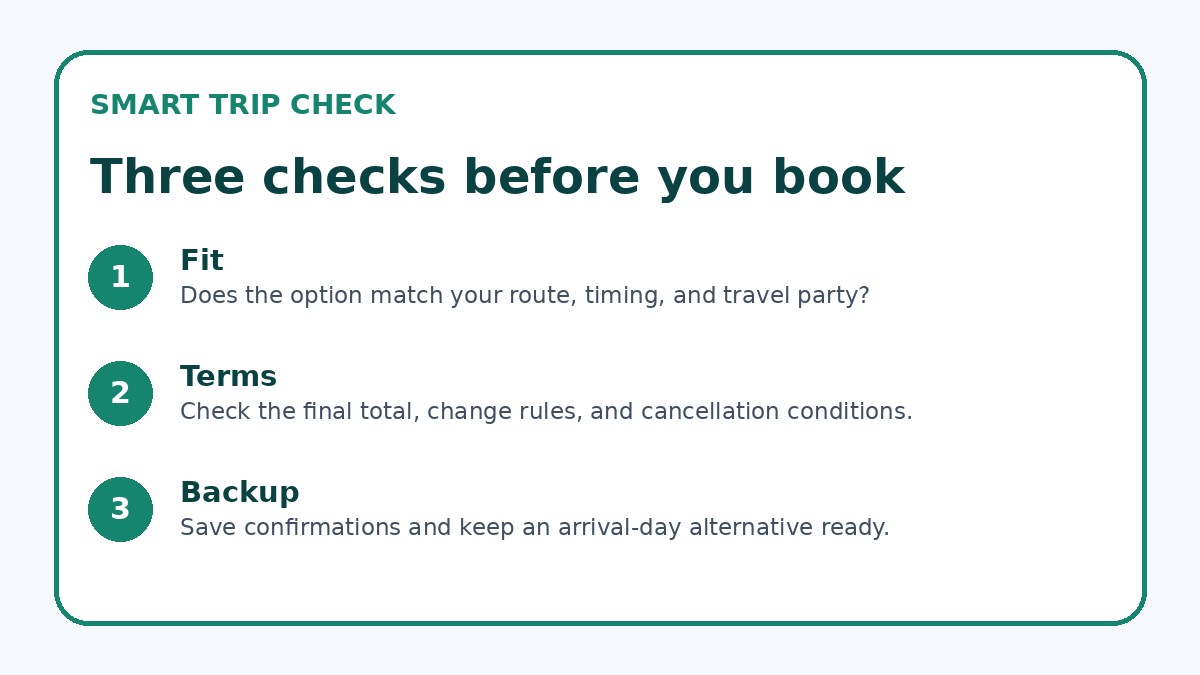
- Confirm whether changes and refunds are allowed per ticket or per booking before you pay.
- Verify exact cut-off times for free changes and whether same-day swaps are permitted.
- Check if seat assignments can be altered during a change and whether couples’ seats remain together.
- Look for administrative or service fees that apply to exchanges or refunds and factor them into total cost.
- If booking mixed providers, confirm transfer protections and how refunds work when one leg is canceled.
- Save or screenshot the provider’s final fare rules and confirmation email as proof of terms.
How to verify policies before you hit book
When you reach the provider’s final booking page, look for clear statements on change fees, refund options, and the exact cutoff times for exchanges. Confirm whether the fare rules apply per passenger or per booking, whether name corrections are allowed, and whether you’ll be charged a fare difference when moving to another service. If the policy language is vague, contact the provider directly or use a comparison service for live terms; Trip.com can be used as one place to compare current availability, but always confirm terms with the operator’s official page.
Also check whether your payment method affects refunds or exchanges (some cards or third-party platforms have different processing rules). If you plan to mix ticket types between two people, simulate both bookings to see the total cost and test whether the system allows splitting passengers across different fare classes. Save screenshots of the final terms and your confirmation; these are useful if you need to argue for a change or refund later.
Frequently asked questions
Is it cheaper to buy two separate tickets or one joint booking for a couple?
Which is cheaper depends on the provider’s pricing structure and fare classes. Some systems price per passenger and allow discounts for group bookings, while others charge identical per-person fares regardless of booking type. Buying separately can let you choose different fare classes—useful if one partner needs flexibility—but it may risk losing seat adjacency. A joint booking can simplify seat pairing and customer service interactions. Always compare total price including change fees, then verify on the final booking page whether group or single bookings affect change rules.
If one person cancels, can the other keep their ticket without penalty?
This depends on whether the operator treats the purchase as an indivisible booking or as independent tickets. Some carriers lock a shared reservation so canceling one traveler triggers conditions for the whole booking; others allow individual ticket changes or cancellations. If retaining one ticket is important, ensure the fare rules explicitly allow per-passenger modifications. If the booking system forces a collective change, consider purchasing separate tickets to maintain independence. Verify the specific ticketing terms on the provider’s confirmation page before finalizing.
How do seat reservations affect flexibility for couples on high-demand routes?
Seat reservations introduce another layer to flexibility: even if your fare is changeable, the new train may have limited paired seats. Flexible fares often allow seat reassignment during exchange, but availability isn’t guaranteed on busy departures. If sitting together is essential, prioritize fare classes or booking options that permit seat selection changes without additional fees, or reserve seats as soon as you book to reduce the chance of separation. Always check whether seat guarantees are part of the fare rules on the operator’s booking interface.
Final planning note
For couples traveling Seoul to Busan, the right balance between cost and peace of mind depends on each person’s schedule flexibility and how much you value sitting together. If both partners face unpredictable commitments, two flexible tickets reduce stress and administrative hassle. If only one partner may need to change plans, combining a flexible ticket with a cheaper fixed fare can cut costs while protecting the trip. Before paying, verify change and refund rules per ticket, seat reassignment policies, and any fees on the provider’s final booking page. Use the checklist to confirm the specifics and save documentation so you and your partner travel with clarity and control.
Continue planning
Check current options and final conditions
Use the provider page to confirm live availability, the final total, cancellation terms, and every condition that matters to your trip.
This evergreen planning guide was created with AI-assisted drafting and a structured quality review. It does not display live prices, schedules, availability, visa guidance, or provider rankings. Verify current details before booking. Some links are affiliate links; we may earn a commission at no additional cost to you.