
For couples planning a stay in Los Angeles, the single most practical question is how flexible your hotel booking should be. Choose a fully refundable rate if your dates might change, a semi-flexible option if you want lower cost with some protection, or a prepaid nonrefundable rate if plans are fixed and you prioritize savings. Think about how likely your schedule is to shift—work obligations, flight changes, or mixed-purpose travel (city days and beach time) all matter. Also consider who is making the decision: if one partner values certainty and the other values price, a middle-ground policy can keep both happy. This guide explains the tradeoffs between refundable, partially refundable, and nonrefundable bookings, how to read hotel policies, what to verify on the provider’s final booking page, and practical tips for couples to choose the right level of flexibility.
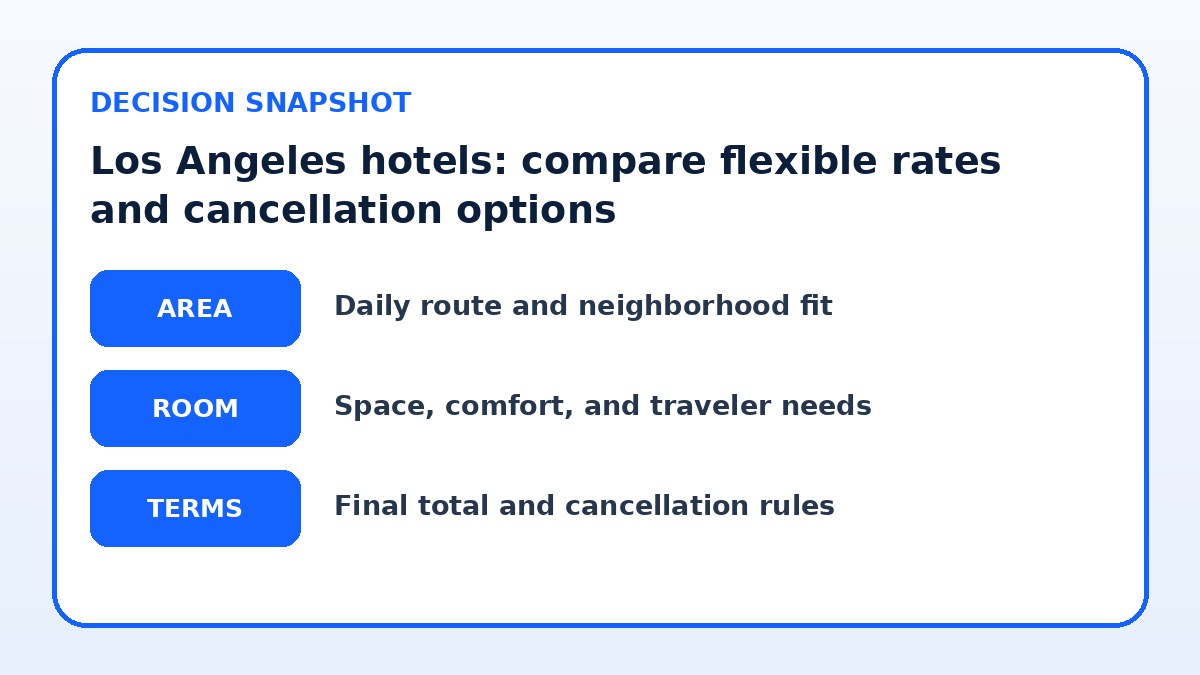
See current options before you compare the details
Availability and final conditions change. Open Trip.com now or keep reading for the practical comparison.
Understand the main flexible booking types
Hotels commonly sell three broad categories: fully refundable, partially refundable, and nonrefundable prepaid rates. Fully refundable options typically allow cancellation up to a certain time before arrival with no charge, which is useful when flights or work schedules are uncertain. Partially refundable rates often permit free cancellation until a set deadline—48 hours, 7 days, or more—after which a penalty or full payment applies. Nonrefundable prepaid bookings usually lock in the rate at payment and do not allow refunds for cancellations, though some hotels may permit changes for a fee or offer partial credits.
When reading those categories, focus on deadlines and exceptions rather than on marketing names like “flex” or “standard.” Hotels may combine refundable perks—like free cancellation until a specified date—with advance purchase discounts or minimum-stay rules. Also check how the policy treats early departures, no-shows, and changes to the lead guest’s name. These details are what create real differences in flexibility and cost, and they are the items couples should verify on the provider’s final booking confirmation before accepting.
How flexibility affects couples’ itineraries and budgets
Flexible bookings let couples adapt their itinerary—extend a weekend into a longer stay, move to a different neighborhood, or accommodate a delayed flight—without immediate financial penalty. That adaptability is especially valuable for mixed-purpose trips where one partner has work commitments or conferences. Budget-wise, the premium for full flexibility can be meaningful; couples must weigh the peace of mind against the extra spend. If both travelers’ schedules are firm and the trip is planned around fixed events, skipping the flexibility premium usually makes financial sense.
Another factor is emotional cost: traveling partners often have different tolerance levels for uncertainty. One partner may prefer the cheapest prepaid option and accept the risk, while the other prefers refundable security. Choosing a partially flexible policy can be a negotiation tool—keeping some savings while avoiding worst-case losses. For longer stays or high-season travel, the potential cost of last-minute rebooking elsewhere can make a refundable or semi-flexible rate more attractive despite the higher upfront charge.
| Approach | Best for | Tradeoff to check |
|---|---|---|
| Fully refundable rate | Couples with uncertain travel dates or high chance of last-minute changes | Higher nightly cost but maximum flexibility and simpler cancellations |
| Partially refundable / free-cancellation-until deadline | Couples who can finalize plans within a fixed window before arrival | Lower cost than fully refundable, but penalties apply after the cancellation deadline |
| Prepaid nonrefundable rate | Couples with firm dates prioritizing lower prices | Lowest upfront cost but little to no recovery if plans change |
| Split-stay or mixed booking approach | Couples balancing one partner’s flexibility needs and the other’s desire to save | More planning effort and potential inconvenience of changing rooms or neighborhoods |
Ready to check the option that fits your plan?
Use your exact dates and traveler details so the provider page can show the current total and conditions.

Reading the fine print: what to verify before booking
Always read the provider’s exact cancellation and change policy on the final booking page. Look for deadlines expressed in local hotel time, details about how refunds are processed, and whether a deposit is charged at booking or at check-in. Verify whether the policy applies to all rooms on the booking or just the first night; some hotels keep the first night as a nonrefundable deposit even when the rest is refundable. Also check if modifications—date shifts, name changes, or room upgrades—are allowed and whether those changes carry fees.
Confirm how refunds are issued and the timeline for receiving money back to your original payment method. Note extras that may not be refundable—resort fees, parking, or third-party add-ons—and whether taxes are refundable. If you booked through an OTA or a corporate channel, ensure its cancellation rules match the hotel’s rules; discrepancies happen and the hotel’s final policy usually governs. If needed, take screenshots or save the confirmation PDF so you can reference the exact terms in case of dispute.
Before you book
- Read the hotel’s cancellation deadline and confirm the time zone used (hotel local time versus your home time).
- Verify whether the booking requires a deposit, charges the first night, or takes full payment at booking.
- Confirm whether resort fees, parking, or add-ons are refundable under the chosen rate.
- Check if name changes, date adjustments, or room transfers are allowed and what fees apply.
- If booking through an OTA, compare the OTA policy with the hotel’s policy shown on the confirmation page.
- Save or screenshot the final confirmation page that lists the cancellation policy and any special terms.
Practical strategies couples can use in Los Angeles
Split bookings: If one partner expects schedule changes, consider splitting the stay between a fully refundable booking for the uncertain nights and a cheaper prepaid option for nights you’re sure about. This hybrid approach lets you lock savings where you can and keep flexibility where it matters. Also think about neighborhood choices: staying centrally (Downtown, Hollywood, or near the beaches) can reduce the need to change hotels later if plans shift, limiting the chance of incurring extra relocation costs.
Use hold or pay-later options carefully: Some hotels or booking platforms allow you to reserve without immediate payment and pay closer to arrival—this can act like a temporary refundable hold. But these options vary: verify how long a hold lasts and whether the rate can change when you pay. Consider travel insurance that covers hotel cancellations for covered reasons, or a credit card that offers trip interruption protections; these tools can supplement booking flexibility if you expect higher uncertainty.
Frequently asked questions
Can I transfer a hotel booking to another person if my partner can’t travel?
Policies vary by hotel. Many properties allow a change of the lead guest name without penalty if done before the cancellation deadline, while others require the original guest to remain on the reservation or to present a matching payment method. Always check the final booking page for the hotel’s rule on name changes and whether they need identity verification at check-in. If you anticipate this scenario, contact the hotel directly before booking to confirm the exact process.
If flights change, can I change my hotel dates without losing money?
That depends on the rate type and the hotel’s change policy. Fully refundable or flexible rates typically permit date modifications or cancellations within the allowed window. Partially refundable bookings may allow changes before the deadline but could charge fees for late adjustments. Prepaid nonrefundable bookings usually offer the least leeway, though some hotels apply the payment as a credit toward new dates for a fee. Always verify the change and cancellation terms on the booking confirmation and ask the hotel if they offer exceptions in extenuating circumstances.
Should couples rely on travel insurance instead of buying a refundable rate?
Travel insurance can cover cancellations for specific reasons listed in the policy (illness, covered emergency, etc.) and may be cost-effective compared with refundable rate premiums. However, insurance does not typically reimburse for voluntary changes in plans unless the policy includes a cancel-for-any-reason (CFAR) endorsement, which is more expensive. If your main worry is routine schedule changes, a refundable hotel rate offers simpler, immediate protection. If you need broader coverage against covered emergencies, insurance can be a useful complement—check policy exclusions and claim procedures carefully.
Final planning note
For couples visiting Los Angeles, the right booking flexibility depends on your tolerance for uncertainty, budget constraints, and how fixed your travel dates are. Fully refundable rates deliver peace of mind for unpredictable plans, while partially refundable options create a balanced compromise between cost and protection. Prepaid nonrefundable bookings save money when dates are firm but carry risk if plans shift. Practical tactics—split stays, verifying the final booking page for exact terms, and using screenshots for records—help couples reduce disputes and stress. Before you confirm, compare the detailed cancellation, change, and deposit terms on the hotel’s final booking page; consider travel insurance for broader coverage, and choose the approach that minimizes both financial loss and relationship friction on your trip.
Continue planning
Check current options and final conditions
Use the provider page to confirm live availability, the final total, cancellation terms, and every condition that matters to your trip.
This evergreen planning guide was created with AI-assisted drafting and a structured quality review. It does not display live prices, schedules, availability, visa guidance, or provider rankings. Verify current details before booking. Some links are affiliate links; we may earn a commission at no additional cost to you.