For a business traveler squeezing a trip to Busan into a packed calendar, price alerts can be a quiet ally — if you control the alerts, not the other way around. The quick answer: create targeted alerts for the exact routes and dates you need, attach decision rules (price thresholds, refundable vs nonrefundable, and a decision deadline), and treat an alert as a prompt to compare—not an automatic buy trigger. This keeps you responsive to genuine savings while preventing impulse bookings that create scheduling headaches or nonrefundable fares you regret. The rest of this guide explains how to set effective alerts, what tradeoffs matter for corporate travel, what to verify on booking pages, and a short checklist you can use the moment an alert fires.
See current options before you compare the details
Availability and final conditions change. Open Trip.com now or keep reading for the practical comparison.
Design alerts that reflect business constraints
If your travel is governed by corporate policy, begin there. Choose alert parameters that mirror your allowed itineraries: the airports you can use, cabin class, maximum total travel time, and schedule windows that fit meetings. Narrow alert geography to Busan arrival airports and only select outbound/inbound windows that match your meeting times or buffer needs. This reduces the number of irrelevant alerts and makes any triggered price directly actionable against your company rules.
Also decide in advance how flexible you can be. If your trip must start on a specific day, set a tight date range and accept fewer alerts. If dates are flexible, monitor a small range of nearby days and consider multi-day windows. Include preferred carriers only if you have loyalty or corporate discounts with them; otherwise a wider carrier set gives more options but more alerts to manage.
Define decision rules to avoid impulse buys
Every alert should carry a simple decision matrix: a maximum acceptable fare, whether nonrefundable tickets are allowed, and a deadline to decide. If you require refundable fares or the ability to change flights without penalty, state that up front and configure alerts to include those fares. If your company allows nonrefundable fares for lower cost but requires preapproval, make approval part of the rule so you won't book on a reactive impulse.
Use decision deadlines tied to real constraints, such as booking windows your travel policy permits or vendor change fee windows. A deadline reduces the psychological pressure to book immediately and creates a planned moment to compare the alert against alternatives like refundable fares, different carriers, or shifting meeting times.
| Approach | Best for | Tradeoff to check |
|---|---|---|
| Aggressive alert-and-book at first drop | Travelers with rigid schedules seeking immediate savings | Higher chance of nonrefundable or inconvenient itineraries and limited time to compare alternatives |
| Moderate alerts with decision rules | Business travelers balancing cost control and flexibility | Requires discipline to follow rules and a short delay before booking |
| Watch-only alerts for market context | Those who can wait and want trend data before booking | May miss a good fare window and needs active monitoring |
| Alerts limited to refundable fares | Travelers who prioritize schedule changes and expense approvals | Usually higher fares; fewer alerts, so limited savings opportunities |
Ready to check the option that fits your plan?
Use your exact dates and traveler details so the provider page can show the current total and conditions.
Compare options methodically when an alert fires
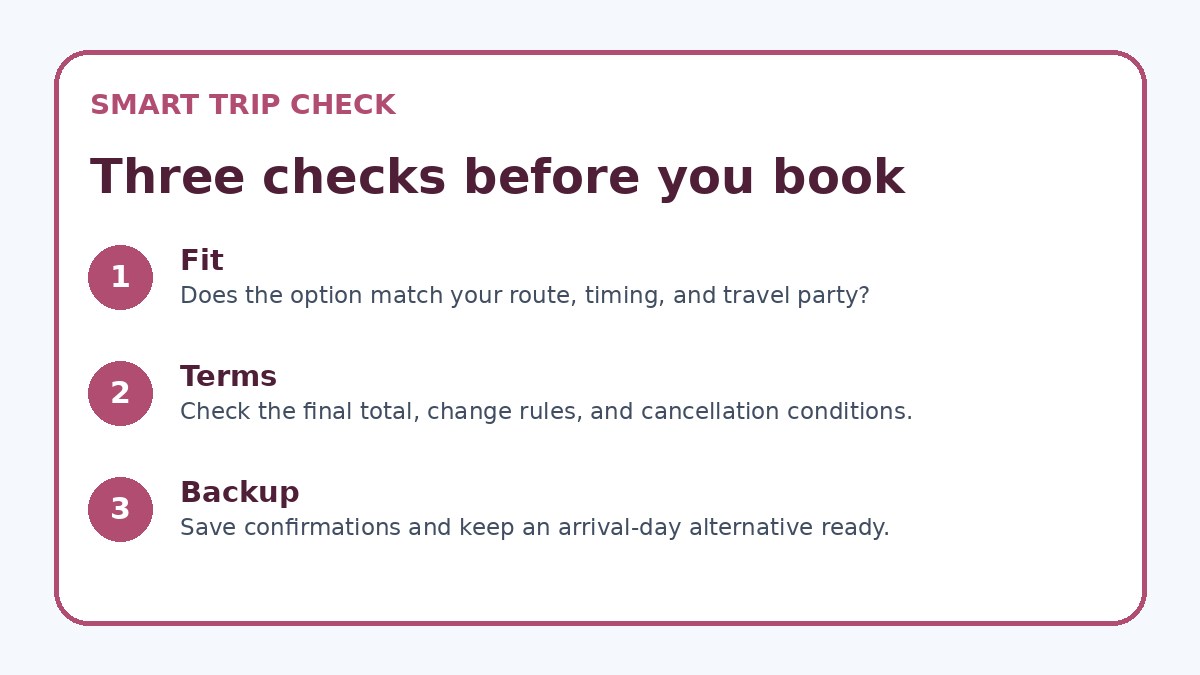
When an alert arrives, follow a short checklist: verify the exact itinerary, total price with taxes and fees, change and cancellation terms, and any corporate discount eligibility. Open the provider's final booking page to confirm these facts; do not rely solely on the alert headline. If you use a corporate booking tool or travel manager, include them in the comparison to see if a consolidator or negotiated rate produces a better overall outcome.
If the alert is for a connecting itinerary, compare the triggered option with direct or alternative connections. Consider total door-to-door time, missed-meeting risk from tight connections, and luggage transfer reliability. The cheapest option can increase risk and hidden time costs; weigh these factors against raw fare savings before committing.
Before you book
- Set alerts only for the exact airports, dates, and cabin class that match your business needs.
- Attach a maximum fare, refundability requirement, and a decision deadline to every alert.
- When an alert triggers, open the seller’s final booking page to confirm total price, fees, and fare rules.
- Compare the alerted itinerary with at least one refundable option and your corporate booking tool.
- If the alert shows connections, verify minimum connection time, operating carrier, and luggage transfer terms.
- Before booking, run the itinerary past your travel manager or policy approver if required by company rules.
What to verify on the provider booking page
Before you hit purchase, check the provider's final booking page for details that can change: exact change/cancellation fees, baggage allowances by fare class, seat assignment rules, and whether the fare is eligible for corporate or loyalty program accrual. Don’t assume the alert reflects these details accurately—explicitly confirm them on the seller’s checkout screen because those elements determine the true cost and flexibility.
Also verify the routing and carrier marketing/operating designations; an alert may show a carrier code that differs from the actual operating airline, which affects lounges, upgrades, and frequent-flier credit. If your itinerary involves different tickets or separate PNRs, confirm minimum connection protection and who is responsible for missed connections. If helpful, compare the same itinerary on a corporate booking tool or Trip.com to cross-check availability and policy compliance.
Frequently asked questions
How long should I monitor price alerts for Busan before deciding to buy?
Monitor price alerts long enough to see a pattern but not so long you miss necessary approvals. For business travel that’s date-sensitive, a short monitoring window of several days up to your company’s booking deadline can be sufficient to confirm a true dip versus a one-day fluctuation. If dates are flexible, extend monitoring to compare mid-week and weekend patterns. Always align the monitoring period with your decision deadline so an alert triggers a scheduled review rather than an impulsive purchase.
Can I rely on alerts alone for corporate expense compliance?
No—alerts are a sourcing tool, not a compliance decision. Use alerts to surface potential fares, but you still must verify that the selected option meets your corporate travel policy: allowable carriers, fare class, approval workflows, and refund rules. Before booking, confirm any corporate discounts or negotiated fares through your corporate portal or travel manager. Alerts can speed discovery, but compliance requires explicit checks against your employer’s rules and approval processes.
What if the alert offers a low fare but I worry about tight connections into Busan?
Treat tight connections as a material cost, not just an inconvenience. Compare the alerted option’s total door-to-door time and minimum connection windows with alternative itineraries that offer longer layovers or direct segments. Factor in the risk of missed connections, potential rebooking responsibilities, and whether the carrier provides protected connections. If the risk would jeopardize meetings or require extra buffer time, prefer a slightly higher fare with more reliable timing to protect your schedule.
Final planning note
Price alerts can be a very effective way for business travelers to find competitive Busan travel deals—provided you design them around real constraints and attach clear decision rules. Configure alerts for the exact dates, airports, and fare classes you’ll accept, then treat each alert as a signal to validate fare rules, compare refundable alternatives, and consult your corporate policy or travel manager if required. That process keeps you agile enough to capture useful savings while avoiding impulse purchases that create schedule or expense headaches. Use the checklist and comparison approaches here to make every alert actionable rather than anxiety-inducing.
Continue planning
Check current options and final conditions
Use the provider page to confirm live availability, the final total, cancellation terms, and every condition that matters to your trip.
This evergreen planning guide was created with AI-assisted drafting and a structured quality review. It does not display live prices, schedules, availability, visa guidance, or provider rankings. Verify current details before booking. Some links are affiliate links; we may earn a commission at no additional cost to you.