If you need dependable Seoul to Gyeongju transport for a business day, decide first on your priorities: speed, schedule certainty, or flexibility with luggage. For many corporate travelers, a high-speed train or express bus balances predictability and comfort; if you value absolute schedule control and direct door-to-door service, a private car or chauffeur may be preferable. Preparing the travel day means aligning departure times with meeting windows, packing a compact working kit, and planning contingencies for delays or connection issues. Before booking, check the provider’s final schedule, cancellation and change terms, seat-selection options, and how they handle luggage and Wi‑Fi. Trip.com is one place to compare current options, but verify all critical details on the provider’s official booking page before confirming.
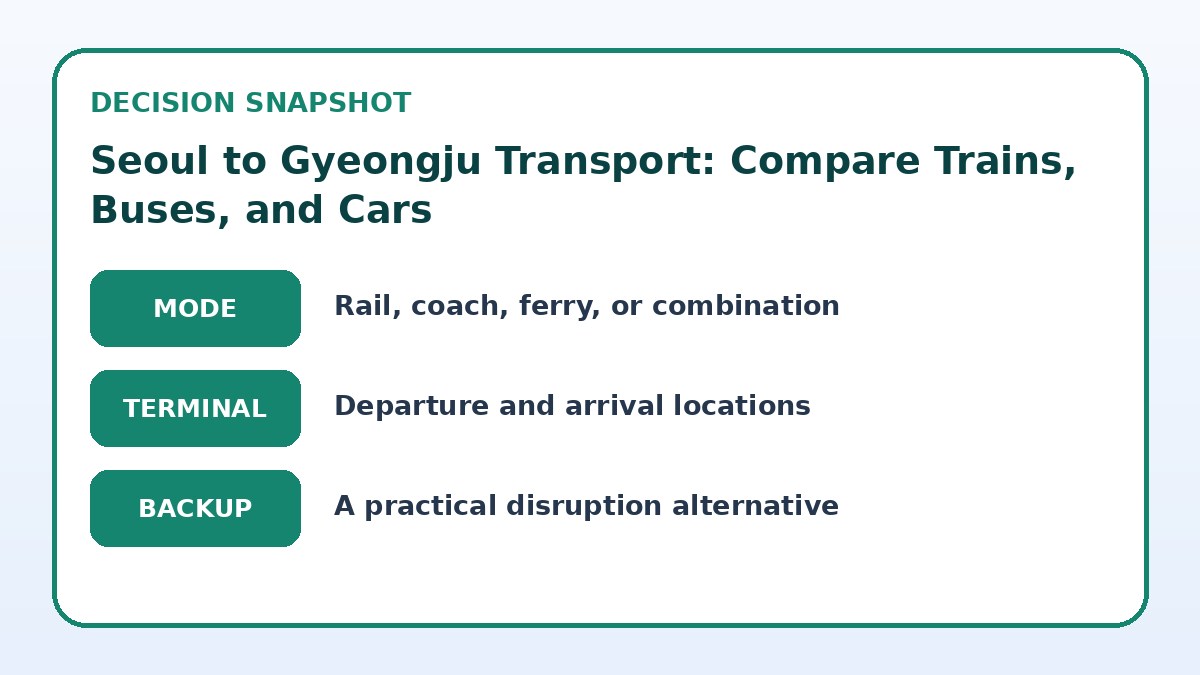
See current options before you compare the details
Availability and final conditions change. Open Trip.com now or keep reading for the practical comparison.
Choose the right transport mode for your priorities
Start by ranking what matters for your trip: minimizing travel time, maximizing schedule certainty, keeping costs predictable, or maintaining flexibility with luggage and stops. High-speed rail tends to offer the best balance between speed and reliable timetables on many Korea routes, while express intercity buses can be cost-efficient and direct. A private car gives door-to-door convenience and flexibility to stop or change plans, but adds complexity in traffic and route uncertainty. For multi-leg trips, compare total door-to-door time, not just the in-vehicle time; include transfer walks, check-in, and potential local transit at each end.
Also consider how you work while traveling: if uninterrupted Wi‑Fi and a stable desk-like setup matter, a reserved train seat or a private car will usually be better than a bus. Check seat reservation options and whether the transport mode provides power outlets and quiet space for calls. If you must arrive strictly on time for a presentation or meeting, prioritize options with more frequent departures or flexible change policies so you can switch if your schedule shifts. Finally, think about luggage—bulky or multiple items may favor a private car or baggage-friendly train services.
Plan the travel day timeline and backups
Map out the full travel day from hotel checkout to meeting arrival, working backward from the meeting start time. Allow buffer time for getting to the departure point, security or ticketing lines, and local transfers at the destination. If you rely on public transport, pick a departure at least one slot earlier than the minimum acceptable arrival to absorb delays. For road travel, factor in potential peak traffic windows—morning or evening congestion can add substantial unpredictability—so have a margin or choose a less traffic-prone travel window.
Create two contingency options: a faster alternative and a more flexible one. The faster alternative might be an earlier train or flight; the flexible option could be a later connection with more seats available or a private car you can book on short notice. Share your itinerary and contact numbers with your meeting host and hotel concierge so they can assist if you need last-mile help. Keep digital and printed copies of reservations, and download any tickets or boarding passes to your phone to avoid relying on spotty mobile data.
| Approach | Best for | Tradeoff to check |
|---|---|---|
| High-speed train | Predictable schedules, ability to work onboard with reserved seats | May require transfer to/from stations; ticket changes can have restrictions |
| Express bus | Direct routing to some destinations and lower cost flexibility | Less stable workspace and potential for roadside delays |
| Private car or chauffeur | Door-to-door convenience, flexible timing, and luggage handling | Subject to traffic unpredictability and typically higher expense |
| Mixed-mode (train + taxi/local car) | Balances speed of rail with last-mile flexibility to reach specific addresses | Adds a transfer that must be timed carefully to avoid delays |
Ready to check the option that fits your plan?
Use your exact dates and traveler details so the provider page can show the current total and conditions.
Pack and set up a business travel kit
Assemble a compact kit that fits in a carry-on or briefcase to avoid checked-luggage wait times and loss risk. Include the essentials: device chargers, a power bank rated to top up your primary device, noise-cancelling or noise-reducing headphones for calls, and a portable hotspot or verified SIM arrangement if consistent connectivity is critical. Add a small set of presentation backups—copies of slides on a USB stick and cloud-access links—and ensure all files open on your devices. If you present from someone else’s setup, pack adapter cables and a compact HDMI or USB-C adapter.
Organize your kit for quick access: tickets and IDs in an easy pocket, chargers coiled in a separate pouch, and a pen and small notepad ready for instant notes. Consider a light, wrinkle-resistant outfit for meetings and a compact grooming kit so you can freshen up on arrival. Keep snacks and a refillable water bottle to avoid interruptions during travel. Recharge electronics fully the night before travel and set any devices to flight- or low-power mode for long trips to preserve battery life.
Before you book
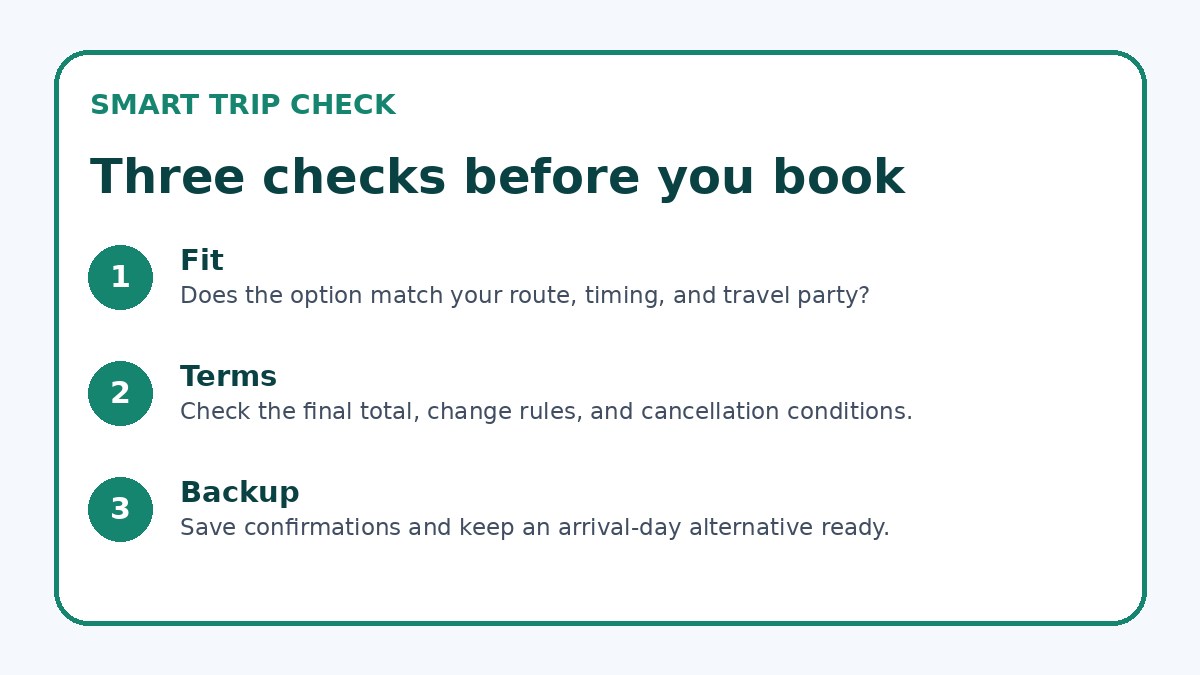
- Confirm departure and arrival locations and printed directions to each transport point.
- Download or screenshot tickets and reservation confirmation; save an extra copy in cloud storage.
- Charge all devices and pack a power bank and necessary adapters in your carry-on.
- Share your detailed itinerary and contact numbers with your meeting host and hotel.
- Check live status updates for your chosen mode an hour before departure.
- Arrange a backup transport option you can book quickly if your primary choice is disrupted.
Verify bookings and on-the-day logistics
Before finalizing reservations, read the provider’s cancellation, change, and refund policies so you know the cost of adjustments. Confirm exact departure and arrival locations—stations, terminals, or pickup points can have similar names—and check whether seat reservations, seat class, or baggage allowances require separate selection. If booking through an aggregator like Trip.com, use it to compare options but validate schedule times, baggage rules, and seat guarantees directly on the transport operator’s booking page; those details can change after aggregator listings are updated.
On travel day, re-check live status updates for trains, buses, or road conditions and arrive at the departure point with extra time for queueing or security. Keep printed and electronic copies of tickets and ID easy to access. If you’ve arranged a car pickup, confirm the driver’s contact details and vehicle description shortly before departure to avoid confusion. Finally, schedule a brief call or message with your meeting host on arrival to confirm any final adjustments to meeting timing or location.
Frequently asked questions
Which option is the most reliable for arriving on time in Gyeongju from Seoul for a meeting?
Reliability depends on your definition: trains are typically more timetable-driven and less affected by road congestion, which often makes them a dependable option for punctual arrivals. Express buses can be reliable too but are more exposed to highway traffic, and private cars offer door-to-door convenience but inherit road risk. To choose, compare departure frequency, the number of alternative departures the same day, and how easy it is to change or rebook. For absolute certainty, plan an earlier departure slot and a backup option.
How should I handle presentations or calls while traveling between Seoul and Gyeongju?
Prepare for mixed connectivity: reserve a seat with power and test any onboard Wi‑Fi policies before relying on them. Download presentation materials and have local-accessible cloud links and a USB backup in case of connectivity loss. Use noise-reducing headphones for calls and choose travel windows with lower onboard noise if you need uninterrupted meeting time. Communicate your availability to meeting participants in advance, and schedule important calls around confirmed quiet periods or when you're certain of a stable connection.
What last-minute steps should I take the morning of travel?
First, recheck live status for your train, bus, or road route and confirm pickup details if using a car service. Verify that you have all travel documents, tickets, ID, and your business kit accessible. Inform your meeting contact of your estimated arrival and any minor changes. Leave with a margin for transfers and security lines—plan to arrive at the departure point earlier than necessary to reduce stress. Finally, ensure your primary device is charged and that you have local data or a portable hotspot prepared for instant connectivity on arrival.
Final planning note
For business travel between Seoul and Gyeongju, the right transport choice comes down to your priorities—timetable certainty, uninterrupted work time, or door-to-door convenience. Prepare the travel day by building a clear timeline with buffers, packing a compact but complete work kit, and verifying all bookings and pickup details directly with providers. Use a layered contingency approach: pick an earlier departure or a flexible secondary option, share your plan with your host, and keep backups of critical files and communications. With these steps, you can reduce last-minute friction and arrive ready for productive meetings.
Continue planning
Check current options and final conditions
Use the provider page to confirm live availability, the final total, cancellation terms, and every condition that matters to your trip.
This evergreen planning guide was created with AI-assisted drafting and a structured quality review. It does not display live prices, schedules, availability, visa guidance, or provider rankings. Verify current details before booking. Some links are affiliate links; we may earn a commission at no additional cost to you.